

Multi Platform Cloud Backup Solution Cloud Architecture And Security Review




Try Before you Buy Download Free Sample Product
 Impress Your
 Audience
 100%
100% Editable
 Save Hours
 of Time


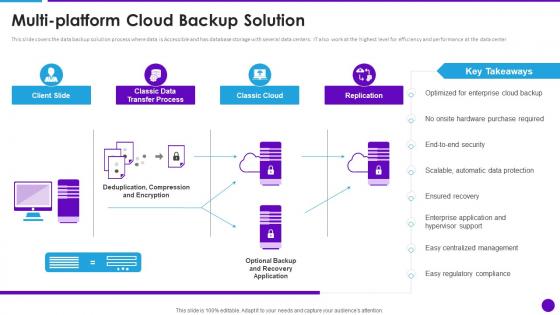
This slide covers the data backup solution process where data is Accessible and has database storage with several data centers. IT also work at the highest level for efficiency and performance at the data center
People who downloaded this PowerPoint presentation also viewed the following :
Multi Platform Cloud Backup Solution Cloud Architecture And Security Review with all 6 slides:
Use our Multi Platform Cloud Backup Solution Cloud Architecture And Security Review to effectively help you save your valuable time. They are readymade to fit into any presentation structure.





FAQs for Multi Platform Cloud Backup Solution Cloud Architecture
Multi-platform cloud backup solutions deliver centralized data protection, seamless cross-device synchronization, automated scheduling, scalable storage capacity, and enhanced disaster recovery capabilities. These systems streamline IT operations by eliminating platform-specific backup tools, reducing administrative overhead, and ensuring consistent data accessibility, with many organizations finding that unified backup strategies significantly lower costs while improving security and compliance across their entire technology infrastructure.
Multi-platform cloud backup enhances data security through encrypted storage, redundant data centers, automated versioning, and cross-platform synchronization, while offering flexible recovery options across different operating systems and devices. Organizations utilizing these solutions can restore critical files from anywhere, reduce downtime during system failures, and maintain business continuity, with many enterprises finding that diversified backup strategies significantly minimize data loss risks.
Businesses should consider factors including data encryption standards, compliance certifications, recovery time objectives, storage scalability, and integration capabilities with existing systems. Healthcare organizations and financial institutions particularly benefit from providers offering HIPAA or SOX compliance, automated backup scheduling, and cross-platform compatibility, ultimately delivering enhanced data security and operational continuity.
Cloud backup solutions handle encryption through multiple layers including end-to-end encryption, advanced encryption standards like AES-256, zero-knowledge architectures, and automated key management systems. These comprehensive security frameworks enable organizations across healthcare, financial services, and legal sectors to meet stringent compliance requirements like HIPAA, SOX, and GDPR, while maintaining seamless data accessibility and operational efficiency.
Multi-platform backup solutions support remote work by enabling seamless data synchronization across devices, automatic backup scheduling, and secure mobile access to critical files from anywhere. These systems streamline remote collaboration through real-time file sharing, cross-device compatibility, and bandwidth optimization, with many distributed teams finding that unified backup platforms ultimately enhance productivity while ensuring business continuity.
Organizations implementing multi-platform cloud backup face challenges including data integration complexity, vendor compatibility issues, security standardization across platforms, cost management, and staff training requirements. These obstacles can initially slow deployment timelines and increase operational overhead, but many enterprises find that strategic planning, phased implementation, and comprehensive vendor evaluation ultimately deliver streamlined operations and enhanced data protection.
Pricing models vary significantly through subscription tiers, storage capacity limits, per-gigabyte rates, and feature differentiation across providers. While enterprise solutions typically offer unlimited storage with advanced security features, consumer-focused services use tiered pricing based on storage needs, with many businesses finding that hybrid models combining free basic tiers with premium features deliver optimal cost-efficiency.
Data redundancy serves as a critical foundation in multi-platform cloud backup strategies by creating multiple copies of data across different cloud providers, geographic locations, and storage tiers. This strategic approach enables organizations to maintain business continuity during outages, minimize data loss risks, and ensure faster recovery times, with many enterprises finding that redundant multi-cloud architectures ultimately deliver enhanced reliability and competitive operational advantages.
Users manage backup schedules across multiple platforms through centralized management consoles, automated scheduling tools, policy-based configurations, and unified monitoring dashboards that provide cross-platform visibility. These solutions streamline operations by synchronizing backup windows, optimizing resource allocation, and ensuring consistent data protection policies, with many organizations finding that centralized approaches reduce administrative overhead while improving backup reliability and compliance across their entire infrastructure.
Single platform cloud backup pitfalls include vendor lock-in, service outages creating complete data inaccessibility, limited geographic redundancy, escalating costs over time, and reduced negotiating power with providers. These risks can significantly impact business continuity, with many organizations finding that diversifying across multiple platforms enhances reliability, reduces dependency vulnerabilities, and ultimately delivers greater operational resilience.
Multi-platform cloud backup solutions integrate with existing IT infrastructure through APIs, native connectors, and agent-based deployments that work across operating systems, databases, and virtualized environments. These solutions seamlessly connect with Active Directory, storage arrays, and network protocols, enabling organizations to maintain current workflows while extending protection to hybrid environments, ultimately delivering centralized management and operational efficiency.
Users should look for intuitive dashboard navigation, one-click backup scheduling, drag-and-drop file selection, real-time sync status indicators, and cross-device accessibility from any browser or mobile app. These interface features streamline data management by reducing setup complexity, minimizing user errors, and enabling seamless backup monitoring, with many organizations finding that simplified interfaces significantly improve employee adoption rates and reduce IT support overhead.
Healthcare organizations leverage multi-platform cloud backup for HIPAA compliance and patient data protection, while financial services ensure regulatory adherence and transaction security across systems. Manufacturing companies streamline operations by protecting IoT data and production schedules, retail businesses safeguard customer information and inventory systems, and educational institutions secure student records and research data, ultimately delivering industry-specific compliance and operational continuity.
Major organizations across healthcare, finance, and retail have successfully implemented multi-platform cloud backup to enhance operational resilience. Companies like Netflix utilize hybrid cloud strategies combining AWS and Google Cloud for content delivery, while financial institutions leverage multi-cloud approaches for regulatory compliance and disaster recovery, ultimately delivering improved uptime, reduced recovery times, and enhanced data protection across their critical business operations.
Backup and restoration processes vary significantly between cloud platforms through different storage architectures, data transfer methods, encryption protocols, and recovery timeframes. While AWS uses S3 with Glacier for long-term storage, Microsoft Azure employs blob storage with hot and cool tiers, and Google Cloud utilizes nearline and coldline storage, with many organizations finding that multi-platform strategies ultimately deliver enhanced redundancy and faster recovery options.
-
You can rely on SlideTeam whenever you run out of designs for your presentation. Thank you so much SlideTeam!
-
“Easy to use. I always wanted to have a quick search for products and SlideTeam has helped me have it.”