

Multiple Blockchain Based Companies Boosting The Real Estate Industry Training Ppt





Try Before you Buy Download Free Sample Product
 Impress Your
Audience
 100%
Editable
 Save Hours
of Time


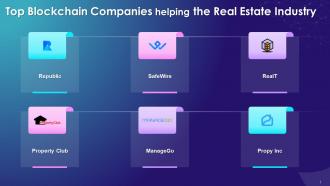
This slide illustrates the top blockchain based companies that are playing a major role in boosting the real estate industry such as Republic, Safewire, Realt, Property Club, Mangego, and Propy inc.
People who downloaded this PowerPoint presentation also viewed the following :
Multiple Blockchain Based Companies Boosting The Real Estate Industry Training Ppt with all 16 slides:
Use our Multiple Blockchain Based Companies Boosting The Real Estate Industry Training Ppt to effectively help you save your valuable time. They are readymade to fit into any presentation structure.







FAQs for Multiple Blockchain Based Companies Boosting The Real Estate
Blockchain technology in real estate offers transparency, reduced fraud, faster transactions, lower costs, and improved security through immutable record-keeping. These advantages streamline property transfers by eliminating intermediaries, automating processes through smart contracts, and providing verified ownership histories, with many real estate firms finding that blockchain ultimately delivers enhanced trust and operational efficiency.
Blockchain enhances transparency by creating immutable property records, automating transactions through smart contracts, and providing real-time access to ownership history, financial details, and legal documentation. Through distributed ledgers, buyers and sellers can verify property authenticity, streamline due diligence processes, and reduce fraud risks, ultimately delivering faster closings and greater confidence in transactions.
Smart contracts automate real estate processes by executing predefined conditions automatically, eliminating intermediaries, reducing transaction times, and ensuring transparent property transfers. Through blockchain-based smart contracts, real estate transactions streamline escrow management, automate payment releases, and verify ownership transfers, with many property developers and real estate firms finding that these technologies significantly reduce costs while enhancing transaction security and efficiency.
Blockchain reduces property transaction costs by eliminating intermediaries, automating processes through smart contracts, and streamlining title verification and documentation. Through digital ledgers and automated escrow systems, real estate firms and financial institutions minimize legal fees, reduce processing times, and enhance transparency, with many property developers finding that blockchain delivers faster closings and significantly lower administrative expenses.
Blockchain facilitates fractional ownership by tokenizing real estate assets into digital shares, enabling multiple investors to own portions of properties through smart contracts that automatically distribute rental income and manage ownership transfers. This approach democratizes real estate investment, allowing smaller investors to access premium properties while providing liquidity through secondary trading markets, ultimately delivering diversified portfolios and enhanced accessibility.
Blockchain implementation in real estate faces challenges including regulatory uncertainty, high integration costs, industry resistance to change, technical complexity, and scalability concerns. While these barriers present initial hurdles, many organizations find that strategic partnerships with technology providers, phased implementation approaches, and stakeholder education help overcome resistance, ultimately delivering enhanced transparency, reduced transaction times, and improved operational efficiency across property transactions.
Blockchain ensures property record integrity through immutable ledgers, cryptographic hashing, distributed verification, and timestamp authentication, making fraudulent alterations nearly impossible. These security mechanisms enable banks, title companies, and government registries to maintain transparent ownership histories, reduce disputes, and accelerate property transactions, ultimately delivering enhanced trust and operational efficiency.
Blockchain could significantly streamline cross-border real estate transactions by enabling faster payment processing, reducing currency exchange complexities, automating compliance verification, and providing transparent ownership records across jurisdictions. Through smart contracts and decentralized verification systems, international buyers and sellers can minimize traditional banking delays, legal documentation barriers, and trust issues, ultimately delivering more efficient global property transactions.
Real estate professionals can leverage blockchain for property title management by creating immutable digital records, automating verification processes, and enabling transparent ownership transfers through smart contracts. This technology streamlines title searches, reduces fraud risks, and accelerates closing procedures, with many real estate firms finding that blockchain ultimately delivers faster transactions and enhanced security.
**INPUT**: What are some successful case studies of blockchain implementation within the real estate sector? **OUTPUT**: Successful blockchain implementations include Dubai's property registry digitization, Propy's international property transactions, RealT's fractional ownership platform, Harbor's tokenized real estate investments, and Sweden's land registry trials. These platforms streamline property transfers, enhance transparency, reduce transaction costs, and enable fractional ownership, with many investors and institutions finding that blockchain ultimately delivers faster closings and improved market accessibility.
Blockchain simplifies rental processes by enabling smart contracts for automated payments, transparent lease agreements, and secure tenant verification through immutable records. Property management companies increasingly use blockchain-based platforms to streamline rent collection, reduce disputes over deposits, and create tamper-proof maintenance logs, ultimately delivering faster transactions and enhanced trust between parties.
Blockchain could revolutionize real estate crowdfunding through enhanced transparency, automated smart contracts, fractional ownership tokenization, reduced intermediary costs, and global investor accessibility. These technologies streamline investment processes by enabling instant transactions, automated dividend distributions, and verified property records, with many crowdfunding platforms finding that blockchain delivers faster funding cycles and broader investor participation.
Regulatory considerations include compliance with property laws, data privacy regulations, anti-money laundering requirements, consumer protection standards, and cross-jurisdictional legal frameworks. These compliance measures enhance transparency and security by establishing clear ownership records, streamlined transaction processes, and automated regulatory reporting, with many real estate firms finding that proactive regulatory alignment delivers competitive advantage and investor confidence.
Blockchain contributes to sustainable real estate through transparent carbon tracking, energy-efficient smart contracts for green building certifications, and decentralized renewable energy trading between properties. By enabling fractional ownership of sustainable developments and automating ESG compliance reporting, blockchain reduces administrative waste while facilitating investments in eco-friendly projects, ultimately delivering environmental accountability and operational efficiency.
Tokenizing real estate assets significantly enhances market liquidity by enabling fractional ownership, reducing minimum investment thresholds, and facilitating faster transactions through digital exchanges. This approach transforms traditionally illiquid properties into tradeable digital assets, with platforms increasingly enabling investors to buy and sell shares seamlessly, ultimately delivering greater market accessibility and operational efficiency.
-
“Easy to use. I always wanted to have a quick search for products and SlideTeam has helped me have it.”
-
Best way of representation of the topic.