


Multiple Project Change Management Matrix




Try Before you Buy Download Free Sample Product
 Impress Your
Audience
 100%
Editable
 Save Hours
of Time


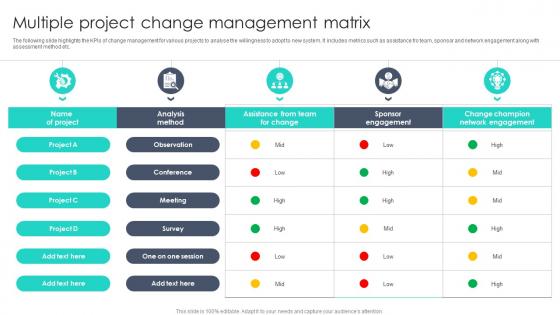
The following slide highlights the KPIs of change management for various projects to analyse the willingness to adopt to new system.It includes metrics such as assistance fro team, sponsor and network engagement along with assessment method etc.
People who downloaded this PowerPoint presentation also viewed the following :
Multiple Project Change Management Matrix with all 6 slides:
Use our Multiple Project Change Management Matrix to effectively help you save your valuable time. They are readymade to fit into any presentation structure.






FAQs for Multiple Project
Key components of a Change Management Matrix include stakeholder impact assessment, change readiness evaluation, communication strategies, training requirements, and resistance mitigation plans. These elements work together by identifying affected parties, measuring organizational preparedness, and creating targeted interventions, with many companies finding that systematic matrix approaches streamline transitions while minimizing disruption across departments.
A Change Management Matrix facilitates stakeholder engagement by mapping stakeholder influence, interest levels, and communication preferences, enabling targeted outreach strategies, personalized messaging, and appropriate engagement frequencies. This structured approach helps project managers identify key champions, address resistance proactively, and maintain consistent dialogue across all stakeholder groups, ultimately delivering higher buy-in and smoother change adoption throughout the organization.
A Change Management Matrix can be tailored by adjusting stakeholder categories, communication channels, resistance factors, and success metrics specific to each sector's regulatory environment, operational complexity, and cultural dynamics. Healthcare organizations focus on patient safety protocols and compliance timelines, while manufacturing emphasizes production continuity and worker safety training, with financial services prioritizing regulatory approval processes and risk mitigation, ultimately enabling industry-specific transformation strategies.
Communication serves as the foundational element that connects all components of a Change Management Matrix, enabling stakeholder alignment, resistance management, and progress tracking across organizational levels. Through strategic messaging, feedback loops, and transparent updates, organizations enhance employee buy-in, accelerate adoption timelines, and minimize disruption, with many companies finding that structured communication ultimately delivers smoother transitions and sustainable change outcomes.
Organizations can measure Change Management Matrix success through stakeholder adoption rates, timeline adherence, budget compliance, employee satisfaction scores, and performance metrics alignment with change objectives. These measurements enable companies to track progress across healthcare systems implementing new technologies, manufacturing plants adopting lean processes, and financial institutions rolling out digital transformations, ultimately delivering measurable ROI and sustainable organizational transformation.
Organizations typically face resistance from employees unfamiliar with structured change processes, inadequate stakeholder mapping, and difficulty prioritizing competing initiatives within the matrix framework. Many companies struggle with insufficient communication during implementation, lack of leadership buy-in, and resource allocation challenges, with successful organizations finding that comprehensive training and phased rollouts ultimately deliver smoother transitions and enhanced organizational adaptability.
A Change Management Matrix supports employee training and development by identifying skill gaps, mapping required competencies against current capabilities, and prioritizing training initiatives based on change impact. Through structured assessment frameworks, organizations can deliver targeted learning programs, track progress systematically, and ensure workforce readiness, ultimately enhancing employee adaptability and organizational resilience during transitions.
Excel, PowerPoint, Visio, project management platforms like Monday.com, and specialized change management software like Prosci or ChangeGear offer robust matrix creation capabilities. These tools streamline stakeholder mapping, impact assessment, and timeline visualization by providing templates, collaboration features, and real-time updates, with many organizations finding that integrated platforms deliver enhanced visibility and coordination across change initiatives.
A Change Management Matrix integrates seamlessly with agile methodologies by providing structured change evaluation within iterative sprint cycles, enabling rapid assessment of scope modifications, stakeholder impact, and resource allocation adjustments. This combination streamlines decision-making processes during sprint planning and retrospectives, with many software development teams and product organizations finding that structured change frameworks enhance agility while maintaining project control and stakeholder alignment.
A Change Management Matrix should be updated continuously throughout the project lifecycle, typically during weekly status meetings, milestone reviews, and whenever new changes are proposed or approved. This dynamic approach ensures stakeholder engagement strategies, communication plans, and resistance mitigation tactics remain aligned with evolving project conditions, ultimately delivering sustained adoption and minimizing implementation risks across organizational levels.
Best practices for visualizing a Change Management Matrix include using clear impact-effort grids, color-coded priority levels, stakeholder mapping overlays, timeline integration, and progress tracking indicators. These visualization techniques streamline decision-making by highlighting quick wins, major projects, and fill-in tasks, with many organizations finding that well-designed matrices enhance stakeholder buy-in and accelerate transformation initiatives.
Cultural factors significantly influence Change Management Matrix design by shaping communication preferences, decision-making processes, hierarchy respect levels, and resistance patterns within organizations. Companies must adapt their matrices to reflect cultural dimensions like power distance, individualism versus collectivism, and uncertainty avoidance, with many global organizations finding that culturally-aligned change frameworks deliver higher adoption rates and smoother transitions.
A Change Management Matrix promotes organizational resilience by systematically identifying risks, mapping stakeholder responses, tracking adaptation progress, and establishing clear communication protocols during transitions. Through structured assessment frameworks, organizations can anticipate disruption points, develop contingency plans, and maintain operational continuity, with many companies finding that proactive change mapping significantly reduces implementation time and enhances employee buy-in during critical transformations.
**INPUT**: What metrics should be included in a Change Management Matrix for evaluation purposes? **OUTPUT**: Change management matrices should include stakeholder readiness scores, communication effectiveness rates, training completion percentages, resistance levels, and adoption timeline adherence. These metrics enable organizations to track progress across departments, identify implementation bottlenecks early, and measure user acceptance rates, with many companies finding that comprehensive measurement ultimately delivers smoother transitions and higher success rates. [Word count: 54 words]
The Change Management Matrix addresses employee resistance by systematically identifying resistance sources, stakeholder impact levels, and targeted intervention strategies across different change phases. Through structured assessment tools and communication frameworks, organizations can proactively engage resistant employees with tailored approaches, address specific concerns, and gradually build buy-in, ultimately transforming opposition into support while ensuring smoother change implementation.
-
I’m not a design person, so I couldn’t make a presentation to save my life. Thankfully, they have all kinds of templates that I regularly use for my work.
-
I have just started downloading templates for my presentations and I must say this is a great design. It helped accelerate my presentation design process and made it more visually appealing.