

Multiple Steps To Create Email Marketing Strategy




Try Before you Buy Download Free Sample Product
 Impress Your
 Audience
 100%
100% Editable
 Save Hours
 of Time


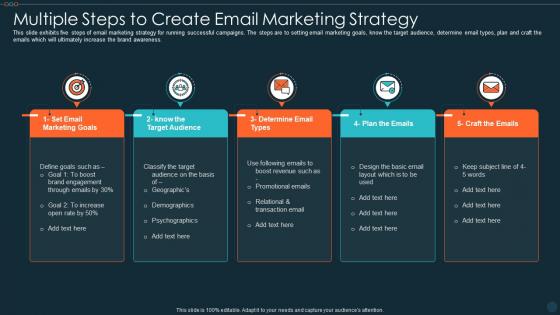
This slide exhibits five steps of email marketing strategy for running successful campaigns. The steps are to setting email marketing goals, know the target audience, determine email types, plan and craft the emails which will ultimately increase the brand awareness.
People who downloaded this PowerPoint presentation also viewed the following :
Multiple Steps To Create Email Marketing Strategy with all 6 slides:
Use our Multiple Steps To Create Email Marketing Strategy to effectively help you save your valuable time. They are readymade to fit into any presentation structure.





FAQs for Multiple Steps To Create
**INPUT**: What are the key components of an effective email marketing strategy? **OUTPUT**: Effective email marketing strategies include audience segmentation, compelling subject lines, personalized content, automated workflows, and performance analytics. These components work together by targeting specific customer groups, enhancing open rates, and delivering relevant messaging, with many businesses finding that strategic email campaigns significantly improve customer engagement, drive conversions, and ultimately deliver measurable ROI across industries.
Segmentation enhances email campaign performance by enabling targeted messaging, improving open rates, increasing click-through rates, and reducing unsubscribe rates through personalized content delivery. By categorizing audiences based on demographics, purchase history, and engagement patterns, marketers achieve significantly higher conversion rates and ROI, with many organizations finding segmented campaigns generate substantially more revenue than generic broadcasts.
Personalization significantly enhances email marketing engagement by delivering targeted content based on subscriber behavior, preferences, demographics, and purchase history. Through dynamic content and segmentation strategies, businesses achieve higher open rates, increased click-throughs, and improved conversions, with retail and e-commerce companies finding that personalized campaigns generate substantially better customer responses and revenue growth.
A/B testing enhances email marketing effectiveness by enabling systematic comparison of subject lines, content formats, send times, and call-to-action placement to optimize performance metrics. Through split testing different elements, marketers can identify which variations drive higher open rates, click-through rates, and conversions, with many organizations finding significant improvements in campaign ROI and customer engagement.
Key email marketing metrics include open rates, click-through rates, conversion rates, unsubscribe rates, bounce rates, and revenue per email. These metrics enable marketers to optimize campaign performance by identifying engagement patterns, refining targeting strategies, and enhancing content effectiveness, with many organizations finding that tracking these consistently delivers improved ROI and stronger customer relationships.
Businesses can grow their email lists through valuable lead magnets like eBooks or webinars, strategic website opt-in forms, social media campaigns, and referral programs that incentive sharing. These approaches attract genuinely interested subscribers by offering clear value exchanges, with many retail and service companies finding that content-driven strategies yield higher engagement rates and ultimately deliver stronger customer relationships than aggressive acquisition tactics.
Compelling email subject lines incorporate personalization, urgency, clear value propositions, A/B testing, and mobile optimization while avoiding spam triggers. These practices enhance open rates by creating immediate relevance, establishing trust, and delivering concise messaging that resonates across industries, with retail and financial services finding that personalized, benefit-focused subject lines significantly improve customer engagement and conversion outcomes.
Mobile optimization is critically important in email marketing strategies, as over 60% of emails are opened on mobile devices, making responsive design essential for engagement and conversion rates. Without mobile-friendly templates, businesses risk significantly reduced click-through rates, poor user experiences, and lost revenue opportunities, with many companies finding that mobile-optimized campaigns deliver substantially higher ROI and customer satisfaction.
Recommended automation tools include Mailchimp, HubSpot, Constant Contact, ActiveCampaign, and ConvertKit, each offering features like drip campaigns, segmentation, and behavioral triggers. These platforms streamline workflows by automating customer journeys, personalizing content delivery, and tracking engagement metrics, with many businesses finding that strategic automation reduces manual effort while significantly improving conversion rates and customer retention.
Email marketing integrates with other digital marketing strategies through synchronized content calendars, shared customer data platforms, cross-channel retargeting campaigns, and unified messaging frameworks. These integrations enhance customer journey mapping by connecting social media engagement, website behavior, and email responses, with many organizations finding that coordinated campaigns deliver significantly higher conversion rates and improved customer lifetime value.
Common email marketing mistakes include poor subject lines, inadequate list segmentation, inconsistent sending schedules, weak personalization, and neglecting mobile optimization. These missteps significantly impact engagement rates, with many retail and financial services companies finding that strategic segmentation and compelling subject lines enhance open rates while consistent scheduling builds subscriber trust, ultimately delivering improved conversions.
Businesses can leverage user-generated content in email campaigns by featuring customer reviews, showcasing social media posts, highlighting testimonials, incorporating user photos, and sharing success stories. This strategic approach enhances authenticity and engagement, with retail brands and service companies finding that UGC-driven emails deliver higher open rates, increased trust, and ultimately stronger customer relationships while reducing content creation costs.
Email marketing legal considerations include CAN-SPAM Act compliance, GDPR requirements, explicit consent protocols, unsubscribe mechanisms, and data protection standards. These regulations streamline trust-building by ensuring transparent sender identification, clear opt-out processes, and proper data handling, with many organizations finding that compliance ultimately enhances customer relationships and reduces legal risks.
Email frequency and timing significantly impact open rates by aligning with subscriber preferences, avoiding inbox fatigue, and maximizing visibility during peak engagement windows. Strategic timing enables marketers to reach audiences when they're most active, while optimal frequency maintains engagement without overwhelming recipients, with many businesses finding that personalized scheduling based on individual behavior patterns delivers higher open rates and stronger customer relationships.
Strategies to reduce bounce rates include maintaining clean subscriber lists, implementing double opt-in processes, regularly removing inactive addresses, using authentication protocols like SPF and DKIM, and monitoring sender reputation. These approaches streamline deliverability by ensuring valid recipients, building trust with email providers, and maintaining consistent engagement metrics, ultimately delivering higher inbox placement rates and improved campaign performance across organizations.
-
Unique and attractive product design.
-
Understandable and informative presentation.