

Nanobiosensors Powerpoint Template Bundles Ppt Sample





Try Before you Buy Download Free Sample Product
 Impress Your
Audience
 100%
Editable
 Save Hours
of Time


Our Nanobiosensors Powerpoint Template Bundles Ppt Sample are topically designed to provide an attractive backdrop to any subject. Use them to look like a presentation pro.
People who downloaded this PowerPoint presentation also viewed the following :
Content of this Powerpoint Presentation
Slide 1: This slide introduces Nanobiosensors. State your company name and begin.
Slide 2: This slide shows the projected market growth of nano biosensor technology. The reasons for growth are the increase in demand for advanced healthcare devices, government support, and research and development.
Slide 3: This slide shows the various use cases of nano biosensor technology in different fields. The industries are healthcare, environment, energy harvester, food industry, agriculture, etc
Slide 4: This slide shows the latest trends prevailing in the market regarding new technology movement in nano biosensors. The trends are integration with AI and ML, and advancement in POCT.
Slide 5: This slide shows the forecasted market size of nano biosensors in the healthcare sector. The reasons for growth are the rise in diabetic patients and the development of new diagnostic tools for treatments.
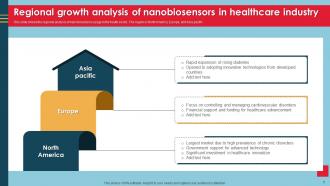
Slide 6: This slide shows the regional analysis of nanobiosensors usage in the heath sector. The region is North America, Europe, and Asia pacific.
Slide 7: This slide shows the recent development taking place in innovating nano sensors. The most recent developments are new breakthroughs in cancer detection at early stages.
Slide 8: This slide shows the market dynamic of nanobiosensors technology globally. The market drivers are a real-time measurement of pollutants, portable device deployment, lack on long-term stability of nanobiosensors.
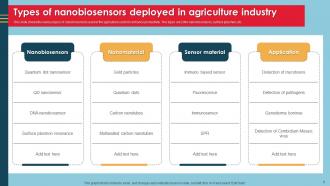
Slide 9: This slide shows the various types of nanobiosensors used in the agriculture sector to enhance productivity. The types are DNA nanobiosensors, surface plasmon, etc.
Slide 10: This slide shows Nanobiosensor technology icon used in healthcare industry.
Slide 11: This is a Thank You slide with address, contact numbers and email address.
Nanobiosensors Powerpoint Template Bundles Ppt Sample with all 19 slides:
Use our Nanobiosensors Powerpoint Template Bundles Ppt Sample to effectively help you save your valuable time. They are readymade to fit into any presentation structure.














FAQs for Nanobiosensors Powerpoint Template
Okay so nanobiosensors have three key parts. First there's the bioreceptor - that's your enzymes, antibodies, DNA stuff that actually grabs onto whatever you're trying to find. Then you've got the transducer which basically turns that biological reaction into something you can measure. The signal processor amplifies everything and shows you the results. What makes them crazy sensitive though? The nanomaterials - carbon nanotubes, gold nanoparticles, quantum dots, all that tiny tech. Honestly the bioreceptor choice is probably your biggest decision upfront since it determines what you'll actually detect.
So basically, nanobiosensors work better because they're stupidly small - which sounds counterintuitive, right? But that tiny size means way more surface area packed into the same space, so you get tons more spots for target molecules to bind. The signals end up way stronger even when you're looking for super rare stuff. Plus they cut down on background noise big time. Traditional sensors would totally whiff on single molecules, but these little guys catch them no problem. Oh, and they're faster too since molecules don't have to travel as far. Perfect for catching diseases early or finding those needle-in-haystack biomarkers.
So nanomaterials are basically what make biosensors insanely more sensitive. The surface area is massive compared to regular materials, so you can cram way more detection sites into a small spot. That means picking up lower concentrations of whatever you're testing for. They also help electrons move better between the biological parts and electrodes - the physics at that tiny scale is honestly wild. Carbon nanotubes, gold nanoparticles, graphene... they each have different strengths. I'd definitely mess around with different ones to see what works best for your specific sensor.
So basically these things hunt for disease markers in your blood or spit at the molecular level - crazy sensitive stuff. They mix nanoparticles with antibodies or DNA pieces that latch onto specific biomarkers. What's cool is you can catch cancer cells or infections before you even feel sick. Takes minutes instead of waiting days for lab results. Honestly the speed blows my mind. If you're setting this up for your lab though, I'd figure out which biomarkers matter for your research first - that'll determine what kind of sensor setup you need.
Oh man, there's some wild stuff happening right now! Those implantable glucose sensors can actually stay in for months now instead of just days. Carbon nanotubes and graphene are making detection crazy sensitive - we're talking cancer proteins, viral RNA, the works. The smartphone integration is honestly game-changing since you skip all those lab waits. Also they figured out multiplexing (finally!) so one blood drop can test for multiple diseases at once. Check out recent Nature Nanotechnology papers if you're thinking of using any of this. Some really solid research coming out lately.
So basically, nanobiosensors use these super specific recognition elements - antibodies, aptamers, enzymes - that only bind to your target molecule. It's like a lock-and-key thing but tiny. When the right molecule attaches, you get a signal change you can measure (optical, electrical, whatever). The real trick? Getting the surface chemistry right when you functionalize the sensor. Even with all the other junk floating around in biological samples, only your target will trigger that response. Honestly, picking the right recognition element upfront is probably the most crucial step - that's where you'll make or break your specificity.
Nanobiosensors are honestly pretty amazing - they can pick up way tinier concentrations than regular sensors because everything happens at the nanoscale. Response times are crazy fast since molecules don't have to travel far. Plus you get this massive surface area that makes them super selective. The portability factor is huge too - we're talking smartphone-sized instead of those giant lab machines. You'll need way less sample volume, which is clutch for clinical work. Oh, and here's the cool part: you can test for multiple biomarkers at once with the same device. For point-of-care stuff, nano is definitely the way to go. The performance boost is just too good to ignore.
Okay so nanobiosensors are pretty wild - they detect tiny amounts of biomarkers in real-time, which is way more precise than regular testing. Like your glucose monitor but for literally any molecule. Instead of waiting for lab results every few months, doctors can track drug levels and disease markers continuously. This lets them tweak your treatment based on how YOUR body actually responds, not some generic protocol. I mean, we're finally moving past the whole "give everyone the same dose and hope it works" approach. It's basically turning medicine into something that's actually personalized to your biology.
Dude, nanobiosensors are seriously changing environmental monitoring. You can detect crazy small amounts of pollutants, toxins, even pathogens in water and soil - way more precise than old-school methods. The real-time data aspect is what gets me excited though. Picture this: heavy metals in drinking water or nasty bacteria in rivers, detected instantly. They work remotely too, so you don't need people constantly checking on them. If you're doing environmental work, I'd definitely connect with some nanotech labs. The field's exploding right now and there's probably applications you haven't even thought of yet.
Honestly, the biggest pain points are gonna be scaling up manufacturing and getting through regulatory hell. When you're working at nanoscale, even tiny inconsistencies can wreck everything - and doing that at commercial volumes? Nightmare fuel. FDA approval for medical stuff takes forever and costs a fortune too. You'll also need to prove your sensors actually stay stable long-term and aren't toxic. Oh, and somehow integrate with whatever systems already exist out there. My advice? Figure out your exact application first, then get a good regulatory consultant on speed dial. Trust me on that one.
So basically they work through these flexible patches or get woven into smart fabrics that can sample your sweat and saliva continuously. Pretty wild stuff. Most use electrochemical sensors that turn biological signals into data your phone can read. You'll see them in smartwatches or those stick-on patches first - glucose monitoring is probably the easiest starting point. The real challenge isn't the sensing part though, it's keeping them powered without making them chunky. Nobody wants to wear a brick on their wrist! I'd focus on single biomarkers initially before trying to track everything at once.
Oh man, privacy is the big one here. You're basically building a 24/7 health surveillance system - kinda creepy if you ask me. People need to actually understand what they're signing up for, not just click "agree" on some dense legal document. Who gets access to all that data? Can insurance companies use it against you? There's also the equity thing since rich people will probably get it first. Honestly, the consent process needs to be crystal clear upfront. Data governance has to be sorted out before you even think about rolling this stuff out to anyone.
Dude, nanobiosensors are gonna completely change how we do drug development. Instead of waiting weeks for lab results, doctors can track how well meds are working in real-time. Clinical trials will be way faster too since they're monitoring everything continuously. The coolest part? Precision medicine will actually live up to the hype - patients get drugs tailored to their exact molecular makeup. I'm honestly excited about this one. Your current workflow is probably gonna need some serious updates to handle all that continuous data streaming in, but it'll be worth it.
Okay so there's actually some cool stuff happening with nanobiosensors already. Abbott's FreeStyle Libre is probably the biggest win - uses tiny enzymes to monitor glucose and honestly changed the game for diabetics. Those rapid COVID tests everyone was using? Gold nanoparticles made that work. Crazy how fast they got those everywhere, though I guess desperation speeds things up. Veracyte does cancer diagnostics with nanobiosensors too, analyzing gene patterns to help doctors pick better treatments. If you're looking into this space, focus on where speed and sensitivity really matter - that's where the money is.
Dude, these things are game-changers for outbreak response. Instead of waiting days for lab results, you get pathogen detection in minutes - which is obviously critical when you're trying to stop something from spreading everywhere. They're crazy portable too, like some literally fit in your pocket, so teams can test right at the outbreak site. No more shipping samples across the country and twiddling your thumbs. They'll detect multiple pathogens at once with barely any sample prep, which honestly seems almost too good to be true but apparently works. If you're working on response protocols, I'd seriously consider adding these to your rapid detection arsenal.
-
Excellent design and quick turnaround.
-
Spacious slides, just right to include text. SlideTeam has also helped us focus on the most important points that need to be highlighted for our clients.