


Navigating The Banking Industry Landscape Trends And Challenges Powerpoint Presentation Slides




Try Before you Buy Download Free Sample Product
 Impress Your
 Audience
 100%
100% Editable
 Save Hours
 of Time


Here is a competently designed Navigating the banking landscape Trends and Challenges PowerPoint Presentation. This PPT sheds light on data security, the focus is safeguarding sensitive information in an era of escalating cyber threats. The presentation commences with an introduction to the Banking Industry, unraveling growth drivers such as digitization. Emphasis is placed on robust cyber security to protect sensitive customer data. Additionally, the Digital Banking PPT slides serve as your compass, this presentation unravels the challenges and opportunities that define the modern banking sector. It offers invaluable insights for professionals and institutions aiming to thrive in a swiftly changing financial landscape. Lastly, Risk Management PPT templates conclude the presentation by including dashboards to facilitate effective tracking and measurement of the banking sectors effectiveness. Download our 100 percent editable and customizable PowerPoint, compatible with Google Slides, to streamline your presentation process.
People who downloaded this PowerPoint presentation also viewed the following :
Content of this Powerpoint Presentation
Slide 1: This slide introduces Banking Industry Landscape Navigating the Trends and Challenges. State your company name and begin.
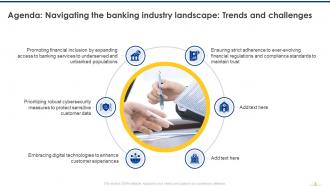
Slide 2: This is an Agenda slide. State your agendas here.
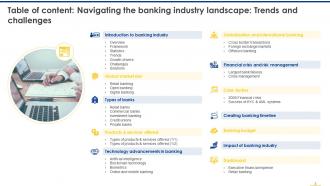
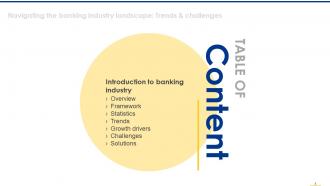
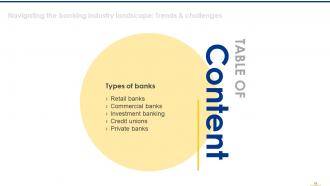
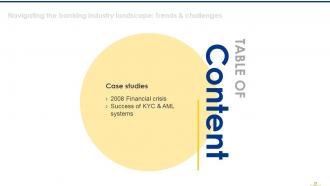
Slide 3: This slide shows Table of Content for the presentation.
Slide 4: This slide shows title for topics that are to be covered next in the template.
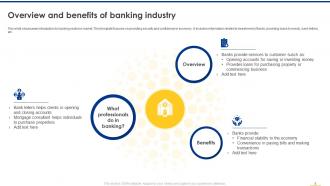
Slide 5: This slide showcases introduction to banking sector in market. This template focuses on providing security and confidence in economy.
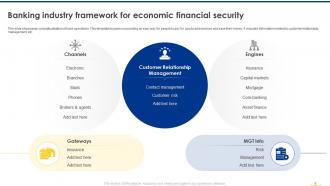
Slide 6: This slide displays conceptualisation of bank operations. This template focuses on providing an easy way for people to pay for goods and services and save their money.
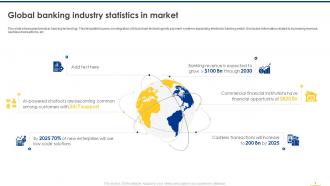
Slide 7: This slide showcases trends in banking technology. This template focuses on integration of blockchain technology into payment systems expanding electronic banking sector.
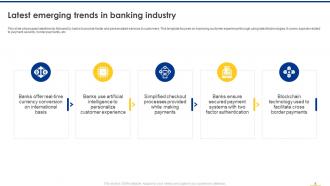
Slide 8: This slide displays latest trends followed by banks to provide faster and personalized services to customers.
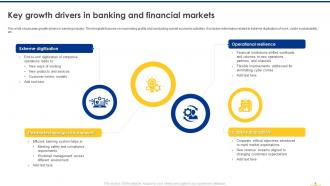
Slide 9: This slide showcases growth drivers in banking industry. This template focuses on maximizing profits and conducting overall economic activities.
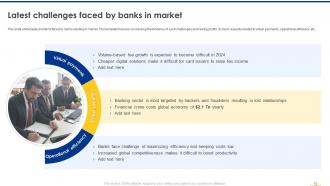
Slide 10: This slide displays problems faced by banks existing in market. This template focuses on reducing the tendency of such challenges and raising profits.
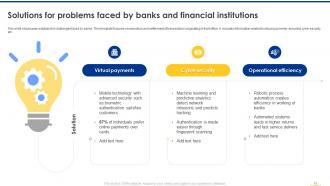
Slide 11: This slide presents solutions for challenges faced by banks. This template focuses on execution and settlement of transactions originating in front office.
Slide 12: This slide shows title for topics that are to be covered next in the template.
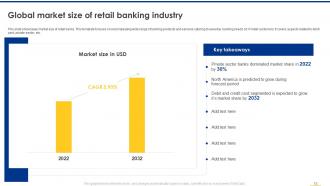
Slide 13: This slide showcases market size of retail banks. This template focuses on encompassing wide range of banking products and services catering to everyday banking needs.
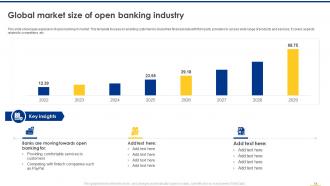
Slide 14: This slide presents expansion of open banking in market. This template focuses on enabling customers to share their financial data with third party providers.
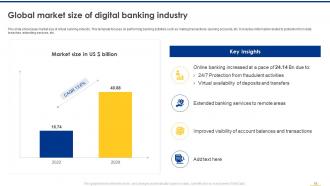
Slide 15: This slide showcases market size of virtual banking industry. This template focuses on performing banking activities such as making transactions, opening accounts, etc.
Slide 16: This slide shows title for topics that are to be covered next in the template.
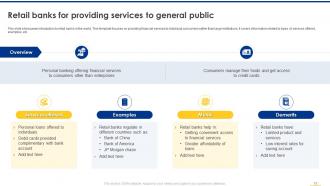
Slide 17: This slide showcases introduction to retail banks in the world. This template focuses on providing financial services to individual consumers rather than large institutions.
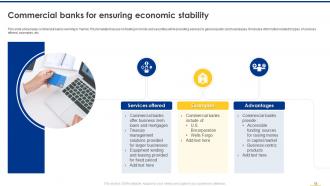
Slide 18: This slide presents commercial banks working in market. This template focuses on trading in bonds and securities while providing services to general public and businesses.
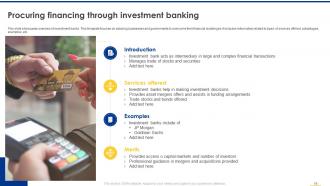
Slide 19: This slide showcases overview of investment banks. This template focuses on advising businesses and governments to overcome their financial challenges.
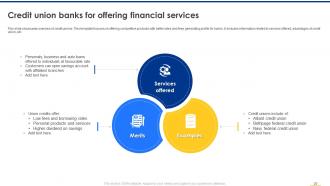
Slide 20: This slide displays overview of credit unions. This template focuses on offering competitive products with better rates and fees generating profits for banks.
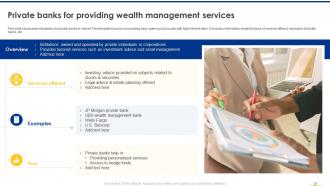
Slide 21: This slide showcases introduction to private banks in market. This template focuses on providing easy opening of accounts with high interest rates.
Slide 22: This slide shows title for topics that are to be covered next in the template.
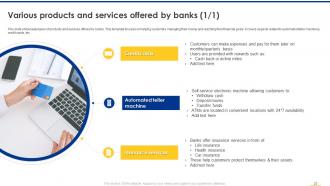
Slide 23: This slide showcases types of products and services offered by banks. This template focuses on helping customers managing their money and reaching their financial goals.
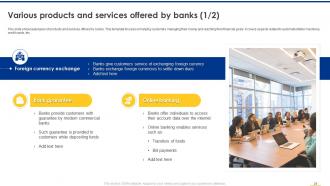
Slide 24: This slide presents types of products and services offered by banks. This template focuses on helping customers managing their money and reaching their financial goals.
Slide 25: This slide shows title for topics that are to be covered next in the template.
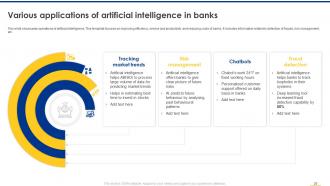
Slide 26: This slide showcases operations of artificial intelligence. This template focuses on improving efficiency, service and productivity and reducing costs of banks.
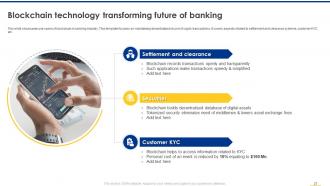
Slide 27: This slide describes use cases of blockchain in banking industry. This template focuses on maintaining decentralized record of crypto transactions.
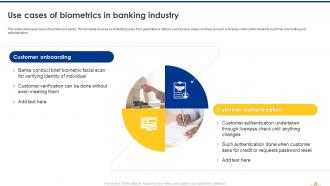
Slide 28: This slide showcases need of biometrics in banks. This template focuses on protecting users from generative AI attacks such as face swaps and fake account.
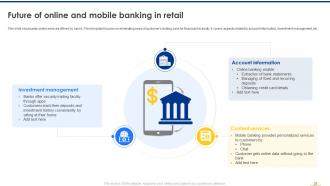
Slide 29: This slide presents online services offered by banks. This template focuses on eliminating need of customer’s visiting bank for financial necessity.
Slide 30: This slide shows title for topics that are to be covered next in the template.
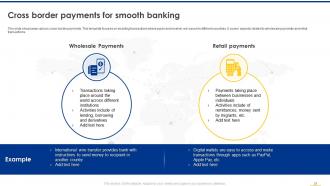
Slide 31: This slide showcases various cross-border payments. This template focuses on enabling transactions where payer and receiver are based in different countries.
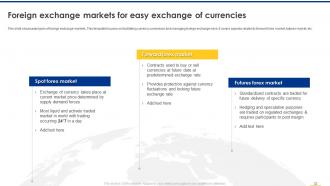
Slide 32: This slide displays types of foreign exchange markets. This template focuses on facilitating currency conversion and managing foreign exchange risks.
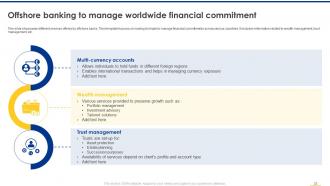
Slide 33: This slide showcases different services offered by offshore banks. This template focuses on making it simple to manage financial commitments across various countries.
Slide 34: This slide shows title for topics that are to be covered next in the template.
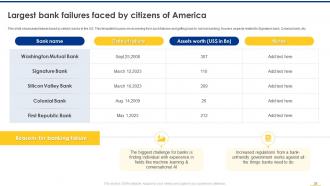
Slide 35: This slide showcases failures faced by certain banks in the US. This template focuses on recovering from such failures and getting back to normal banking.
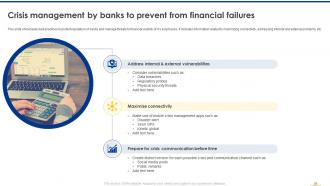
Slide 36: This slide presents best practices to protect reputation of banks and manage threats to financial viability of it’s employees.
Slide 37: This slide shows title for topics that are to be covered next in the template.
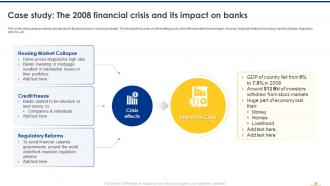
Slide 38: This slide showcases problems caused due to financial crisis in banking industry. This template focuses on eliminating such crisis with innovative technologies.
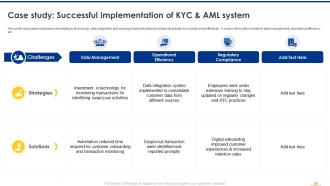
Slide 39: This slide displays importance of investing in technology, data integration and ongoing employee training in financial industry to combat crime effectively.
Slide 40: This slide shows title for topics that are to be covered next in the template.
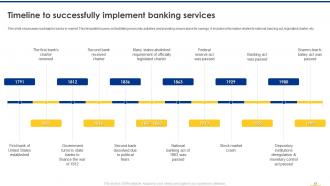
Slide 41: This slide showcases roadmap for banks in market. This template focuses on facilitating economic activities and providing secure place for savings.
Slide 42: This slide shows title for topics that are to be covered next in the template.
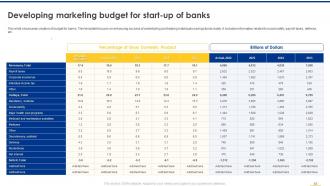
Slide 43: This slide displays creation of budget for banks. This template focuses on enhancing success of undertaking and helping individuals savings funds easily.
Slide 44: This slide shows title for topics that are to be covered next in the template.
Slide 45: This slide showcases impact of developing banking industry in market. This template focuses on influencing economic growth and accessing the credit in economy.
Slide 46: This slide shows title for topics that are to be covered next in the template.
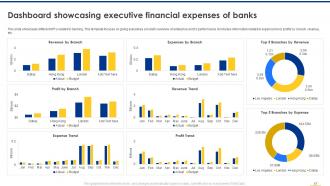
Slide 47: This slide showcases different KPI’s related to banking. This template focuses on giving executives a holistic overview of enterprise and t’s performance.
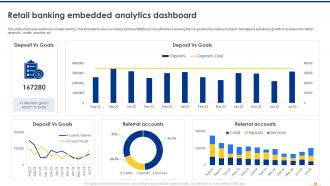
Slide 48: This slide showcases dashboard of retail banking and focuses on making banking institutions more efficient.
Slide 49: This slide shows all the icons included in the presentation.
Slide 50: This slide is titled as Additional Slides for moving forward.
Slide 51: This slide contains Puzzle with related icons and text.
Slide 52: This is Our Target slide. State your targets here.
Slide 53: This is a financial slide. Show your finance related stuff here.
Slide 54: This slide depicts Venn diagram with text boxes.
Slide 55: This slide displays Mind Map with related imagery.
Slide 56: This slide displays Matrix with additional textboxes and related imagery.
Slide 57: This slide displays Lego timeline with additional textboxes and related imagery.
Slide 58: This slide displays silhouettes with additional textboxes and related imagery.
Slide 59: This slide showcases Magnifying Glass to highlight, minute details, information, specifications etc.
Slide 60: This is an Idea Generation slide to state a new idea or highlight information, specifications etc.
Slide 61: This is a Funnel slide. Showcase how the data moves through the process.
Slide 62: This slide displays Hierarchy chart with additional textboxes.
Slide 63: This is a Thank You slide with address, contact numbers and email address.
Navigating The Banking Industry Landscape Trends And Challenges Powerpoint Presentation Slides with all 71 slides:
Use our Navigating The Banking Industry Landscape Trends And Challenges Powerpoint Presentation Slides to effectively help you save your valuable time. They are readymade to fit into any presentation structure.














FAQs for Navigating The Banking Industry Landscape Trends And Challenges
Honestly, AI fraud detection is game-changing right now - banks are catching sketchy stuff way faster. Blockchain's making transactions more secure, plus cloud computing lets them scale without breaking. Open banking APIs are kinda crazy when you think about it... fintech companies can plug straight into traditional banks now. Mobile-first everything is where the money's going, and biometric login is pretty much standard. Real-time payments are finally here too. Oh, and if you're evaluating banks for partnerships or whatever, definitely grill them about their API setup and AI plans first. That'll tell you everything.
Banks are really stepping up their AI game for customer service. Those chatbots don't suck anymore - they can actually solve real problems without bouncing you around. What's wild is how they analyze your spending to catch issues early or suggest stuff you might need. Honestly feels like they know me better than I know myself sometimes, which is... weird but useful? Human agents now handle the tricky cases while AI knocks out routine questions. My friend works at Wells Fargo and says it's totally changed how they operate. Look for banks that blend AI with real people instead of going full robot.
Honestly, digital wallets are basically the new checking accounts now. Venmo, Apple Pay, Cash App - they're doing everything from splitting dinner bills to paying rent. Banks are kinda freaking out because all that juicy transaction data and customer info they used to own? Yeah, it's going elsewhere. Some are trying to build their own wallet apps (with mixed results, let's be real), others are just partnering up with the big players. But here's the thing - you can't just ignore this trend and hope it goes away. Pick a lane: compete or collaborate.
Banks realized they can't fight fintech anymore, so now they're basically buying them up instead. JPMorgan's been on a shopping spree, Goldman launched Marcus - you know the drill. Most are pouring money into their own apps too, which honestly makes sense. Some even started VC arms to fund startups (kinda genius if you ask me). The whole landscape shifted from "us vs them" to collaboration. Banks are just absorbing all those fintech innovations into their old-school systems. Oh, and if you're keeping tabs on this stuff - expect way more partnership announcements than actual competition going forward.
So blockchain basically creates this unchangeable record that's spread across tons of computers instead of just one bank's system. Makes it super hard to hack since you'd have to break into multiple places at once. Your transactions get faster and cheaper too because there's fewer middlemen taking a cut. Each transaction gets cryptographically linked to the previous one - honestly the security aspect is pretty impressive. Oh and banks love it for compliance stuff since everything's transparent. When you're shopping around for banks, definitely ask what their blockchain game plan is. Most decent ones should have some strategy by now.
So banks are totally changing how they operate because of sustainability stuff. They're now looking at environmental and social risks when deciding who gets loans, not just the usual financial numbers. Green bonds are everywhere - seriously, every bank's jumping on this bandwagon. But it's not all just marketing fluff. Banks are actually restructuring their portfolios to get away from fossil fuels and carbon-heavy industries. If you're doing any investment work, you'll want to factor in ESG requirements. Regulatory pressure keeps ramping up, so it's becoming unavoidable.
Banking apps are crazy competitive right now. Users expect way more than balance checking - they want budgeting tools, spending breakdowns, bill scheduling, investment tracking, the whole nine yards. Biometric login isn't even special anymore, it's just expected. Honestly, the coolest feature is personalized insights. Like when your app tells you "you blew 30% more on takeout this month" - people eat that stuff up. The apps winning right now feel more like having a finance buddy than just looking at transactions. You should probably check how your app stacks up against what everyone else is doing.
Dude, compliance is just trying to catch up with how fast everything's going digital. Banks are moving to APIs and cloud storage while regulators are still figuring out the rules - honestly feels like they're making it up as they go sometimes. The whole framework for digital identity verification keeps shifting too. Most compliance teams I know are drowning trying to keep up. At least there's a move toward real-time monitoring instead of those painful quarterly reports we used to do manually. My advice? Get some RegTech tools that can handle the automated reporting across all your digital stuff before you're completely behind.
So open banking lets you connect your bank accounts to other apps through secure data sharing. You get way better budgeting tools and can switch banks easier. Banks hate it though - they're losing their stranglehold on customer data. Now fintech companies can build competing products using the same info your bank has. It's wild how much this levels the playing field. Sure, some people worry about security (fair enough), but banks can't just coast anymore. They actually have to innovate or watch customers leave. If you're working in finance, partnerships are gonna be huge.
So basically banks can dig into customer data to personalize everything - like actually useful fraud alerts based on your real spending habits, not just random notifications. They're getting weirdly good at predicting what you'll need before you know it yourself. Real-time data helps customize the mobile experience and speed up loan approvals too. Instead of sending generic junk offers, they can hit you with stuff that actually matters. Honestly, I'd start by figuring out where customers get frustrated and use data insights to fix those pain points first.
Dude, start with multi-factor authentication and end-to-end encryption - that's your baseline. Zero-trust architecture too, though I know it sounds buzzy. The fraud monitoring needs to happen in real-time because honestly? These hackers are getting scary good. Don't skip penetration testing and keep everything patched. Your employees need training since they'll definitely get targeted with social engineering stuff. Oh, and API security is critical with all those fintech connections. I'd probably run a security audit first if you haven't done one lately. Just assume you'll get hit eventually.
Banks are totally reshaping everything because of three big demographic shifts. Millennials and Gen Z want mobile-first banking, digital wallets, all that sustainability stuff. Boomers need easier online tools and retirement planning help. The Hispanic market is huge too - honestly surprised it took banks this long to figure that out. They're finally doing bilingual services and products that actually fit different cultural money habits. Your bank definitely segments customers way differently now than before. I'd check how your customer base has changed over the last five years, might be eye-opening.
Dude, social media is like a bank's report card now. Customers blast everything online - good and bad experiences spread crazy fast. One viral complaint can seriously damage a bank's reputation overnight. People rave about cool mobile features or completely trash terrible customer service, which influences how others see different banks. Honestly, I learned this the hard way when I almost picked a bank with awful reviews I didn't check first! The transparency actually forces banks to step up their game since bad experiences get amplified. Before choosing a bank, definitely scroll through their social mentions and see how they respond - way more telling than their fancy ads.
So banks are getting really smart with AI now - they're digging into your spending habits and life stuff to give you recommendations that actually fit. Like instead of generic investment advice, you'll get something built for your specific goals. The loan offers make more sense too. Some even have chatbots that remember what you talked about last time (which honestly surprised me). It's way better than the old cookie-cutter approach everyone used to hate. If you're working in banking, definitely check how your bank segments people and whether you're actually doing anything useful with all that customer data you're sitting on.
So the big stuff happening right now - real-time payments are basically becoming table stakes. Digital wallets are crushing traditional cards, and you've got this whole embedded finance thing where payments just happen inside apps without thinking about it. Crypto's still a hot mess regulation-wise but companies are figuring it out. CBDCs are actually picking up steam worldwide (honestly didn't see that coming so fast). AI fraud detection is getting scary good. Buy-now-pay-later isn't just for shopping anymore either. Your team should probably start mapping out what this means for your infrastructure. Customer expectations are gonna shift hard in the next few years.
-
SlideTeam just saved my project! Thank you so much. The variety of templates helped me showcase multiple perspectives easily.
-
I was really impressed with the presentation I created with their templates. I’ll be using their services moving forward.