


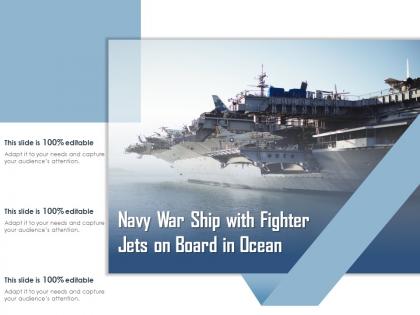
Navy war ship with fighter jets on board in ocean




Try Before you Buy Download Free Sample Product
 Impress Your
 Audience
 100%
100% Editable
 Save Hours
 of Time


Avoid innuendos with our Navy War Ship With Fighter Jets On Board In Ocean. Express ideas in a forthright fashion.
People who downloaded this PowerPoint presentation also viewed the following :
Navy war ship with fighter jets on board in ocean with all 2 slides:
Express yourself in a forthright fashion with our Navy War Ship With Fighter Jets On Board In Ocean. Avoid indulging in innuendos.

FAQs for Navy war ship with fighter jets on
The primary purpose of an aircraft carrier in modern naval operations is to project air power globally, serve as a mobile command center, and provide strategic deterrence in international waters. These floating airbases enable navies to launch fighter jets, conduct surveillance missions, and support humanitarian operations far from home ports, ultimately delivering rapid response capabilities and extending national influence across vast oceanic territories.
Aircraft carriers contribute to power projection by enabling rapid deployment of air power to distant regions, establishing mobile command centers, and providing sustained military presence without requiring foreign bases. These floating airbases allow nations to project force across oceans, support diplomatic initiatives through visible deterrence, and respond to crises globally, with many military strategists finding that carrier strike groups deliver unmatched flexibility and strategic reach in international waters.
Naval aircraft carriers comprise flight decks with catapult launch systems, arresting gear for landing recovery, hangar bays for aircraft storage, advanced radar and navigation systems, and nuclear propulsion plants. These integrated systems enable rapid deployment capabilities, extended operational range, and strategic force projection across global theaters, with modern carriers delivering enhanced maritime security, faster response times, and substantial tactical advantages in increasingly complex naval environments.
Aircraft carriers vary significantly in design and function, with differences including size, propulsion systems, aircraft launch mechanisms, defensive capabilities, and operational roles across different navies. American carriers emphasize nuclear propulsion and steam catapults for heavy aircraft operations, while European carriers often feature ski-jump designs for vertical takeoff aircraft, and emerging naval powers increasingly adopt modular designs that balance cost-effectiveness with strategic projection capabilities.
Aircraft carriers serve as mobile command centers, force projection platforms, and strategic coordination hubs in joint military operations, enabling real-time intelligence sharing, synchronized air support, and unified tactical planning across multinational forces. These floating airbases enhance operational flexibility by providing allied forces with extended reach capabilities, streamlined logistics coordination, and integrated defense systems, ultimately delivering enhanced strategic deterrence and rapid response capabilities in increasingly complex international security environments.
Aircraft carrier technology has evolved through advanced radar systems, nuclear propulsion, electromagnetic catapults, digital command centers, and stealth capabilities. These innovations enhance operational efficiency by extending deployment ranges, accelerating aircraft launches, and improving tactical coordination, with modern carriers like the Ford-class ultimately delivering superior fleet management and strategic advantage in increasingly complex maritime environments.
Aircraft carriers typically deploy fighter jets like F/A-18 Super Hornets for air superiority and strike missions, E-2 Hawkeyes for surveillance and early warning, C-2 Greyhounds for logistics transport, and SH-60 Seahawk helicopters for anti-submarine warfare and search-and-rescue operations. These aircraft work together to create a comprehensive naval aviation capability, with many modern carriers finding that this strategic combination of platforms enables power projection, fleet protection, and sustained operations across vast oceanic theaters.
Aircraft carriers ensure operational safety through comprehensive flight deck protocols, advanced radar systems, rigorous crew training, and strict aircraft maintenance procedures. These systems work together by coordinating takeoff and landing sequences, monitoring weather conditions, and maintaining constant communication between pilots and deck crews, with many naval operations finding that integrated safety measures significantly reduce incidents while enhancing mission effectiveness.
Navy aircraft carriers incorporate environmental considerations including waste management systems, fuel efficiency technologies, ballast water treatment, emission reduction measures, and marine life protection protocols. These systems streamline operations by minimizing ocean pollution, reducing carbon footprints, and ensuring regulatory compliance, with many naval forces finding that sustainable practices ultimately deliver operational cost savings while enhancing environmental stewardship.
Naval strikes from aircraft carriers fulfill strategic objectives by projecting power across vast distances, establishing air superiority, and delivering precision strikes without requiring land-based infrastructure. These floating airbases enable rapid response capabilities, force multiplication through sustained operations, and strategic deterrence, with military planners increasingly recognizing that carrier strike groups deliver unmatched flexibility and operational reach in contested maritime environments.
Aircraft carriers serve as floating command centers for humanitarian missions by providing medical facilities, helicopter landing platforms, clean water production, and emergency communications infrastructure. Through their strategic mobility and self-sufficient capabilities, naval forces deliver rapid disaster response in remote coastal regions, with many international relief operations finding that carriers enable faster medical evacuations, supply distribution, and coordination of multi-agency humanitarian efforts.
Aircraft carriers face significant cybersecurity challenges including network vulnerabilities, command system infiltration, communication interception, sensor manipulation, and weapons system compromise. These sophisticated vessels integrate thousands of interconnected systems that adversaries increasingly target through malware, signal jamming, and data breaches, with naval forces finding that enhanced encryption, network segmentation, and real-time monitoring ultimately deliver operational security and mission effectiveness.
Nuclear-powered carriers typically operate with larger crews, around 5,000-6,000 personnel, compared to conventional carriers with 3,000-4,000, due to complex reactor operations requiring specialized nuclear technicians and enhanced safety protocols. While nuclear vessels enable extended deployments without refueling stops, streamlining global operations and reducing logistical dependencies, conventional carriers require more frequent port visits for fuel resupply, ultimately affecting deployment flexibility and operational tempo in increasingly demanding maritime environments.
Recent geopolitical tensions are driving increased aircraft carrier construction globally, with nations like China expanding fleets while established powers modernize existing vessels through advanced radar systems, cyber defense capabilities, and enhanced operational ranges. These developments are reshaping naval strategies across the Pacific and Atlantic regions, with many defense analysts finding that carriers remain central to power projection despite evolving threats, ultimately delivering strategic deterrence and alliance strengthening.
Aircraft carriers significantly influence regional security dynamics by projecting power, deterring aggression, and enabling rapid response capabilities in contentious areas. Their presence often stabilizes volatile regions through diplomatic signaling and alliance reassurance, while providing flexible platforms for humanitarian missions, crisis response, and coalition operations, ultimately reshaping strategic calculations of both allies and potential adversaries in increasingly complex geopolitical environments.
No Reviews