

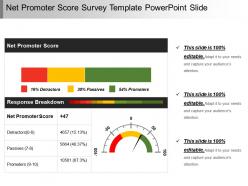
Net promoter score survey template powerpoint slide





Try Before you Buy Download Free Sample Product
 Impress Your
Audience
 100%
Editable
 Save Hours
of Time


The net promoter score PPT template is a tool for measuring the loyalty of the company’s customers. The customer satisfaction survey slide showcases the customer satisfaction research process. Depict the four components for maintaining customer relationship like commitment, connection, contribution and challenges. The net promoter score design template act as an outstanding tool that is really helpful for analyzing the loyalty of customers, clients or even employees. The score survey presentation template describes that NPS is a single question survey technique to assess the liability of the company, product or services, etc. The net promoter score survey sample PPT template is suitable for a user who wants to describe that NPS outcomes are promoters, passives and detractors.
People who downloaded this PowerPoint presentation also viewed the following :
Net promoter score survey template powerpoint slide with all 5 slides:
Draw credible conclusions with the help of our Net Promoter Score Survey Template Powerpoint Slide. It helps analyze the information.


FAQs for Net promoter score survey
So basically it's just one question: "How likely are you to recommend us to a friend?" That's it. You sort answers into three buckets - Promoters (9-10), Passives (7-8), and Detractors (0-6). Then you subtract detractor percentage from promoter percentage. Pretty straightforward math. The whole idea is that recommending something to friends is the real test, right? Like if you won't tell your buddy about it, it's probably not that great. Plus it gives you one clean number to track over time instead of juggling a bunch of different metrics. Makes comparing teams or products way easier too.
So you take the percentage of promoters (9-10 scores) and subtract the detractors (0-6). Like if 60% are promoters and 20% are detractors, you get +40. It goes from -100 to +100. Anything above zero is decent, +50 is actually pretty good. Honestly though, the real value comes from watching it month to month or whatever - that's how you know if customers are actually happier with changes you're making. Oh and passives (7-8 scores) don't count toward the calculation, they just sit there doing nothing.
Honestly, NPS is great because it's just one simple question - would you recommend us? No endless surveys that annoy people. You get a single number that's super easy to track month by month. Since everyone uses it now, you can actually compare yourself to competitors too, which is pretty useful. The cool thing is it predicts loyalty and future behavior, not just whether someone was happy yesterday. Way better than those satisfaction scores that don't really tell you much. I'd start tracking it monthly - the trends will surprise you.
Honestly, email surveys are your best bet to start - super easy to set up and you can actually track who responds. Timing matters big time though. Send them right after a purchase or interaction when it's still fresh. Keep it stupid simple: just the main NPS question and maybe one follow-up about why they picked that number. Don't go crazy sending these every week or people will just ignore you (learned that one the hard way). Try different send times too - I've seen response rates jump just from switching to Tuesday mornings instead of Friday afternoons. Oh, and definitely follow up on the feedback you get.
So NPS goes from -100 to 100. Anything below zero means more people hate you than love you – not great. Between 0-30 is okay, nothing crazy. 30-50 is actually pretty solid, and above 50? You're crushing it. Most companies would kill for 30+, honestly. I wouldn't obsess over hitting some magic number though. What matters more is whether it's going up or down month to month. Like, a steady climb from 25 to 35 beats randomly hitting 45 once, you know?
Break down your NPS by customer type - tenure, spend, demographics, that stuff. Like, a 30 NPS means nothing, but if your enterprise customers are hitting 50 while small businesses are at 10? Now you've got something useful. Also look at touchpoints - support calls, onboarding, recent feature use. I'd honestly start with your obvious segments first since that's where the low-hanging fruit usually is. Geographic and industry cuts can surprise you too. Then just keep digging based on what patterns jump out.
Okay so with NPS follow-up, you've got three different groups to handle. Promoters are easy - just ask them for reviews or referrals since they already love you. Passives are trickier though, they're kinda neutral so find out what's missing for them. Detractors? Drop everything and fix their problems personally. Like, actually call them if you can. Most companies just blast the same cookie-cutter email to everyone which is so lazy. Oh and definitely tackle your angry customers first - they're the ones who'll trash you online. Set up some automated stuff but don't make it sound robotic, you know?
Honestly, your detractors are where the real insights are hiding. Follow up with those low scores to dig into what's actually bothering them, then fix those problems first. Don't ignore your promoters though - figure out what made them happy so you can do more of that. Here's what really works: tell people when you've made changes based on their feedback. Sounds obvious but most companies skip this step. Try breaking down your NPS by different customer segments or product areas. You'll probably spot some patterns that way, and it makes it easier to know where to focus your energy first.
Look, NPS isn't everything - it's just one piece of the puzzle. Don't freak out over tiny changes or compare yourself to random industries (your B2B tool vs Netflix? Come on). The comments are honestly way more valuable than the score itself. Different industries have totally different "good" numbers anyway, so chasing some magic target is pointless. Watch your trends instead. Oh, and actually use that feedback to fix real problems - otherwise you're just collecting data for no reason.
Honestly, quarterly works best for most companies. Gives you solid trend data without annoying people to death. Monthly surveys? Only if you're like a SaaS with tons of touchpoints - otherwise customers will hate you lol. B2B or longer sales cycles can probably get away with twice yearly. Pick whatever frequency and actually stick with it though, or you won't be able to compare anything meaningful. Oh and definitely survey the same customer segments each round. Also don't forget to follow up with people who give feedback - they'll appreciate knowing you listened.
Your NPS is basically tied to how engaged your employees are. Think about it - when your team actually gives a damn about their work, customers notice. They'll solve problems faster, go the extra mile, stuff like that. But if your staff is checked out? You're gonna get that bland, "just doing my job" service that leaves customers feeling meh. Honestly, I've seen this pattern everywhere I've worked. Happy employees = happy customers, every single time. Lots of companies actually track employee engagement first because it predicts NPS trends. You should definitely survey both - employee satisfaction and customer feedback - then look for connections between the two.
Yeah, NPS can predict growth pretty well. Higher scores usually mean better revenue since happy customers refer friends and buy more stuff. Meanwhile detractors will trash-talk you to anyone who'll listen - which sucks. Don't get hung up on individual scores though. Track trends over months instead. Also break it down by customer segments or product lines so you actually know what to fix. Here's what I'd focus on first: turn those neutral customers into promoters. Way easier than converting haters, and you'll see growth impact faster.
Oh man, NPS gets so weird across different countries. Japanese customers basically never give extreme ratings - it's like a cultural thing where they avoid being too positive or negative. Americans? They'll happily throw around 9s and 10s. Germans are just harsh critics no matter what you do (honestly makes sense if you think about it). Don't make the mistake of comparing scores directly between regions - a 7 in Japan might actually mean the same thing as a 9 in the US. Set up different benchmarks for each market instead. Also try asking follow-up questions to figure out what's really behind those numbers, because the score alone won't tell you much.
Yeah, NPS has some major blind spots. That single question thing? It totally misses why people feel neutral or what they actually want fixed. Different cultures mess with the scores too - Scandinavians are way more reserved than Americans when rating stuff. Here's what I'd do: throw in some follow-up questions and maybe try Customer Effort Score alongside it. Honestly, the emotional connection piece is huge and NPS completely ignores that. A few quick interviews help too. Just don't rely on NPS alone - it's useful but definitely not the full story.
Honestly, automating your NPS stuff is a total game-changer. Start with just automating when surveys get sent out - you'll see way better response rates right away. From there, you can set up the whole thing: automated follow-ups, real-time dashboards that ping you when scores tank, even AI that sorts through all those messy open-ended responses (which saves SO much time). The dashboards are probably my favorite part though. Once it's running, automation handles all the tedious reminder emails and data collection. You actually get to focus on fixing whatever's broken instead of drowning in spreadsheets.
-
Best Representation of topics, really appreciable.
-
Nice and innovative design.