

Netflix Case Study Ai Transformation By Entertainment Giant Ai Driven Digital Transformation Planning DT SS




Try Before you Buy Download Free Sample Product
 Impress Your
Audience
 100%
Editable
 Save Hours
of Time


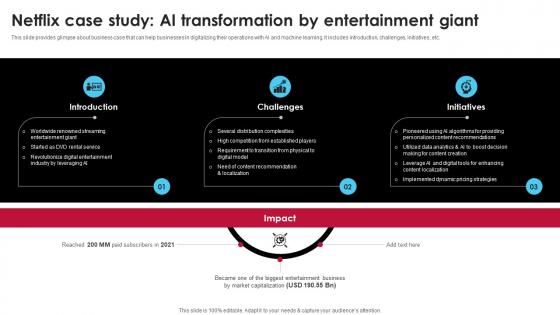
This slide provides glimpse about business case that can help businesses in digitalizing their operations with AI and machine learning. It includes introduction, challenges, initiatives, etc.
People who downloaded this PowerPoint presentation also viewed the following :
Netflix Case Study Ai Transformation By Entertainment Giant Ai Driven Digital Transformation Planning DT SS with all 9 slides:
Use our Netflix Case Study Ai Transformation By Entertainment Giant Ai Driven Digital Transformation Planning DT SS to effectively help you save your valuable time. They are readymade to fit into any presentation structure.








FAQs for Netflix Case Study Ai Transformation By Entertainment Giant Ai Driven Digital Transformation
Netflix's AI-driven features include personalized recommendation algorithms, dynamic thumbnail optimization, content auto-play previews, smart download suggestions, and adaptive streaming quality. These technologies enhance user engagement by curating individual viewing experiences, optimizing visual presentation based on user preferences, and streamlining content discovery, ultimately delivering higher retention rates and viewing satisfaction across Netflix's global subscriber base.
Netflix leverages machine learning algorithms through collaborative filtering, content-based analysis, deep neural networks, natural language processing, and real-time user behavior tracking. These technologies enhance personalization by analyzing viewing patterns, content metadata, and user preferences across millions of subscribers, ultimately delivering more accurate recommendations and increased viewer engagement for competitive advantage.
AI has revolutionized Netflix's content acquisition through predictive analytics for audience demand forecasting, automated content scoring systems, and global market trend analysis. These technologies enable strategic bidding on high-potential projects, optimize licensing investments across regions, and minimize acquisition risks, with Netflix leveraging machine learning to identify undervalued content that competitors overlook, ultimately delivering superior ROI.
Netflix leverages AI throughout original content production by analyzing audience preferences to guide script development, optimizing casting decisions through predictive analytics, and streamlining post-production workflows with automated editing tools. Through machine learning algorithms, Netflix determines which genres, storylines, and talent combinations resonate with specific viewer segments, ultimately reducing production risks while enhancing content relevance and viewer engagement across global markets.
AI significantly enhances Netflix's viewer retention and engagement by enabling personalized content recommendations, optimizing streaming quality, and predicting viewing patterns through advanced algorithms. Through machine learning models, Netflix delivers tailored user experiences, reduces content discovery time, and minimizes buffering issues, with studies showing that personalized recommendations drive over 80% of viewer engagement, ultimately increasing subscriber loyalty and reducing churn rates.
Netflix ensures data privacy and security through advanced encryption, anonymization techniques, strict access controls, federated learning approaches, and comprehensive compliance frameworks. These measures enable the platform to deliver personalized recommendations while protecting user information, with many streaming services finding that robust privacy safeguards ultimately enhance customer trust and competitive advantage.
AI helps Netflix predict film success by analyzing viewer engagement patterns, demographic preferences, historical performance data, and content characteristics like genre, cast, and storylines. Through machine learning algorithms, Netflix can forecast audience reception, optimize production investments, and strategically time releases, with many entertainment companies finding that predictive analytics significantly enhance content portfolio decisions and maximize return on original programming investments.
Netflix's AI technology leads through advanced recommendation algorithms, personalized content curation, predictive analytics for original programming, and sophisticated content delivery optimization, while competitors like Amazon Prime and Disney+ focus more on leveraging existing content libraries. Netflix's decade-long investment in machine learning enables superior viewer engagement and retention rates, with their recommendation engine driving over 80% of viewing decisions, ultimately delivering competitive advantage through data-driven content strategy and user experience personalization.
Netflix's AI content curation raises ethical considerations including algorithmic bias in recommendations, data privacy concerns, content diversity versus echo chambers, transparency in decision-making processes, and potential manipulation of viewing behaviors. While these algorithms enhance user experiences and operational efficiency, streaming platforms must balance personalization with responsible content exposure, ensuring diverse perspectives reach audiences and maintaining user trust through transparent, ethical AI practices.
AI implementation has significantly enhanced Netflix's operational efficiency by automating content categorization, streamlining recommendation algorithms, and optimizing server load distribution across global networks. Through machine learning technologies, Netflix delivers faster content discovery, reduces bandwidth costs by up to 30%, and minimizes manual content tagging, ultimately enabling seamless user experiences while dramatically reducing operational overhead.
Netflix leverages AI to analyze viewer feedback through sentiment analysis of reviews, behavioral pattern recognition, engagement metrics evaluation, and social media monitoring. These technologies enable the platform to identify content preferences, predict audience reactions, and optimize programming decisions, with streaming services finding that AI-driven feedback analysis significantly improves content curation, reduces production risks, and enhances subscriber retention rates.
Netflix has faced challenges including massive data processing complexity, balancing personalization with content diversity, managing computational costs at global scale, and addressing algorithm bias concerns. These obstacles require strategic integration of machine learning infrastructure, continuous algorithm refinement, and substantial resource allocation, with many streaming platforms finding that overcoming these hurdles ultimately delivers enhanced user experiences and competitive advantage.
Netflix balances AI recommendations with diverse content by incorporating diversity metrics into their algorithms, using techniques like controlled randomization, and actively promoting underrepresented creators through dedicated recommendation slots. Through strategic algorithm tuning and content amplification strategies, they enhance user discovery while supporting broader storytelling, ultimately delivering personalized experiences and cultural representation that strengthens their competitive advantage.
Future AI developments that could transform Netflix include advanced emotion recognition for mood-based recommendations, real-time personalized content generation, immersive AR/VR storytelling experiences, and predictive analytics for viewer engagement optimization. These emerging technologies will enable Netflix to deliver hyper-personalized entertainment experiences, streamline content production costs, and create interactive narratives, ultimately providing unprecedented viewer satisfaction and competitive differentiation in the streaming landscape.
Companies can learn from Netflix's AI-driven approach to personalization, content recommendation algorithms, predictive analytics for content creation, and automated quality optimization. By studying Netflix's strategic combination of machine learning for viewer behavior analysis and data-driven content investment decisions, streaming platforms like Hulu, Disney+, and Amazon Prime can enhance user engagement, reduce churn rates, and ultimately deliver more targeted experiences while optimizing content acquisition costs.
-
Superb! The innovative and inspiring template designs provide an edge to the presentation.
-
The quality of PowerPoint templates I found here is unique and unbeatable. Keep up the good work and continue providing us with the best slides!