

Network security assessment report ppt powerpoint presentation slides visuals cpb




Try Before you Buy Download Free Sample Product
 Impress Your
Audience
 100%
Editable
 Save Hours
of Time


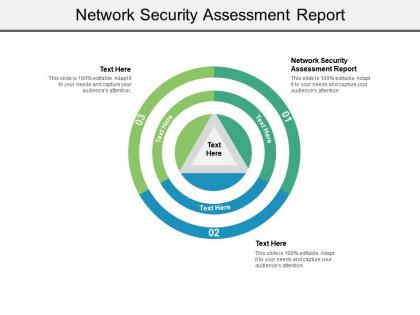
Our Network Security Assessment Report Ppt Powerpoint Presentation Slides Visuals Cpb are topically designed to provide an attractive backdrop to any subject. Use them to look like a presentation pro.
People who downloaded this PowerPoint presentation also viewed the following :
Network security assessment report ppt powerpoint presentation slides visuals cpb with all 2 slides:
Use our Network Security Assessment Report Ppt Powerpoint Presentation Slides Visuals Cpb to effectively help you save your valuable time. They are readymade to fit into any presentation structure.


FAQs for Network security assessment report ppt powerpoint presentation
A comprehensive network security assessment report should include vulnerability identification, risk analysis, threat modeling, compliance evaluation, and remediation recommendations. These components work together by providing organizations with actionable insights into their security posture, prioritized remediation strategies, and regulatory alignment, ultimately enabling businesses to strengthen defenses, reduce breach risks, and maintain competitive advantage in an increasingly complex threat landscape.
Organizations determine their network security assessment scope by identifying critical assets, defining network boundaries, cataloging connected devices, mapping data flows, and establishing compliance requirements. This comprehensive approach enables thorough evaluation of infrastructure components, from servers and databases to IoT devices and cloud integrations, while many enterprises find that prioritizing high-value assets and regulatory obligations delivers focused, actionable security insights.
**INPUT**: What methodologies are commonly used for conducting network security assessments? **OUTPUT**: Network security assessment methodologies include penetration testing, vulnerability scanning, risk analysis frameworks, compliance auditing, and threat modeling approaches. These methodologies enhance organizational security by identifying vulnerabilities, evaluating existing controls, and prioritizing remediation efforts, with many financial institutions and healthcare organizations finding that comprehensive assessments deliver stronger defenses and regulatory compliance. **Word count: 54 words**
Network security assessments should identify unpatched software vulnerabilities, weak authentication protocols, misconfigured firewalls, unsecured wireless networks, and inadequate access controls. These assessments enable organizations to streamline their security posture by addressing credential weaknesses, closing network gaps, and enhancing monitoring capabilities, with many financial institutions and healthcare providers finding that comprehensive vulnerability identification ultimately delivers stronger compliance and reduced breach risks.
Organizations can effectively prioritize risks by evaluating threat likelihood, potential business impact, asset criticality, and remediation complexity. Using risk matrices and scoring frameworks, security teams assess which vulnerabilities could most severely disrupt operations, with many organizations finding that focusing on high-impact, easily exploitable vulnerabilities delivers immediate security improvements while optimizing resource allocation.
Compliance standards like GDPR, HIPAA, and PCI-DSS serve as critical frameworks that guide assessment methodologies, define security requirements, and establish mandatory controls for data protection. These regulations ultimately streamline the evaluation process by providing clear benchmarks, with organizations in healthcare, finance, and retail finding that compliance-driven assessments enhance both regulatory adherence and overall security posture.
A network security assessment report supports incident response planning by identifying vulnerabilities, mapping critical assets, documenting network architecture, and establishing baseline security configurations. These comprehensive insights enable organizations to develop targeted response procedures, prioritize asset protection, and streamline recovery processes, with many IT teams finding that detailed assessments ultimately reduce response times and minimize business disruption.
Network security assessment tools include vulnerability scanners like Nessus and OpenVAS, network mapping tools such as Nmap, penetration testing frameworks like Metasploit, and security information management platforms. These technologies streamline assessment processes by automating vulnerability detection, providing real-time threat analysis, and delivering comprehensive reporting capabilities, with many organizations finding that integrated toolsets enhance operational efficiency while reducing security gaps.
Network security assessment findings should be communicated to non-technical stakeholders through executive summaries, risk-based prioritization, visual dashboards, and business impact analysis that translates technical vulnerabilities into operational risks. These communication strategies enable leadership teams to make informed decisions about resource allocation, budget planning, and strategic security investments, while demonstrating how addressing specific vulnerabilities ultimately delivers improved business continuity and competitive advantage.
Common pitfalls include insufficient risk prioritization, overly technical language without business context, incomplete vulnerability documentation, lack of actionable remediation steps, and inadequate executive summaries. Organizations frequently overlook stakeholder-specific recommendations, timeline feasibility for fixes, and cost-benefit analysis, with many finding that reports lacking clear business impact fail to drive necessary security investments and strategic decision-making.
Organizations should conduct comprehensive network security assessments quarterly, with continuous monitoring and targeted assessments following major system changes, threat intelligence updates, or security incidents. This strategic combination of regular scheduled reviews and responsive evaluations enables companies across sectors like financial services, healthcare, and retail to identify vulnerabilities proactively, adapt to evolving attack vectors, and maintain robust defenses, ultimately delivering enhanced security posture and competitive advantage.
Effective follow-up methods include establishing regular progress reviews, implementing automated vulnerability scanning tools, creating remediation tracking dashboards, conducting periodic penetration testing, and maintaining documentation of all security improvements. These approaches enable organizations to systematically monitor implementation timelines, verify that vulnerabilities are properly addressed, and ensure continuous security posture enhancement, with many enterprises finding that structured follow-up processes significantly reduce their overall risk exposure.
Not addressing discovered vulnerabilities creates significant cybersecurity risks, including data breaches, system compromises, regulatory compliance failures, financial losses, and reputational damage. These unresolved weaknesses enable cybercriminals to exploit network entry points, with many organizations finding that delayed remediation ultimately costs far more than proactive security investments and strategic vulnerability management.
Organizations ensure alignment by integrating assessment objectives with strategic security goals, conducting regular reviews that evaluate current controls against business priorities, and involving stakeholders from IT, compliance, and executive teams in the planning process. This coordinated approach enables companies to identify gaps that directly impact their risk tolerance and operational requirements, while ensuring that assessment findings translate into actionable improvements that strengthen their overall security posture and competitive advantage.
Network security assessment documentation best practices include establishing standardized report templates, implementing version control systems, creating searchable digital archives, and maintaining detailed executive summaries with remediation tracking. Organizations should archive reports in secure, centralized repositories with appropriate access controls, ensuring historical trend analysis capabilities, while many enterprises find that quarterly reviews of archived assessments enable proactive security posture improvements and regulatory compliance.
-
The Designed Graphic are very professional and classic.
-
Visually stunning presentation, love the content.
-
Professional and unique presentations.
-
Great product with effective design. Helped a lot in our corporate presentations. Easy to edit and stunning visuals.