

New Market Entry Powerpoint Ppt Template Bundles





Try Before you Buy Download Free Sample Product
 Impress Your
Audience
 100%
Editable
 Save Hours
of Time


Our New Market Entry Powerpoint Ppt Template Bundles are topically designed to provide an attractive backdrop to any subject. Use them to look like a presentation pro.
People who downloaded this PowerPoint presentation also viewed the following :
New Market Entry Powerpoint Ppt Template Bundles with all 17 slides:
Use our New Market Entry Powerpoint Ppt Template Bundles to effectively help you save your valuable time. They are readymade to fit into any presentation structure.







FAQs for New Market Entry Powerpoint
Key factors include market size and growth potential, competitive landscape analysis, regulatory requirements, cultural considerations, and resource allocation needs. These assessments enable organizations to evaluate entry barriers, customer demand patterns, and operational feasibility across different sectors, with many companies finding that thorough market research ultimately delivers strategic positioning and sustainable competitive advantage.
Businesses can effectively conduct market research through consumer surveys, focus groups, competitor analysis, local demographic studies, and cultural preference assessments. These methods enable companies to understand regional buying behaviors, price sensitivities, and cultural nuances, with many organizations finding that combining digital analytics with on-ground insights delivers deeper market understanding and competitive advantage.
Competitive analysis serves as the foundation for new market entry by identifying key players, market gaps, pricing strategies, customer preferences, and potential barriers to entry. Through comprehensive competitor assessment, businesses can differentiate their offerings, avoid saturated segments, and position strategically, with many companies finding that thorough competitive intelligence ultimately delivers faster market penetration and sustainable competitive advantage.
Businesses can identify potential barriers through comprehensive market research, regulatory analysis, competitive landscape assessment, cultural evaluation, and stakeholder consultation. Through systematic evaluation of legal requirements, local competition, and consumer preferences, companies can anticipate challenges like licensing restrictions, tariff structures, and cultural preferences, ultimately developing strategic entry plans that minimize risks while maximizing market penetration opportunities.
Common entry strategies include direct exporting, joint ventures, franchising, strategic partnerships, and wholly-owned subsidiaries, each offering different levels of control, investment, and risk exposure. These approaches differ significantly across industries, with technology companies often preferring partnerships for rapid scaling, while manufacturing firms typically choose subsidiaries for quality control, and service businesses frequently utilize franchising, ultimately delivering market penetration tailored to specific operational requirements and competitive landscapes.
Cultural differences significantly impact marketing strategies through varying consumer behaviors, communication preferences, purchasing patterns, and brand perceptions across different regions. Companies must adapt their messaging, product positioning, and promotional approaches accordingly, with many retailers and financial services finding that localized campaigns, culturally-sensitive imagery, and region-specific value propositions ultimately deliver higher engagement rates and competitive market advantage.
Companies should consider compliance requirements, licensing obligations, tax regulations, employment laws, and intellectual property protections when entering new markets. These legal frameworks vary significantly across jurisdictions, with businesses in sectors like financial services, healthcare, and manufacturing finding that early regulatory consultation streamlines market entry, minimizes compliance risks, and ultimately delivers faster operational scaling and competitive positioning.
Localization proves crucial for new market entry, enabling companies to adapt products, messaging, cultural preferences, regulatory requirements, and customer expectations effectively. Through strategic localization, businesses enhance user experiences, build trust with local consumers, and minimize cultural missteps, with many international companies finding that tailored approaches deliver significantly higher adoption rates and competitive advantage.
Businesses should evaluate market entry success through customer acquisition rates, revenue growth trajectories, market share penetration, brand recognition levels, and competitive positioning metrics. These indicators enable organizations to assess strategic performance by measuring adoption speed, profitability timelines, and operational efficiency, with many companies finding that balanced scorecards ultimately deliver comprehensive insights for sustainable expansion and competitive advantage.
Partnerships facilitate market entry by providing local expertise, established distribution networks, regulatory knowledge, and shared risk investment. Through strategic alliances, companies leverage partners' customer relationships, cultural insights, and operational infrastructure, while reducing entry costs and accelerating time-to-market, with many organizations finding that collaborative approaches deliver competitive advantages.
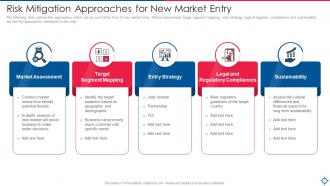
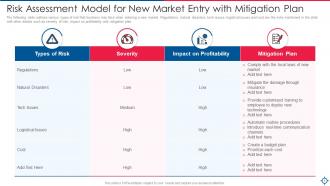
New market entry risks include regulatory compliance challenges, cultural misalignment, competitive pressures, supply chain disruptions, and financial overexposure. These challenges can be mitigated through comprehensive market research, strategic partnerships with local entities, phased rollout approaches, and diversified resource allocation, with many organizations finding that pilot programs and regional expertise ultimately deliver sustainable competitive advantage.
Economic stability significantly influences market entry decisions by affecting consumer purchasing power, currency fluctuation risks, regulatory predictability, and long-term investment security. Companies typically favor stable markets like Germany or Switzerland for predictable returns, while emerging markets with volatility present both challenges and opportunities, with many organizations finding that economic indicators ultimately determine timing, investment scale, and strategic approach for sustainable growth.
Digital presence serves as the foundation for modern market entry, encompassing social media engagement, search engine optimization, content marketing, e-commerce platforms, and targeted digital advertising. These channels enable businesses to build brand awareness, understand local customer preferences, and establish credibility before physical expansion, with many companies finding that strong digital footprints significantly reduce traditional market entry costs and accelerate customer acquisition.
Companies leverage technology for market insights through data analytics platforms, social media monitoring tools, consumer behavior tracking systems, competitive intelligence software, and AI-powered market research solutions. These technologies enable businesses to analyze demographic patterns, assess competitor strategies, and identify consumer preferences across different regions, with many organizations finding that real-time data analysis significantly reduces market entry risks while accelerating strategic decision-making processes.
Successful entries include Starbucks's strategic localization in China, Netflix's data-driven global expansion, and Uber's city-by-city scaling approach, while failures include Walmart's Germany exit and Google+'s social media misfire. These cases demonstrate that market research, cultural adaptation, and phased implementation strategies enable competitive advantage, with many organizations finding that understanding local preferences, regulatory landscapes, and consumer behaviors ultimately delivers sustainable growth and market penetration.
-
What an exhaustive collection of templates you guys have there in slideteam. Impressive!!!
-
Good research work and creative work done on every template.