

New market penetration analysis powerpoint presentation slides





Try Before you Buy Download Free Sample Product
 Impress Your
Audience
 100%
Editable
 Save Hours
of Time


Conduct a thorough market research for new product using New Market Penetration Analysis PowerPoint Presentation Slides. Identify and evaluate the market need, market size, competition, and more with the help of content-ready new market penetration PowerPoint presentation slideshow. This ready-made PowerPoint complete deck comprises of templates like market segmentation, product market mapping, market research for new product, competitive opportunity, market landscape, market attractiveness, and more. Use new market penetration analysis PPT slides to create a plan to introduce your product in the market. These new market penetration analysis PowerPoint slides will help you assess the competitive market and product mapping for a product to be entered in a market successfully. These templates are completely customizable. You can edit the template as per your convenience. Edit the color, text, icon, and font size as per your need. Grab this new market penetration analysis PowerPoint templates to develop and introduce your new product in the market without any hassles. Introduce changes that assure improvement with our New Market Penetration Analysis Powerpoint Presentation Slides. Gain from being able to introspect.
People who downloaded this PowerPoint presentation also viewed the following :
Content of this Powerpoint Presentation
Slide 1: This slide introduces New Market Penetration Analysis. State the name of your company and get started.
Slide 2: This slide shows Market Segmentation into- Geographic, Demographic, Psychographic, Behavioral terms with icon imagery.
Slide 3: This slide shows Product Market Mapping graph with circles and text boxes. Move the circles and the text boxes as per your company’s competitive strength & market attractiveness.
Slide 4: This is Market Research for New Product slide showing two of its aspects- The Market Research Process, The New Product Development Process.
Slide 5: This slide also shows Market Research for New Product with points and sub points.
Slide 6: This is a Competitive Opportunity slide showing Competitive Intelligence Strengths, Weakness & Threats which are- Competitor’s Market Perception, Innovation R & D, R&D in process, Competitor’s Strategies, Financial Review, Value Proposition, Competitor’s Profile.
Slide 7: This slide shows Market Landscape with imagery. It also shows- Key Trend, Market Driver, Forecast.
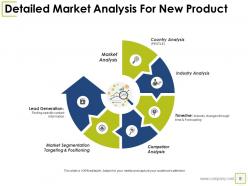
Slide 8: This slide shows Detailed Market Analysis For New Product which consists of- Market Analysis, Country Analysis (PESTLE), Industry Analysis, Competitor Analysis, Market Segmentation, Targeting & Positioning, Lead Generation, Timeline.
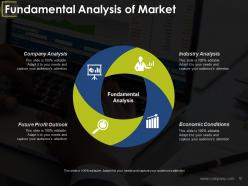
Slide 9: This slide shows the Fundamental Analysis of Market which includes- Industry Analysis, Company Analysis, Economic Conditions, Future Profit Outlook.
Slide 10: This slide shows Competitive Strategies matrix with Competitive Advantage: Lower Cost, Differentiation Competitive Edge: Narrow Target, Broad Target.
Slide 11: This slide displays Market Attractiveness matrix with Strong Medium Week Low Medium High parameters.
Slide 12: This is Market Research Survey Icon Slide. Alter/ modify as per your requirement.
Slide 13: This is a Coffee Time slide. Can be altered as per requirement.
Slide 14: This slide forwards to Charts & Graphs. Can be altered as per requirement.
Slide 15: This slide shows a Stacked Chart in terms of percentage and Expenditure of Product 01, Product 02 etc.
Slide 16: This is a Line with Markers to present product/ entity comparison, specifications etc.
Slide 17: This is a Clustered Column slide to present product/ entity comparison, specifications etc.
Slide 18: This is a Stacked Area slide to present product/ entity comparison, specifications etc.
Slide 19: This slide is titled Additional Slides. You can change the slide content as per your needs.
Slide 20: This is an Our Team slide with name, image and text boxes to put the required information.
Slide 21: This is an About Us slide. State company or team specifications here.
Slide 22: This is Our Mission slide with Vision and Goals. State them here.
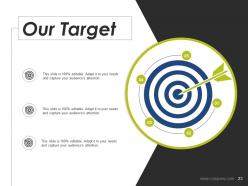
Slide 23: This is Our Target slide with imagery. State them here.
Slide 24: This is a Thank You slide with Address# street number, city, state, Email Address, Contact Numbers.
New market penetration analysis powerpoint presentation slides with all 24 slides:
Earn your bread and butter with our New Market Penetration Analysis Powerpoint Presentation Slides. They ensure good cash flow.





FAQs for New market penetration analysis
Look, pricing's your first move - undercut them where you can to grab their customers. Then blast your marketing everywhere and find new places to sell your stuff. Distribution matters more than people think, honestly. Don't ignore actually making your product better too, that's what seals the deal sometimes. The whole game is about making it obvious why someone should pick you instead of them. I'd start by figuring out where they're screwing up and go hard after those weak spots with some focused campaigns.
Honestly, I'd start with your current customers - figure out who's already buying and what they have in common. Then scope out your competitors' people because let's be real, you're trying to steal their customers anyway! Surveys and social media data help, but don't overthink it. Look for groups that aren't getting what they need or are price-sensitive. The sweet spot? Finding people who already want your stuff but aren't buying from you yet. Focus on segments where you can actually win without changing everything about your product or pricing.
Pricing's huge for market penetration - you're basically going in guns blazing with low prices to steal market share fast. Set prices under competitors, sometimes even below what it costs you to make the thing. Sounds crazy but it works. Short-term profits take a hit, obviously. The trick is knowing when to bump prices back up once you've got your foot in the door. Your bank account needs to survive those early losses though - I've seen companies crash and burn on this strategy. Oh, and don't just be the "cheap option" forever. Build some actual value so customers don't bail when you raise prices later.
Start with your top 3 competitors and dig into everything - pricing, messaging, how they sell stuff. Their one-star reviews are pure gold honestly, customers literally tell you what sucks. Look at customer complaints too, that's where you'll find gaps they're missing. Figure out their strengths so you can either copy what works or go completely different. I always check if they're overpriced first because that's usually the easiest way in. Position yourself as the fix for whatever they're screwing up. Do this deep dive this week while you're motivated.
Keep your branding super consistent everywhere - logo, colors, messaging, the whole thing. People should recognize you instantly whether they see you on Instagram or a random billboard. Partner with local influencers who already have your audience's trust (word-of-mouth still crushes fancy ads, honestly). Find spots your competitors aren't hitting yet. Content marketing's huge too - share stuff that makes you look like the expert. Oh, and start tracking brand awareness metrics now or you'll never know what's actually working. It's boring but necessary.
Look, customer feedback is pure gold for figuring out market penetration. It shows you what's actually working vs. what's bombing. Use it to tweak your positioning and figure out which segments to hit next. Seriously, I can't tell you how many companies just ignore this stuff and then act shocked when nobody buys. The patterns you'll see help you adjust messaging, pricing, maybe even product features. Oh, and barriers - feedback reveals why people aren't adopting your thing. Start collecting it from day one and don't just file it away somewhere.
Market share growth is your main thing to watch - shows you're actually getting somewhere. Also track how fast you're getting new customers and what it's costing you. Revenue from existing markets matters too, obviously. Customer lifetime value is huge though - way more telling than people realize. Same with repeat purchases. Those two will show you if this whole thing is actually working long-term or just looks good on paper. Throw these in a basic dashboard, check monthly. That way you can change course fast if needed.
Honestly, tech just makes everything bigger and more targeted. Social media ads let you get crazy specific with who sees your stuff, and SEO pulls in people already searching for what you sell. Email automation is clutch for nurturing leads without burning out your team. Analytics are probably the most important part though - they'll show you what's actually working vs what's just eating your budget. CRM systems and chatbots handle the flood of new inquiries too. My advice? Pick 2-3 channels where your customers actually hang out, then go all-in on whatever performs best.
Honestly, the biggest trap is cutting prices before you actually know your numbers - saw a startup basically bleed out doing this last year. Also don't try to target everyone right away, that's such a rookie move. Pick a small segment and crush it first. Your competitors will definitely hit back hard, especially if you're messing with their main revenue streams. Oh and here's something people always screw up - they get obsessed with acquiring customers but then can't keep them around. You need decent onboarding ready before you start this whole thing.
Dude, your sales team training is huge for breaking into new markets. They can't just wing it with their normal pitch - that'll bomb hard. You need them to really get the local pain points and how people actually buy in that market. Run some solid workshops before you launch covering the messaging that'll actually land with this new crowd. Objection handling too, because they'll face different pushback. Then keep checking in regularly to see what's working and what isn't. Honestly, skip this step and you're just throwing money at the wall hoping something sticks.
Dude, quality is everything when you're trying to break into a market. Like, you can't just wing it with a mediocre product and hope for the best. You need to either beat the competition's quality at the same price or match it for less. Word travels fast when something sucks - I've watched companies completely tank because they rushed to market with garbage. Your customers will bail immediately and you'll just hemorrhage money on acquisition. Honestly, fix your quality first before you even think about scaling up. Way easier than trying to dig yourself out of a reputation hole later.
Partnerships are honestly a game changer - you basically get instant access to their customer base without having to build trust from scratch. Their audience already knows and trusts them, so when they recommend you, it doesn't feel pushy. You can split marketing costs too, which is huge when you're trying to stretch budget. The trick is finding companies that serve your same customers but aren't competing with you directly. Like, if you sell fitness gear, maybe partner with a nutrition app or meal delivery service. Map out who's already talking to your ideal customers, then brainstorm ways you can help each other out. Win-win deals are way easier to pitch.
Honestly, it depends so much on your industry. Tech companies usually go with freemium or crazy low pricing to hook users fast. Luxury brands? Complete opposite - they keep prices high to stay exclusive. FMCG is all about getting everywhere and throwing coupons at people (seriously, cereal companies never stop). B2B is more about building relationships and proving you'll make them money. The real trick is figuring out how your customers actually buy stuff and what's stopping them. Check what your competitors are doing first, then find the holes you can squeeze into.
Honestly, stick with market penetration if you're not dominating your space yet. Way cheaper and safer than jumping into new stuff. Better pricing, smarter distribution, stronger marketing - that's where your energy should go first. Diversification? Save it for later when you've actually got decent market share and things start slowing down. I've seen too many companies get distracted by what everyone else is doing instead of nailing their core business first. Check your current share and growth numbers - they'll tell you which direction to go. Don't overthink it.
Look, you gotta stay flexible with your market strategy because things change fast. Maybe you start focused on low prices, then suddenly everyone wants premium quality instead. Digital channels might become huge overnight - who saw that pandemic shift coming? Monitor your market data religiously and be ready to pivot your pricing or how you reach customers. Sometimes you'll completely flip your approach, like when sustainability became this massive thing everyone cared about. Set up monthly trend reviews with your team so you catch changes early. Trust me, spotting shifts before competitors do makes all the difference.
No Reviews