New Processes Implementation Flow For Manufacturing
Try Before you Buy Download Free Sample Product
Audience
Editable
of Time
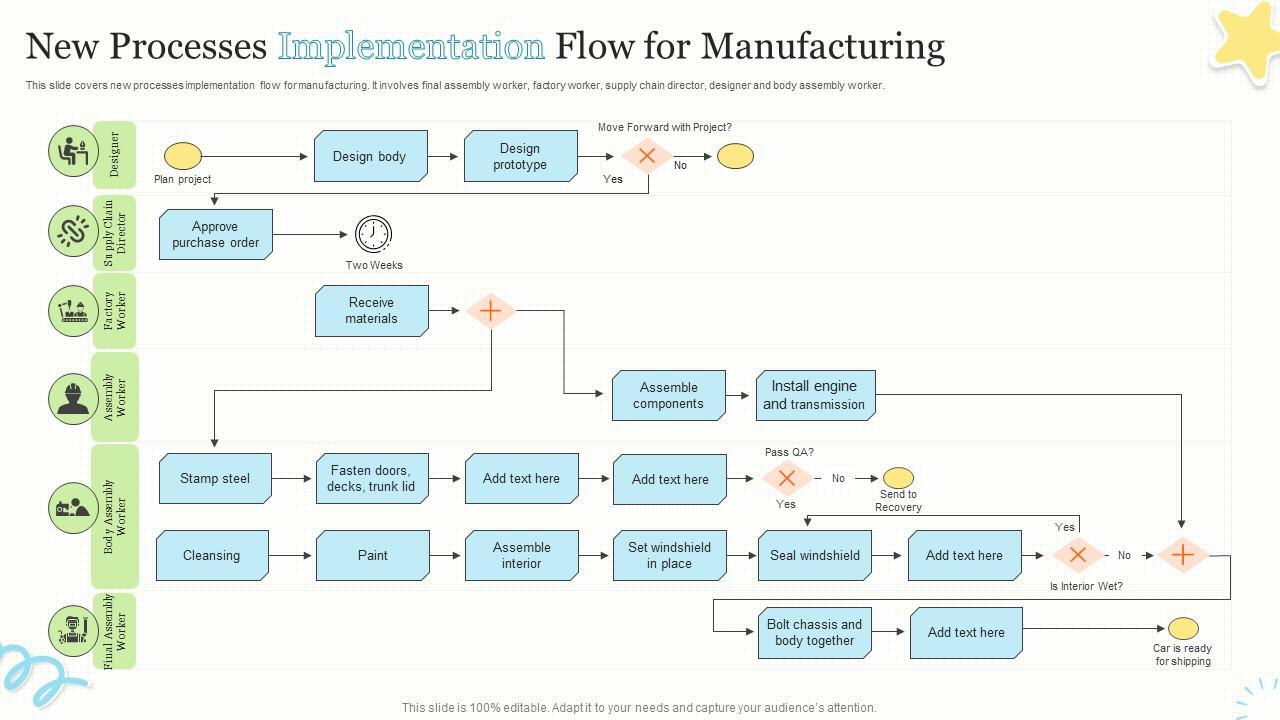
This slide covers new processes implementation flow for manufacturing. It involves final assembly worker, factory worker, supply chain director, designer and body assembly worker.
People who downloaded this PowerPoint presentation also viewed the following :
New Processes Implementation Flow For Manufacturing with all 6 slides:
Use our New Processes Implementation Flow For Manufacturing to effectively help you save your valuable time. They are readymade to fit into any presentation structure.
FAQs for New Processes Implementation
Key manufacturing process implementation stages include planning and design, resource allocation, pilot testing, full-scale deployment, and continuous monitoring. These stages streamline operations by establishing clear workflows, optimizing equipment utilization, and minimizing production bottlenecks, with many manufacturing organizations finding that systematic implementation ultimately delivers enhanced operational efficiency and competitive advantage.
Technology advancements significantly enhance manufacturing process efficiency by automating repetitive tasks, optimizing resource allocation, and enabling real-time monitoring of production lines. Through AI-driven predictive maintenance and IoT sensors, manufacturers streamline operations, reduce downtime, and minimize waste, with automotive and electronics companies finding that these innovations ultimately deliver faster production cycles and substantial cost reductions.
Lean manufacturing streamlines process implementation by eliminating waste, optimizing workflows, and enhancing operational efficiency through continuous improvement methodologies. This approach enables manufacturers to reduce production costs, minimize lead times, and improve quality control, with many automotive and electronics companies finding that Lean principles ultimately deliver competitive advantage and scalable growth.
Companies can effectively assess their current manufacturing processes through comprehensive data analysis, workflow mapping, performance benchmarking, quality audits, and employee feedback collection. These evaluation methods enable manufacturers to identify bottlenecks, inefficiencies, and improvement opportunities by comparing actual performance against industry standards, ultimately streamlining operations and enhancing competitive advantage in an increasingly demanding market.
Manufacturing equipment selection requires evaluating production capacity, cost efficiency, technology compatibility, maintenance requirements, and scalability potential. These factors work together to optimize operational performance, with many manufacturers finding that strategic equipment choices significantly reduce production costs, enhance product quality, and deliver competitive advantages in increasingly demanding markets.
**INPUT**: What are the common challenges faced during process implementation in manufacturing? **OUTPUT**: Common challenges include resistance to change, inadequate training, integration complexities with existing systems, resource allocation constraints, and maintaining quality standards during transitions. While these obstacles present initial hurdles, many manufacturing organizations find that strategic planning, phased rollouts, and comprehensive staff training ultimately deliver enhanced operational efficiency, reduced costs, and stronger competitive positioning in an increasingly automated landscape. [Word count: 60]
Employee training significantly impacts manufacturing process implementation by reducing errors, accelerating adoption timelines, and ensuring consistent quality standards across production lines. Well-trained teams enable smoother transitions during system upgrades, minimize costly downtime, and enhance operational efficiency, with many manufacturing organizations finding that comprehensive training programs ultimately deliver faster ROI and stronger competitive positioning in increasingly automated industrial environments.
Manufacturing process mapping methodologies include value stream mapping, flowcharting, SIPOC diagrams, process discovery workshops, and lean mapping techniques. These approaches streamline operations by identifying bottlenecks, eliminating waste, and optimizing resource allocation, with many manufacturing organizations finding that systematic mapping reduces production costs while enhancing operational efficiency and product quality.
Data analytics improves decision-making in process implementation by providing real-time insights into operational efficiency, identifying bottlenecks before they impact production, and enabling predictive maintenance scheduling. Through advanced analytics platforms, manufacturing organizations can optimize resource allocation, reduce downtime by up to 30%, and enhance quality control, with many facilities finding that data-driven approaches deliver faster implementation timelines and measurable cost reductions.
Manufacturing scalability strategies include modular production systems, flexible automation technologies, standardized processes, strategic supplier partnerships, and data-driven capacity planning. These approaches enable manufacturers to adjust output efficiently through streamlined workflows, automated quality control, and optimized resource allocation, with many industrial companies finding that strategic technology investments ultimately deliver faster production cycles, reduced costs, and enhanced competitive advantage in dynamic markets.
Regulatory requirements significantly shape process implementation by dictating compliance standards, safety protocols, documentation procedures, and quality control measures across industries. Industries like pharmaceuticals require FDA validation processes, while financial services must meet SOX compliance, and manufacturing follows ISO standards, with organizations finding that early regulatory integration streamlines approvals and reduces costly redesigns.
Manufacturing waste reduction best practices include lean manufacturing principles, just-in-time production, predictive maintenance, material optimization, and employee training programs. These strategies streamline operations by eliminating overproduction, reducing material consumption, and preventing equipment downtime, with many manufacturing organizations finding that systematic waste reduction delivers significant cost savings, enhanced operational efficiency, and improved environmental compliance in increasingly competitive markets.
Supplier collaboration enhances manufacturing through shared forecasting, joint product development, integrated quality systems, and real-time communication platforms. These strategic partnerships streamline supply chains, reduce lead times, and improve material quality, with automotive and electronics manufacturers finding that collaborative relationships ultimately deliver cost reductions, faster time-to-market, and enhanced operational efficiency.
Continuous improvement in manufacturing is essential for maintaining competitive advantage, reducing waste, optimizing efficiency, and adapting to evolving market demands and technologies. Through systematic approaches like lean manufacturing and Six Sigma, organizations streamline operations, minimize defects, and enhance product quality, with many manufacturers finding that consistent refinement ultimately delivers cost reduction and sustainable growth.
Manufacturers can manage supply chain disruptions during process implementation through diversified supplier networks, real-time monitoring systems, flexible inventory strategies, and contingency planning protocols. These approaches enable companies to maintain operational continuity while transitioning processes, with many manufacturing organizations finding that proactive risk assessment and supplier relationship management ultimately deliver enhanced resilience and competitive advantage.
-
They had the topic I was looking for in a readymade presentation…helped me meet my deadline.Â
-
They helped us design the pamphlets for our church’s food drive! The people loved the design, and I’m happy to say it was successful. Thank you, SlideTeam!