

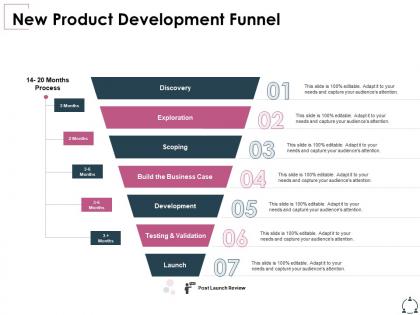
New product development funnel business case ppt powerpoint presentation ideas




Try Before you Buy Download Free Sample Product
 Impress Your
 Audience
 100%
100% Editable
 Save Hours
 of Time


Our New Product Development Funnel Business Case Ppt Powerpoint Presentation Ideas are topically designed to provide an attractive backdrop to any subject. Use them to look like a presentation pro.
People who downloaded this PowerPoint presentation also viewed the following :
New product development funnel business case ppt powerpoint presentation ideas with all 2 slides:
Use our New Product Development Funnel Business Case Ppt Powerpoint Presentation Ideas to effectively help you save your valuable time. They are readymade to fit into any presentation structure.
FAQs for New product development funnel business case ppt
The key stages in the new product development funnel include idea generation, concept development, market research, prototype creation, testing and validation, and commercialization. These stages streamline innovation by systematically filtering concepts, validating market demand, and minimizing risk, with many organizations finding that this structured approach accelerates time-to-market while enhancing product success rates.
Market research and customer feedback fundamentally shape the early product development funnel by identifying unmet needs, validating market demand, and defining target customer segments before significant resources are invested. Through comprehensive market analysis and direct customer insights, companies can refine product concepts, prioritize features, and minimize development risks, ultimately delivering solutions that resonate with their intended audience and achieve stronger market adoption.
Cross-functional collaboration ensures seamless progression through the new product development funnel by integrating diverse expertise, aligning strategic objectives, and accelerating decision-making at each stage. Teams combining R&D, marketing, operations, and finance deliver more comprehensive market solutions, reduce development cycles, and minimize costly revisions, with many organizations finding that collaborative approaches ultimately enhance product-market fit and competitive advantage.
Organizations measure new product development funnel effectiveness through conversion rates between stages, time-to-market metrics, resource utilization efficiency, and revenue generated from launched products. These measurements enable teams to identify bottlenecks, optimize resource allocation, and streamline processes, with many companies finding that data-driven funnel analysis reduces development cycles by 20-30% while improving market success rates.
Strategies to minimize product development bottlenecks include cross-functional collaboration, parallel processing workflows, automated testing protocols, clear milestone definitions, and resource allocation optimization. These approaches streamline development cycles by reducing handoff delays, accelerating feedback loops, and eliminating redundant approval stages, with many organizations finding that strategic workflow redesign ultimately delivers faster time-to-market and enhanced competitive positioning.
Prototyping and testing enable organizations to identify design flaws, validate market demand, and refine functionality before full-scale production, significantly reducing costly post-launch failures. Through iterative testing phases, companies can gather user feedback, optimize features, and assess manufacturing feasibility, with many finding that early validation ultimately delivers faster time-to-market and higher success rates.
Idea validation in the initial stages prevents costly development of products that lack market demand, ensuring resources are allocated to viable concepts with genuine customer need and commercial potential. Through market research, prototype testing, and customer feedback, organizations can identify promising opportunities early, minimize development risks, and accelerate time-to-market, ultimately delivering products with higher success rates.
Organizations prioritize ideas through structured evaluation frameworks that assess market potential, technical feasibility, resource requirements, strategic alignment, and competitive differentiation at each funnel stage. These criteria enable companies to systematically filter concepts, with many finding that balancing quantitative metrics like ROI projections with qualitative factors such as brand fit ultimately delivers stronger product portfolios and more efficient resource allocation.
Innovation serves as the primary catalyst for product success by differentiating offerings, addressing unmet market needs, and creating competitive advantages throughout the development funnel. It enables organizations to streamline development processes, reduce time-to-market, and enhance customer experiences, with many companies finding that strategic innovation ultimately delivers higher market adoption rates and sustained revenue growth.
Technology and software tools enhance the new product development funnel by streamlining ideation through collaborative platforms, accelerating prototyping with CAD and 3D modeling, and automating testing processes. These solutions enable faster market validation, reduce development costs, and improve cross-functional collaboration, with many organizations finding that integrated development platforms deliver shorter time-to-market and enhanced competitive positioning.
Common challenges include inadequate market research, insufficient cross-functional communication, resource allocation conflicts, unclear decision criteria, and poor stakeholder alignment between stages. These transition bottlenecks often result in delayed timelines, increased development costs, and compromised product quality, with many organizations finding that implementing structured gate reviews and dedicated transition protocols significantly streamlines their development process.
Feedback loops can be established through systematic data collection at each funnel stage, regular cross-functional reviews, customer feedback integration, and performance metrics tracking. Organizations in sectors like tech and consumer goods find that implementing structured retrospectives, stakeholder surveys, and iterative testing cycles enables continuous refinement, ultimately delivering more efficient development processes and improved product outcomes.
Defining clear success metrics at each stage enables organizations to measure progress objectively, identify bottlenecks early, and make data-driven decisions about resource allocation and project continuation. These metrics streamline the development process by providing measurable benchmarks for concept validation, prototype testing, and market readiness, ultimately reducing time-to-market and increasing launch success rates across industries.
Companies ensure alignment by establishing clear strategic objectives at each funnel stage, implementing regular cross-functional reviews between leadership and development teams, and using data-driven metrics that directly measure business impact. Through integrated planning processes, organizations can continuously validate product features against market demands and revenue goals, while maintaining transparent communication channels that enable rapid pivots, ultimately delivering products that drive competitive advantage and measurable business outcomes.
Creating a culture of continuous improvement requires establishing regular retrospectives, cross-functional collaboration, data-driven decision making, iterative feedback loops, and employee empowerment initiatives. These practices streamline product development by encouraging experimentation, reducing time-to-market, and enhancing team accountability, with many organizations finding that fostering psychological safety and celebrating learning from failures ultimately delivers stronger innovation outcomes and sustained competitive advantage.
-
I discovered this website through a google search, the services matched my needs perfectly and the pricing was very reasonable. I was thrilled with the product and the customer service. I will definitely use their slides again for my presentations and recommend them to other colleagues.
-
Unique and attractive product design.
-
Innovative and attractive designs.
-
Good research work and creative work done on every template.
-
Wonderful templates design to use in business meetings.