

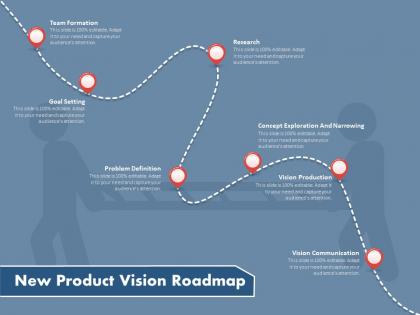
New product vision roadmap





Try Before you Buy Download Free Sample Product
 Impress Your
 Audience
 100%
100% Editable
 Save Hours
 of Time


Our New Product Vision Roadmap are explicit and effective. They combine clarity and concise expression.
People who downloaded this PowerPoint presentation also viewed the following :
New product vision roadmap with all 2 slides:
Give your audience a fulfilling experience. They will find our New Product Vision Roadmap elevating.
FAQs for New
A product roadmap serves as a strategic communication tool that aligns teams, stakeholders, and resources around shared product vision, priorities, and timelines. It enables organizations to coordinate development efforts, manage stakeholder expectations, and make informed resource allocation decisions, while providing transparency into product evolution and market positioning, ultimately delivering strategic alignment and competitive advantage across departments.
Feature prioritization on product roadmaps typically involves evaluating customer impact, business value, technical feasibility, and strategic alignment with company objectives. Successful product teams use frameworks like RICE scoring, MoSCoW method, or value-versus-effort matrices, with many technology companies finding that regular stakeholder feedback and market analysis enable more accurate prioritization, ultimately delivering higher customer satisfaction and competitive advantage.
Key components of an effective product roadmap include strategic objectives, feature prioritization, timeline milestones, resource allocation, and stakeholder alignment mechanisms. These elements work together by providing clear direction, managing expectations, and facilitating cross-functional coordination, with many product teams finding that well-structured roadmaps ultimately deliver faster time-to-market and enhanced competitive positioning.
A product roadmap focuses on strategic goals, market opportunities, feature priorities, and long-term vision, while a project timeline emphasizes specific tasks, deadlines, and execution details. Product roadmaps guide what to build and why, enabling teams to adapt to market changes and customer feedback, whereas project timelines streamline delivery schedules, ultimately ensuring strategic alignment with operational efficiency.
Customer feedback serves as a critical input for product roadmap prioritization, feature validation, market alignment, and strategic direction setting. Through surveys, user interviews, and usage analytics, product teams can identify pain points, validate assumptions, and prioritize development efforts that deliver maximum customer value, ultimately ensuring roadmap decisions drive user satisfaction and competitive advantage.
Product roadmaps should be updated quarterly as a baseline, with more frequent adjustments during periods of significant market shifts, customer feedback, or strategic pivots. Many successful organizations review their roadmaps monthly to incorporate new insights, competitive developments, and changing priorities, ultimately ensuring alignment with business objectives while maintaining stakeholder confidence and operational agility.
Popular product roadmap tools include ProductPlan, Roadmunk, Aha!, Monday.com, and Asana, each offering different visualization and collaboration capabilities. These platforms streamline roadmap creation through drag-and-drop interfaces, real-time collaboration, and integration with development tools, with many product teams finding that cloud-based solutions enhance cross-functional alignment and accelerate decision-making processes.
A product roadmap aligns with company objectives by mapping features and releases to strategic goals, revenue targets, market positioning, and customer outcomes. Through quarterly milestone reviews and cross-functional planning, organizations ensure product development supports broader business vision, with many companies finding that structured alignment processes deliver measurable growth and competitive advantage.
Common product roadmap challenges include conflicting stakeholder priorities, resource constraints, market uncertainty, technical limitations, and changing customer requirements. These obstacles can derail strategic planning by creating scope creep, timeline delays, and misaligned expectations, with many organizations finding that insufficient communication and unrealistic goal-setting ultimately compromise product development efficiency and competitive positioning.
Teams should communicate product roadmap changes through regular updates, transparent explanations of reasoning, impact assessments, and revised timelines with clear documentation. These approaches enhance stakeholder trust by providing context for decisions, managing expectations proactively, and maintaining alignment across departments, with many organizations finding that consistent communication reduces project friction and strengthens strategic buy-in.
Best practices for visualizing product roadmap presentations include using clear timelines, color-coded priorities, milestone markers, feature groupings, and stakeholder-specific views. These visualization techniques streamline communication by highlighting strategic initiatives, dependencies, and deliverables, with many organizations finding that well-designed roadmap presentations enhance stakeholder alignment, accelerate decision-making, and ultimately deliver greater project transparency and executive buy-in.
Agile methodologies transform product roadmap development by emphasizing iterative planning, continuous customer feedback integration, and adaptive prioritization based on market changes. Through shorter sprint cycles and regular stakeholder reviews, product teams can pivot strategies more quickly, respond to user needs dynamically, and deliver incremental value while maintaining strategic alignment with evolving business objectives.
Cross-departmental collaboration is essential for creating effective product roadmaps, as it ensures alignment between engineering, marketing, sales, and customer success teams while incorporating diverse perspectives and constraints. This collaborative approach enables organizations to prioritize features more strategically, reduce development conflicts, and deliver products that meet both technical feasibility and market demands, ultimately accelerating time-to-market.
Product roadmap success metrics include user adoption rates, feature utilization statistics, revenue growth indicators, customer satisfaction scores, and time-to-market measurements. These metrics enable product teams to assess strategic alignment, resource allocation effectiveness, and competitive positioning, with many organizations finding that combining quantitative performance data with qualitative customer feedback delivers comprehensive insights for roadmap optimization.
A product roadmap supports startup scaling by aligning development priorities with growth objectives, coordinating team efforts across expanding departments, and ensuring resource allocation matches strategic milestones. Through clear feature prioritization and timeline visibility, startups can communicate progress to investors, onboard new team members efficiently, and pivot strategically while maintaining focus, ultimately delivering consistent product evolution that supports rapid business expansion.
No Reviews