

New Software Development Process Stages




Try Before you Buy Download Free Sample Product
 Impress Your
Audience
 100%
Editable
 Save Hours
of Time


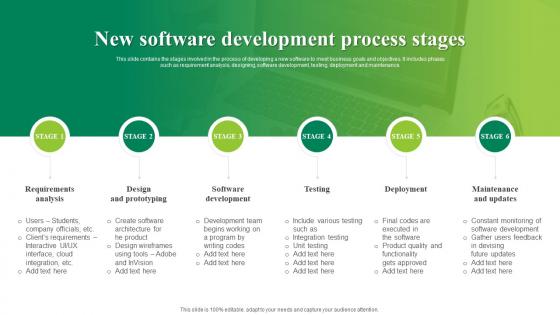
This slide contains the stages involved in the process of developing a new software to meet business goals and objectives. It includes phases such as requirement analysis, designing, software development, testing, deployment and maintenance.
People who downloaded this PowerPoint presentation also viewed the following :
New Software Development Process Stages with all 6 slides:
Use our New Software Development Process Stages to effectively help you save your valuable time. They are readymade to fit into any presentation structure.






FAQs for New Software
The key phases in the software development lifecycle include planning and requirements analysis, system design, implementation and coding, testing, deployment, and maintenance. These phases streamline project delivery by establishing clear objectives, creating scalable architectures, and ensuring quality assurance, with many organizations finding that structured SDLC approaches significantly reduce development costs while accelerating time-to-market.
Requirement gathering directly influences software project success by establishing clear project scope, identifying stakeholder needs, minimizing costly changes during development, and ensuring alignment between technical solutions and business objectives. Through comprehensive requirement analysis, development teams can reduce project risks, accelerate delivery timelines, and enhance user satisfaction, with many organizations finding that thorough upfront planning ultimately delivers higher ROI and competitive advantage.
Software development methodologies include Agile, Waterfall, DevOps, Scrum, Lean, and Kanban, each offering distinct approaches to project management and delivery cycles. These methodologies enhance development efficiency by streamlining collaboration, accelerating deployment timelines, and improving quality control, with many organizations finding that strategic combinations deliver faster time-to-market and competitive advantage.
Software prototypes aid development by enabling early visualization, facilitating stakeholder feedback, identifying design flaws, and reducing costly late-stage revisions. Through interactive mockups and proof-of-concept models, development teams streamline requirements gathering, enhance user experience design, and accelerate iteration cycles, with many organizations finding that prototyping ultimately delivers faster time-to-market and improved product quality.
User stories play a crucial role in translating business needs into actionable development requirements by capturing functionality from the end-user's perspective, defining acceptance criteria, and prioritizing features based on user value. They enable development teams to maintain user-centric focus throughout the project lifecycle, with many organizations finding that this approach streamlines communication between stakeholders and developers, ultimately delivering more intuitive software solutions.
Version control systems enhance collaboration by enabling multiple developers to work simultaneously on the same codebase, tracking all changes with detailed histories, and managing code merges seamlessly. Through platforms like Git, development teams streamline conflict resolution, maintain project transparency, and accelerate deployment cycles, with many software organizations finding that structured version control ultimately delivers faster product releases and significantly improved code quality across distributed teams.
Agile methodology transforms traditional software development stages by introducing iterative cycles, continuous feedback loops, and adaptive planning throughout the development process. This approach enables development teams to deliver working software faster, respond to changing requirements more effectively, and maintain closer collaboration with stakeholders, ultimately reducing project risks while enhancing product quality and customer satisfaction.
Testing in waterfall occurs during dedicated phases after development completion, involving comprehensive system testing, user acceptance testing, and extensive documentation. Agile integrates continuous testing throughout development cycles, with automated unit tests, sprint-based testing, and iterative feedback loops, enabling faster bug detection and resolution while maintaining quality standards across shorter development iterations.
Best practices for documenting software development stages include maintaining comprehensive requirements specifications, detailed design documents, code comments and API documentation, thorough testing protocols, and deployment guides. These documentation standards streamline collaboration between development teams, ensure knowledge transfer continuity, and accelerate onboarding processes, with many organizations finding that systematic documentation ultimately reduces maintenance costs and enhances long-term project scalability.
Teams should prioritize features by evaluating business value, user impact, technical complexity, and resource requirements, while considering market demands and strategic objectives. Through methods like user story mapping, MoSCoW prioritization, and stakeholder feedback sessions, development teams can balance customer needs with technical constraints, ultimately delivering maximum value incrementally and maintaining competitive advantage in dynamic markets.
Effective project management techniques in software development include Agile methodologies, sprint planning, risk assessment, resource allocation, and continuous integration practices. These approaches streamline workflows by enhancing team collaboration, minimizing bottlenecks, and accelerating delivery timelines, with many organizations finding that strategic implementation ultimately delivers improved product quality and competitive advantage.
Deployment strategies significantly influence post-launch support by determining rollback capabilities, monitoring effectiveness, and issue resolution speed. Blue-green and canary deployments enable faster problem identification and seamless reversions, while gradual rollouts help support teams manage user feedback systematically, ultimately reducing support ticket volumes and enhancing system stability across enterprise environments.
Software maintenance ensures long-term functionality, security, and performance after deployment through bug fixes, updates, feature enhancements, and system optimization. This critical phase typically consumes 60-70% of total software costs, with many organizations finding that proactive maintenance strategies significantly reduce downtime, enhance user satisfaction, and extend application lifespan while maintaining competitive advantage.
Feedback loops enhance software development by enabling rapid identification of issues, facilitating iterative refinements, and ensuring alignment with user requirements throughout development cycles. Through continuous integration, automated testing, and user feedback mechanisms, development teams streamline debugging processes, accelerate feature deployment, and deliver more reliable products, with many organizations finding that these practices significantly reduce time-to-market while improving overall software quality.
Ethical considerations include user privacy protection, data security implementation, algorithmic bias prevention, accessibility compliance, and transparent functionality disclosure. These principles help developers create responsible software by safeguarding personal information, ensuring fair outcomes across diverse user groups, and maintaining trust, with many technology companies finding that ethical practices ultimately deliver stronger user relationships and competitive advantage.
-
The templates are handy and I can personalize them as per my needs. Glad to be your subscriber!
-
Templates are beautiful and easy to use. An amateur can also create a presentation using these slides. It is amazing.