

Nikes Market Positioning Strategy With Customer Pain Points Successful Product Positioning Guide





Try Before you Buy Download Free Sample Product
 Impress Your
Audience
 100%
Editable
 Save Hours
of Time


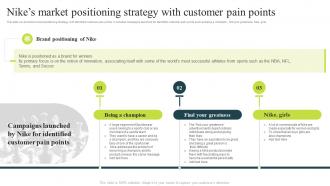
This slide covers Nikes brand positioning strategy with identified customer pain points. It includes campaigns launched for identified customer pain points such as being a champion, find your greatness, Nike, girls.
People who downloaded this PowerPoint presentation also viewed the following :
Nikes Market Positioning Strategy With Customer Pain Points Successful Product Positioning Guide with all 6 slides:
Use our Nikes Market Positioning Strategy With Customer Pain Points Successful Product Positioning Guide to effectively help you save your valuable time. They are readymade to fit into any presentation structure.





FAQs for Nikes Market Positioning Strategy With Customer Pain Points Successful
Nike's unique value propositions include superior athletic performance technology, innovative design aesthetics, powerful emotional storytelling through "Just Do It," exclusive athlete partnerships, and premium brand prestige. These differentiators work together by creating aspirational connections with consumers, driving product innovation, and establishing cultural relevance, with many athletes and fitness enthusiasts finding that Nike delivers both functional excellence and lifestyle status.
Nike leverages brand storytelling by creating emotional narratives around athletic achievement, perseverance, and personal transformation that resonate deeply with consumers across demographics. Through campaigns featuring inspiring athlete journeys, breakthrough moments, and "Just Do It" messaging, Nike transforms product marketing into aspirational storytelling, ultimately building stronger brand loyalty and commanding premium pricing in an increasingly competitive athletic market.
Nike segments markets through psychographic targeting (lifestyle and athletic identity), demographic divisions (age, gender, income), geographic customization (regional preferences and cultural nuances), and behavioral patterns (usage frequency, brand loyalty levels). These segmentation strategies enable Nike to deliver tailored product lines, personalized marketing campaigns, and targeted retail experiences across diverse consumer groups, ultimately driving brand relevance and market penetration in an increasingly competitive athletic apparel landscape.
Nike's premium pricing strategy reflects its positioning through consistently higher price points than competitors, limited edition releases, and price premiums for innovative technologies like Air Max and Flyknit. This approach reinforces brand exclusivity while signaling superior quality and performance, with many consumers viewing higher prices as validation of Nike's athletic innovation and status appeal, ultimately delivering both aspirational brand equity and sustained profit margins.
Innovation and technology serve as Nike's primary differentiation pillars, encompassing advanced materials like Flyknit and React foam, data-driven performance apps, and smart manufacturing processes. These technological investments enable Nike to command premium pricing, attract tech-savvy consumers, and maintain competitive advantages in performance athletics, with many retailers finding that innovation-focused brands drive significantly higher customer loyalty and market share.
Nike adapts its global marketing by localizing campaigns to reflect cultural values, regional sports preferences, and local athletes while maintaining core brand pillars of performance, innovation, and inspiration. Through strategic partnerships with regional influencers, country-specific product launches, and culturally relevant messaging, Nike delivers consistent brand experience across markets, with many international divisions finding that this balanced approach enhances local relevance while preserving global brand equity and competitive advantage. **Word count: 60**
**INPUT**: What impact does sponsorship of athletes and teams have on Nike's brand positioning? **OUTPUT**: Athlete and team sponsorships significantly enhance Nike's brand positioning by creating emotional connections, driving aspirational appeal, and establishing credibility across diverse sports markets. Through strategic partnerships with elite performers like LeBron James and Serena Williams, Nike delivers authentic storytelling, global visibility, and competitive differentiation, with many consumers ultimately associating the brand with peak performance and athletic excellence. [Word count: 60 words]
Social media has revolutionized Nike's market positioning by enabling direct consumer engagement, real-time brand storytelling, and personalized marketing campaigns that amplify their athletic excellence narrative. Through platforms like Instagram and Twitter, Nike leverages influencer partnerships, user-generated content, and targeted advertising to create authentic connections, ultimately delivering enhanced brand loyalty and competitive advantage in an increasingly digital marketplace.
Nike's sustainability initiatives enhance brand positioning by attracting environmentally conscious consumers, differentiating from competitors, and aligning with global environmental trends. These programs, including circular design and carbon neutrality goals, enable Nike to capture younger demographics, strengthen premium market positioning, and build long-term brand loyalty, ultimately delivering competitive advantage in an increasingly sustainability-focused marketplace.
Nike's celebrity endorsements align strategically with its aspirational brand identity by partnering with elite athletes like Michael Jordan, LeBron James, and Serena Williams who embody excellence, determination, and peak performance. These partnerships resonate deeply with Nike's target demographics across sports enthusiasts, young consumers, and lifestyle-focused segments, while reinforcing the brand's "Just Do It" ethos and premium positioning in an increasingly competitive athletic market.
Nike leverages customer feedback through social media monitoring, product reviews, athlete partnerships, and direct consumer surveys to continuously refine its positioning strategy. This feedback enables Nike to adjust messaging around performance innovation, adapt product development priorities, and enhance brand storytelling, with many campaigns increasingly reflecting authentic consumer experiences and aspirations, ultimately strengthening market differentiation.
Nike's CSR commitment enhances brand perception by demonstrating environmental stewardship, promoting social equity, and supporting community development initiatives. Through sustainable manufacturing practices, diversity programs, and youth sports investments, Nike builds consumer trust, attracts socially conscious customers, and differentiates itself from competitors, ultimately delivering stronger brand loyalty and market positioning.
Nike leverages integrated digital marketing, high-profile athlete endorsements, experiential retail stores, and strategic social media campaigns to communicate its premium athletic positioning. Through partnerships with elite athletes like LeBron James and Serena Williams, immersive Nike stores, and targeted digital content across platforms, the brand reinforces its innovation leadership while building emotional connections, ultimately delivering consistent brand experiences that resonate with diverse consumer segments globally.
Nike's market positioning has evolved from performance-focused athletics to purpose-driven lifestyle branding, emphasizing sustainability, social justice, and digital innovation while maintaining athletic excellence. Through strategic partnerships with influential athletes, direct-to-consumer digital platforms, and campaigns addressing social issues, Nike connects with younger demographics seeking authentic brand values, ultimately delivering enhanced customer loyalty and competitive advantage in an increasingly conscious marketplace.
Nike employs cross-promotional strategies including celebrity athlete endorsements, strategic partnerships with sports leagues, collaborations with fashion brands, music industry tie-ins, and lifestyle influencer campaigns. These approaches enable Nike to transcend traditional athletic markets by connecting with entertainment, fashion, and cultural sectors, ultimately delivering broader brand visibility and enhanced consumer engagement across diverse demographic segments.
-
Excellent products for quick understanding.
-
I can say with full confidence that all your business, academic, or professional work requirements will be sufficed with SlideTeam. Their gallery is as rich as 2Million+!!