

Objectives Of Search Engine Marketing Campaign Defining SEM Campaign Management




Try Before you Buy Download Free Sample Product
 Impress Your
 Audience
 100%
100% Editable
 Save Hours
 of Time


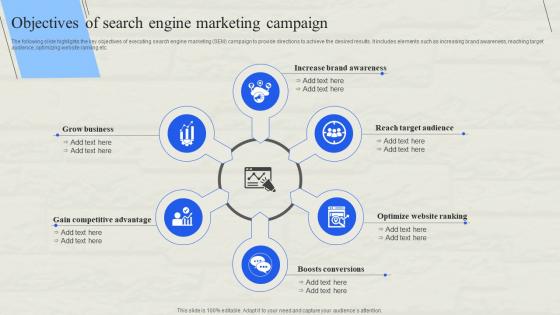
The following slide highlights the key objectives of executing search engine marketing SEM campaign to provide directions to achieve the desired results. It includes elements such as increasing brand awareness, reaching target audience, optimizing website ranking etc.
People who downloaded this PowerPoint presentation also viewed the following :
Objectives Of Search Engine Marketing Campaign Defining SEM Campaign Management with all 6 slides:
Use our Objectives Of Search Engine Marketing Campaign Defining SEM Campaign Management to effectively help you save your valuable time. They are readymade to fit into any presentation structure.





FAQs for Objectives Of Search Engine Marketing Campaign Defining
Primary SEM campaign objectives include increasing website traffic, generating qualified leads, boosting brand visibility, improving conversion rates, and maximizing return on advertising spend. These strategies enhance online presence by targeting specific keywords, demographics, and user behaviors, with many businesses finding that well-executed SEM campaigns deliver measurable revenue growth and competitive market positioning.
Businesses define SEM success through key performance indicators including click-through rates, conversion rates, cost-per-acquisition, return on ad spend, and quality scores across campaigns. These metrics enable organizations to measure revenue generation, brand visibility, and customer acquisition efficiency, with many companies finding that strategic SEM optimization ultimately delivers enhanced market positioning and sustainable competitive advantage.
Key SEM metrics include click-through rates, conversion rates, cost-per-click, quality scores, and return on ad spend. These indicators streamline campaign optimization by revealing audience engagement patterns, keyword effectiveness, and budget efficiency, with many digital marketers finding that comprehensive tracking ultimately delivers improved ROI and competitive advantage in increasingly crowded online markets.
Keyword research directly shapes SEM objectives by revealing search volume patterns, competitive landscapes, user intent signals, and conversion potential across different terms. Through comprehensive keyword analysis, businesses can set realistic traffic targets, optimize budget allocation for high-performing terms, and align campaign goals with actual market demand, ultimately delivering measurable ROI improvements and strategic competitive positioning.
Audience targeting enables SEM campaigns to reach specific demographics, interests, geographic locations, and behavioral patterns, significantly improving conversion rates and reducing acquisition costs. Through precise targeting parameters, businesses can deliver relevant ads to qualified prospects, minimize wasted spend on uninterested audiences, and ultimately achieve higher ROI while maximizing campaign effectiveness.
Businesses can balance brand awareness and direct response in SEM by implementing tiered campaign strategies, allocating budget across branded and generic keywords, utilizing different ad formats for varying funnel stages, and employing audience segmentation techniques. Through strategic bidding adjustments and performance tracking, companies in retail, finance, and healthcare streamline their marketing efforts while maximizing both visibility and conversions, ultimately delivering comprehensive market presence.
Ad copy and design significantly influence SEM campaign effectiveness by determining click-through rates, conversion rates, and overall user engagement with advertisements. Compelling headlines, clear value propositions, and visually appealing designs enhance user experience and drive qualified traffic, while A/B testing different creative elements enables marketers to optimize performance, reduce cost-per-click, and ultimately deliver higher ROI across search platforms.
Seasonal trends significantly reshape search engine marketing objectives by driving demand fluctuations, shifting keyword priorities, and requiring budget reallocation strategies. Retailers adjust campaigns for holiday shopping spikes, travel companies optimize for vacation seasons, and B2B organizations leverage fiscal year-end cycles, with many finding that seasonal alignment delivers higher conversion rates, improved ROI, and enhanced competitive positioning.
Landing page optimization significantly impacts SEM campaign success by improving conversion rates, reducing bounce rates, and maximizing return on advertising spend through targeted messaging and user experience enhancements. These optimizations streamline the customer journey from click to conversion, with many e-commerce and service businesses finding that well-optimized landing pages deliver higher quality scores, lower cost-per-click rates, and ultimately stronger campaign ROI.
A/B testing refines SEM campaign goals by systematically comparing ad variations, landing pages, keywords, and bidding strategies to identify highest-performing elements. Through controlled experiments, marketers can optimize click-through rates, conversion rates, and cost-per-acquisition while reducing wasted spend, with many organizations finding that continuous testing ultimately delivers 20-30% improvements in campaign ROI.
Budget allocation for SEM objectives requires strategic distribution across search and display advertising, keyword bidding, audience targeting, and performance optimization tools. Successful campaigns typically allocate 60-70% to high-converting search ads while reserving funds for testing new keywords and audiences, with many organizations finding that balanced investment across awareness and conversion goals ultimately delivers improved ROI and sustainable growth.
Common SEM pitfalls include poor keyword targeting, inadequate budget allocation, weak ad copy, insufficient landing page optimization, and neglecting mobile users. These issues streamline campaign failure by reducing click-through rates, increasing cost-per-acquisition, and diminishing conversion rates, with many businesses finding that addressing these fundamentals ultimately delivers improved ROI and competitive advantage.
Competitive analysis shapes SEM campaign goals by revealing competitor keyword strategies, ad positioning tactics, budget allocations, and market gaps that present opportunities for differentiation. Through competitor research, businesses can identify underserved keywords, optimize bidding strategies, and craft messaging that highlights unique value propositions, ultimately delivering enhanced market positioning and improved campaign ROI.
Algorithm changes can significantly reshape SEM objectives by altering keyword rankings, ad visibility, and quality score calculations, requiring marketers to pivot strategies around content relevance, user experience, and technical optimization. These shifts often push businesses toward more comprehensive approaches focusing on authentic engagement, mobile optimization, and long-term brand authority, ultimately delivering sustainable competitive advantages over quick-fix tactics.
Geographic targeting strategies significantly enhance SEM campaign effectiveness by enabling precise audience segmentation, localized ad content, regional bid adjustments, and market-specific keyword optimization. Through location-based targeting, businesses streamline ad spend efficiency, deliver more relevant customer experiences, and capture higher conversion rates, with many organizations finding that regional customization ultimately delivers stronger ROI and competitive advantage in local markets.
-
I took a chance with SlideTeam. I never looked back. Great products and great service.
-
Their professional templates are very impressive, even my manager was curious about the source. I am very grateful.