

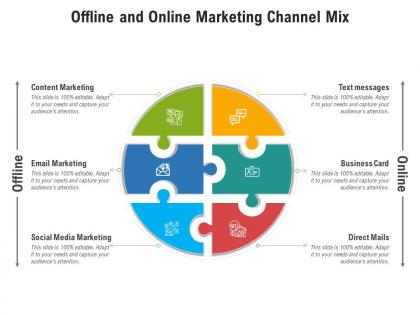
Offline and online marketing channel mix




Try Before you Buy Download Free Sample Product
 Impress Your
Audience
 100%
Editable
 Save Hours
of Time


Our Offline And Online Marketing Channel Mix are topically designed to provide an attractive backdrop to any subject. Use them to look like a presentation pro.
People who downloaded this PowerPoint presentation also viewed the following :
Offline and online marketing channel mix with all 2 slides:
Use our Offline And Online Marketing Channel Mix to effectively help you save your valuable time. They are readymade to fit into any presentation structure.


FAQs for Offline and online
Honestly? Pick 3-4 channels max where your customers actually hang out. I see people trying to be everywhere and it's just expensive chaos. Start by figuring out where your best customers found you originally - that's gold right there. Content marketing + social + email usually plays nice together. Keep your message consistent but don't obsess over it being identical everywhere. Track what's actually driving sales, not just clicks or whatever vanity metric looks good. Oh and don't spread your budget too thin - better to dominate a few channels than suck at everything.
Honestly, just figure out where your customers actually are first. Check your current data - which channels are bringing in the best leads? Yeah, digital is cheaper and easier to track, but if your people are still reading newspapers or whatever, don't ignore that. Try testing different splits like 70/30 between online and offline stuff. I'd probably start with a 90-day test of some new mix and see what happens. The whole thing is really about measuring what you can and being ready to move money around based on actual results, not just what feels right.
Look, social media is basically where you go to actually *talk* with your audience, not just throw ads at them. Pick 2-3 platforms where your people actually spend time - seriously, don't try to be everywhere at once because you'll just burn out. I learned this the hard way lol. Use them to build real relationships and share stuff people care about. They're also great for sending traffic back to your website or boosting your email campaigns. The whole point is having genuine conversations, not just posting random content into the void.
Look, your audience basically tells you where to show up. Gen Z lives on TikTok and Insta, while older folks still check email religiously and scroll Facebook. Income matters too - are you targeting people who shop premium or hunt for deals? Education level determines if you can get technical or need to keep things super simple. Oh, and location obviously affects whether you go heavy on local ads or focus digital. I'd start by figuring out where each customer group actually spends their time, then test what actually converts. Don't just guess - the data will surprise you sometimes.
Track conversion rates, customer acquisition cost, and lifetime value first - that's your money stuff. Also watch cost per click and engagement rates. Perfect attribution is basically impossible so don't stress about it too much. Just compare channels using the same timeframes. ROI matters obviously, but I'd make a simple dashboard with your top 3-4 metrics side by side. Makes it way easier to see which channels are actually worth throwing more money at. Honestly, keeping it simple beats getting lost in a million different data points.
Okay so first thing - map out your customer journey and figure out where each channel makes sense. Social media's great for getting people to notice you, email's perfect for staying in touch, paid ads push conversions. Just don't let your messaging get all wonky between platforms. Track how they work together too, not just separately - like maybe Instagram gets people to sign up for your emails, then they actually buy through your site later. Oh and set up attribution tracking right away or you'll be guessing what's actually working. Trust me, I've seen people blow their budget on channels that look good but aren't really doing much.
Privacy changes are killing third-party tracking - iOS updates basically nuked that. So brands are going all-in on first-party data and email/SMS now. AI's everywhere too. People are using ChatGPT for content (some of it's actually decent) and predictive stuff for ad spend. Connected TV is finally having its moment since everyone streams now. Budget's moving there from regular TV. Oh and TikTok Shop actually works for certain niches, which is wild. Honestly? Check your attribution setup first - it's probably broken. Then test two new channels this quarter. Don't overthink it.
Honestly, it all comes down to what you're actually selling. B2B software that's super complex? You're gonna need direct sales calls and maybe some webinars - places where you can actually walk people through why they need it. Consumer stuff though? Social media and influencers are your best bet. Here's the thing - physical products are a pain because you need channels that handle shipping and returns. Amazon's great for that. Digital products are way easier since you can just sell through app stores or your own site. But here's what I'd do first: figure out where your customers already hang out when they're looking to buy something like yours.
Honestly, the worst thing you can do is rely on just one channel - super risky if it tanks. I see people jumping on whatever new platform is trending, but that's backwards. Go where your people actually are instead. Though don't make my mistake of trying to be everywhere at once - you'll burn out fast. Track your numbers properly so you know what's genuinely working vs what just *feels* right. Start with 2-3 solid channels, get good at those first. Then expand based on actual data, not hunches.
Honestly, most people just look at last-click data which is total BS - you need to see the whole customer journey. Pull a 90-day report from GA4 or your CRM comparing cost per acquisition across channels. That'll show you what's actually working. Social might not convert directly but it could be helping your email campaigns perform better, you know? Check your attribution data to see how different touchpoints work together. Then measure lifetime value by channel and shift money toward whatever's giving you the best ROI. Start there and you'll have a much clearer picture.
Honestly, it all comes down to how your customers actually behave vs. what you assume they do. Like, maybe they're scrolling Instagram for ideas but actually buying stuff in your physical store - so you need both working together, not just throwing cash at one channel. We had this whole email campaign targeted at Gen Z once... total disaster lol. Their browsing habits, what devices they use, how long they take to decide - that stuff completely changes which channels will actually make you money. Map out their real journey first, then build your channel mix around that. Don't force people into the path you want them to take.
Honestly, you don't need to be everywhere at once - that's just gonna burn you out. Pick maybe 3-4 places where your actual customers are hanging out (not where you think they should be). Everyone obsesses over social media, but email and local partnerships? Those can be goldmines since big companies totally overlook them. The trick is staying consistent with whatever you pick rather than bouncing around. I'd say master one channel first, then slowly add more. Test everything and when something clicks, go hard on it. Quality beats quantity every time.
Multi-channel is definitely the way to go. People hang out in different places - some are glued to Instagram, others only check email. If you put everything into one platform and it tanks or changes its rules, you're basically screwed. With multiple channels, you can test what actually works and hit people at different points when they're ready to buy. That said, don't go crazy and try to be everywhere at once. Pick 2-3 you can handle well. I learned this the hard way lol. Better to crush it on a few platforms than suck at everything.
Think of content marketing like meal prep, but for marketing. You create one big piece - maybe a guide or video - then chop it up for different places. That blog post becomes email content, social snippets, ad copy, whatever. Way less work than starting fresh every time. Match your content to where people are though - don't hit someone with a sales pitch when they're just browsing. I'm big on tracking what actually works where, because some stuff just hits different on LinkedIn vs Instagram, you know? The trick is being smart about how you repurpose, not just throwing the same thing everywhere.
So the main thing is getting all your systems talking to each other - customers hate repeating themselves to different people. Your website, store, and phone support should all see the same customer info. Train everyone on the same systems too. Oh and definitely sync up inventory across everything so you're not selling stuff you don't actually have (learned that one the hard way at my old job). The tech side is honestly where most places mess up. Map out where customers move between channels and fix those awkward handoff moments. Keep your messaging consistent everywhere too.
-
Content of slide is easy to understand and edit.
-
Good research work and creative work done on every template.
-
Great quality product.