


Omni channel strategy sample presentation ppt




Try Before you Buy Download Free Sample Product
 Impress Your
 Audience
 100%
100% Editable
 Save Hours
 of Time


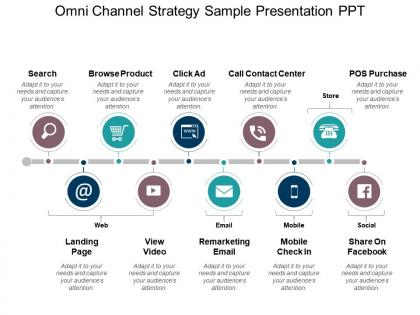
Provide an integrated shopping experience to your business customers with our Omni channel strategy PPT design. It allows you to improve your business sales by improving your customer experience. Use this Omni channel marketing PPT diagram to build a strong relationship with your business customers. It further helps in enhancing your customer retention rate and also helps your business to take a competitive edge over your competitors in the market. Implementing this cross-channel strategy PowerPoint template will further helps you improve your business brand value also. You can also define the benefits of initializing the Omni channel marketing strategy with this PowerPoint layout design. Such as, it helps in building an effective and customer oriented business plan for your company. And also helps in enhancing your customer satisfaction rate by developing some competent business strategies. Start customizing this exclusive PPT image design in accordance to your Omni channel strategy design of your organization. Click on the download link now. Our Omni Channel Strategy Sample Presentation Ppt are easy to access and employ. It is deigned to enhance convenience.
People who downloaded this PowerPoint presentation also viewed the following :
Omni channel strategy sample presentation ppt with all 5 slides:
Build greater backing for your cause with our Omni Channel Strategy Sample Presentation Ppt. It helps increase allies.




FAQs for Omni channel strategy
Key components include unified customer data platforms, consistent brand messaging across touchpoints, integrated inventory management, seamless payment systems, and cross-channel customer service capabilities. These elements work together by eliminating silos between online and offline experiences, enabling real-time inventory visibility, and providing personalized interactions, with many retail and financial services organizations finding that this strategic integration ultimately delivers enhanced customer satisfaction and increased revenue growth.
Brands ensure seamless omni-channel experiences by integrating customer data across platforms, maintaining consistent messaging and visual identity, and implementing unified inventory management systems. Through centralized CRM platforms and real-time synchronization, retailers like Sephora and banks streamline customer interactions, enabling personalized service whether customers engage online, mobile, or in-store, ultimately delivering enhanced satisfaction and competitive advantage.
Technology serves as the backbone of omni-channel retail strategies through integrated inventory management systems, customer relationship management platforms, point-of-sale solutions, mobile applications, and data analytics tools. These technologies streamline operations by synchronizing stock levels across channels, personalizing customer experiences, and enabling seamless transitions between online and offline touchpoints, ultimately delivering enhanced customer satisfaction and competitive advantage.
Businesses measure omni-channel success through customer lifetime value, cross-channel conversion rates, customer satisfaction scores, and unified customer journey analytics. These metrics enable organizations to track seamless experiences across touchpoints, identify optimization opportunities, and demonstrate ROI, with many retailers and financial services finding that integrated measurement approaches deliver enhanced customer insights and competitive advantage.
Companies typically face integration complexity, data silos, inconsistent customer experiences, technology compatibility issues, and resource allocation challenges when implementing omni-channel strategies. While these obstacles require significant coordination across departments, organizations in retail, banking, and healthcare increasingly find that strategic planning, unified data platforms, and cross-functional collaboration ultimately deliver seamless customer journeys and competitive advantage.
Customer data integration significantly enhances omni-channel strategy effectiveness by creating unified customer profiles, enabling personalized experiences across touchpoints, and facilitating seamless transitions between channels. Through centralized data systems, retailers and financial services companies deliver consistent messaging, targeted recommendations, and contextual interactions, while reducing friction and improving customer satisfaction, ultimately driving higher conversion rates and stronger brand loyalty.
Retail giants like Amazon and Walmart, financial services including JPMorgan Chase, healthcare systems like Kaiser Permanente, hospitality brands such as Marriott, and automotive companies like Tesla have successfully implemented omni-channel strategies. These organizations streamline customer experiences by integrating online platforms, mobile apps, and physical locations, ultimately delivering seamless interactions, enhanced customer satisfaction, and significant competitive advantages across all touchpoints.
Mobile optimization is critically important in omni-channel strategy, as mobile devices drive over 50% of digital interactions and serve as the primary touchpoint connecting online and offline experiences. Through responsive design, mobile-first checkout processes, and location-based services, retailers like Starbucks and Sephora seamlessly integrate mobile with in-store experiences, ultimately delivering unified customer journeys and competitive advantage.
Social media integrates into omni-channel marketing through consistent brand messaging, cross-platform customer data synchronization, social commerce features, influencer partnerships, and real-time customer service integration. These platforms enable businesses to create seamless customer journeys by connecting social interactions with email campaigns, in-store experiences, and website touchpoints, ultimately delivering personalized engagement and driving conversions across multiple channels.
Small businesses can leverage omni-channel strategies through cost-effective social media integration, email automation platforms, and consistent brand messaging across existing touchpoints like websites and physical locations. By starting with basic customer data collection and using free or low-cost tools for inventory management and customer communication, many small retailers find they can deliver seamless experiences while building customer loyalty and increasing sales without major technology investments.
Best practices for training employees include comprehensive product knowledge across all channels, consistent communication protocols, empathy-driven customer service skills, and cross-platform technology proficiency. These training approaches streamline customer interactions by enabling seamless handoffs between channels, maintaining brand voice consistency, and empowering staff to resolve issues regardless of touchpoint, ultimately delivering unified experiences that enhance customer satisfaction and loyalty.
Customer segmentation fundamentally shapes omni-channel strategy by enabling personalized experiences across different touchpoints, with each segment requiring tailored messaging, preferred communication channels, and customized customer journeys. Through strategic segmentation, retailers can optimize resource allocation, deliver targeted content that resonates with specific demographics, and create seamless transitions between online and offline interactions, ultimately enhancing customer satisfaction and driving higher conversion rates.
CRM systems serve as the central hub for omni-channel customer management, consolidating interaction data from email, social media, phone calls, live chat, and in-store visits into unified customer profiles. Through integrated dashboards and automated workflows, organizations streamline response times, personalize communications, and maintain consistent service quality across all touchpoints, with many retail and financial services companies finding significant improvements in customer satisfaction and operational efficiency.
Businesses can refine their omni-channel strategy by systematically collecting customer feedback across all touchpoints, analyzing behavioral data patterns, conducting regular satisfaction surveys, and implementing A/B testing on channel integrations. This continuous feedback loop enables companies to identify friction points, optimize channel transitions, and personalize experiences, with many retailers finding that data-driven refinements significantly enhance customer retention and operational efficiency.
Inventory management significantly impacts omni-channel success by enabling real-time visibility, preventing stockouts, and ensuring seamless fulfillment across all touchpoints. Effective systems streamline operations by synchronizing stock levels, optimizing allocation, and reducing carrying costs, with many retailers finding that integrated inventory ultimately delivers faster order processing and enhanced customer experiences across digital and physical channels.
-
Very well designed and informative templates.
-
Great designs, Easily Editable.
-
Great designs, really helpful.
-
Awesomely designed templates, Easy to understand.