


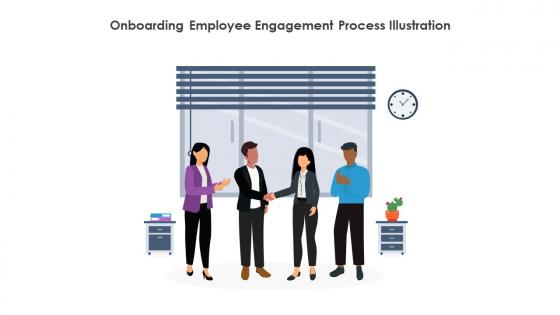
Onboarding Employee Engagement Process Illustration




Try Before you Buy Download Free Sample Product
 Impress Your
 Audience
 100%
100% Editable
 Save Hours
 of Time


This Onboarding employee engagement process illustration is a 100 percent editable Illustration. The downloaded file will have this Illustration in EPS, PNG and Powerpoint pptx format and is perfect for your next project. It has a simple yet stylish design.
People who downloaded this PowerPoint presentation also viewed the following :
Onboarding Employee Engagement Process Illustration with all 6 slides:
Use our Onboarding Employee Engagement Process Illustration to effectively help you save your valuable time. They are readymade to fit into any presentation structure.





FAQs for Onboarding Employee
Effective onboarding improves employee retention by creating clear expectations, building strong cultural connections, and providing comprehensive role preparation from day one. Through structured programs, organizations enhance job satisfaction, reduce early turnover anxiety, and accelerate productivity, with many companies finding that well-designed onboarding processes increase retention rates by 25-50% within the first year.
Key components include structured orientation sessions, role-specific training modules, mentorship programs, clear goal-setting frameworks, and comprehensive resource libraries. These elements work together by accelerating time-to-productivity, enhancing employee engagement, and reducing turnover rates, with many organizations finding that strategic onboarding programs deliver improved retention and faster integration across departments.
Presentation templates enhance onboarding by standardizing information delivery, ensuring consistent messaging across departments, and reducing preparation time for HR teams. These templates streamline the introduction of company policies, role expectations, and cultural values, while enabling organizations to maintain professional visual standards and deliver engaging, interactive sessions that help new hires retain critical information more effectively.
Company culture serves as the foundation for effective onboarding, shaping how new employees understand organizational values, communication styles, work expectations, and team dynamics from day one. A strong cultural integration approach enables organizations to accelerate employee engagement, reduce turnover rates, and build lasting connections, with many companies finding that culture-focused onboarding delivers higher retention and faster productivity gains.
Technology streamlines remote onboarding through digital workflows, virtual reality training, automated document processing, cloud-based collaboration tools, and AI-powered personalization systems. These solutions enable seamless integration by delivering consistent experiences, reducing administrative overhead, and facilitating real-time connections, with many organizations finding significantly faster employee productivity and enhanced engagement across distributed teams.
Organizations should track metrics including time-to-productivity, employee retention rates, job satisfaction scores, completion rates of onboarding modules, and manager feedback assessments. These measurements enable companies to identify process gaps, streamline training workflows, and enhance new hire experiences, with many finding that comprehensive tracking ultimately delivers faster integration, reduced turnover costs, and stronger long-term performance outcomes.
Personalized onboarding plans can be created through role-specific training modules, skills assessments, learning style evaluations, mentorship matching, and flexible timeline adjustments. These approaches enable organizations to address diverse backgrounds, experience levels, and departmental requirements, with many companies finding that customized onboarding enhances employee engagement, accelerates productivity, and ultimately delivers higher retention rates across different workforce segments.
Effective onboarding significantly accelerates employee productivity by establishing clear expectations, providing structured training pathways, and integrating new hires into company culture and workflows. Organizations with comprehensive onboarding programs see employees reach full productivity 25-30% faster, with reduced time-to-competency in critical tasks, stronger team integration, and measurably higher performance metrics within the first quarter.
Organizations can incorporate feedback by conducting regular check-ins with new hires, using pulse surveys, exit interviews from departing employees, and manager assessments throughout the onboarding journey. These feedback mechanisms enable companies to identify gaps, streamline processes, and enhance employee experiences, with many organizations finding that continuous feedback loops significantly improve retention rates and accelerate time-to-productivity.
Best practices for onboarding team leaders and managers include structured role-specific training, clear performance expectations, mentorship pairing, stakeholder introductions, and comprehensive resource access. These approaches streamline leadership transitions by building confidence, establishing key relationships, and accelerating decision-making capabilities, with many organizations finding that strategic onboarding reduces time-to-productivity and enhances long-term leadership effectiveness.
Visual aids and infographics streamline onboarding by simplifying complex information, enhancing knowledge retention, and accelerating comprehension of company processes and policies. These tools enable new employees to grasp organizational structures, workflows, and procedures more effectively than text-heavy materials, with many organizations finding that visual presentations reduce training time while improving engagement and long-term information recall.
Companies face challenges including inconsistent messaging across departments, resource allocation for comprehensive training materials, managing remote and hybrid employee integration, coordinating multiple stakeholders, and measuring program effectiveness. These obstacles often result from inadequate planning and insufficient technology infrastructure, with many organizations finding that investing in standardized templates and digital platforms ultimately streamlines processes while delivering improved retention rates.
Mentoring programs integrate into onboarding through structured buddy systems, cross-departmental partnerships, skill-specific coaching sessions, and progressive milestone check-ins that extend beyond initial orientation. Many organizations find that pairing new hires with experienced mentors accelerates cultural integration, enhances job performance, and significantly reduces turnover rates, ultimately delivering stronger employee engagement and faster productivity gains.
Follow-up sessions after initial onboarding ensure continued employee engagement, address emerging challenges, and reinforce organizational culture and processes that may fade over time. These structured touchpoints enable managers to identify knowledge gaps, provide targeted support, and accelerate productivity, with many organizations finding that systematic follow-ups significantly improve retention rates and long-term employee satisfaction.
Organizations can use storytelling in onboarding presentations by incorporating employee success narratives, company founding stories, customer impact tales, and role-specific journey examples that create emotional connections. These narrative approaches transform traditional policy presentations into engaging experiences, helping new hires visualize their potential career paths, understand company values through real scenarios, and retain crucial information more effectively, ultimately delivering higher engagement and faster cultural integration.
-
Excellent Designs.
-
I loved the hassle-free signup process. A few minutes and, I had this giant collection of beautiful designs.