

Online And Offline Brand Marketing Strategy Powerpoint Presentation Slides





Try Before you Buy Download Free Sample Product
 Impress Your
Audience
 100%
Editable
 Save Hours
of Time


This marketing guide help organization increase brand awareness among consumers and generate new leads. Check out our efficiently designed presentation on Online and Offline Brand Marketing Strategy. The following presentation can help the marketing department to improve the brand perception and increase the sales of company products. This PPT is helpful for an organization intending to capture the market share and build trust with consumers. It initially showcases a roadmap that can help the organization formulate and manage consumer brand awareness campaign. This module also showcases content distribution and marketing strategies that can help an organization increase awareness about the brand and improve the online traffic on the company website. It also describes an online advertising strategy that can help to leverage paid channels to promote the brand. Moreover, it includes various other online marketing strategies, i.e., search engine optimization and referral marketing. This Brand marketing guide also highlights offline brand promotion strategies, including radio advertisements, trade shows, television promotions, magazine advertisements, billboard marketing, etc. At last, KPIs that can help to track the effectiveness of brand awareness campaigns and dashboards that can help to track and evaluate the consumer brand promotional campaigns are displayed. Download this 100 percent editable presentation and get access to our highly researched and skillfully designed product.
People who downloaded this PowerPoint presentation also viewed the following :
Content of this Powerpoint Presentation
Slide 1: This slide introduces Online and Offline Brand Marketing Strategy. State your company name and begin.
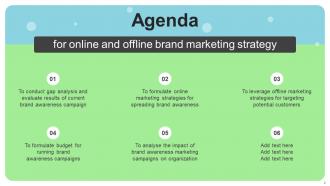
Slide 2: This slide states Agenda of the presentation.
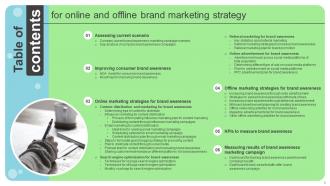
Slide 3: This slide shows Table of Content for the presentation.
Slide 4: This slide highlights title for topics that are to be covered next in the template.
Slide 5: This slide showcases current scenario of brand awareness campaigns conducted by organization.
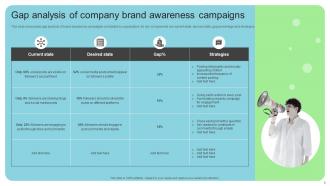
Slide 6: This slide shows Gap analysis of company brand awareness campaigns.
Slide 7: This slide highlights title for topics that are to be covered next in the template.
Slide 8: This slide presents AIDA model for consumer brand awareness.
Slide 9: This slide displays Roadmap for improving brand awareness.
Slide 10: This slide highlights title for topics that are to be covered next in the template.
Slide 11: This slide represents Determining type of content to distribute.
Slide 12: This slide showcases Process of formulating influence marketing plan for content marketing.
Slide 13: This slide shows Distributing content through influencer marketing campaigns.
Slide 14: This slide presents Ideal time for running email marketing campaigns.
Slide 15: This slide displays Scheduling calendar for email marketing campaign.
Slide 16: This slide represents Content distribution plan through email marketing campaigns.
Slide 17: This slide showcases Plan to distribute content using social media.
Slide 18: This slide shows Steps to formulate guest blogging strategy for promoting content.
Slide 19: This slide presents Podcast plan for content distribution and increasing brand awareness.
Slide 20: This slide helps Sharing customer testimonials on different platforms for brand awareness.
Slide 21: This slide highlights title for topics that are to be covered next in the template.
Slide 22: This slide displays Techniques for on page search engine optimization.
Slide 23: This slide represents Techniques for off page search engine optimization.
Slide 24: This slide showcases Monthly roadmap for search engine optimization.
Slide 25: This slide highlights title for topics that are to be covered next in the template.
Slide 26: This slide shows Key statistics about referral marketing.
Slide 27: This slide presents Referral marketing strategies to increase brand awareness.
Slide 28: This slide displays Referral marketing plan for brand promotion.
Slide 29: This slide highlights title for topics that are to be covered next in the template.
Slide 30: This slide represents Advertisement reach across social media platforms of total population.
Slide 31: This slide showcases Determining different type of ads on social media platforms.
Slide 32: This slide shows Plan for advertisement on social media platforms.
Slide 33: This slide presents PPC advertisement plan for brand awareness.
Slide 34: This slide highlights title for topics that are to be covered next in the template.
Slide 35: This slide displays Increasing brand awareness through radio advertisement.
Slide 36: This slide represents Strategies to spread brand awareness with trade shows.
Slide 37: This slide showcases Increasing brand awareness through television advertisement.
Slide 38: This slide shows Billboard advertisement planning for creating brand awareness.
Slide 39: This slide presents Offline networking activities for brand awareness.
Slide 40: This slide displays Magazine advertisement plan for brand awareness.
Slide 41: This slide represents Other offline advertising activities for brand awareness.
Slide 42: This slide highlights title for topics that are to be covered next in the template.
Slide 43: This slide showcases KPIs to measure brand awareness.
Slide 44: This slide highlights title for topics that are to be covered next in the template.
Slide 45: This slide shows Dashboard for tracking brand awareness advertisement campaign results.
Slide 46: This slide presents Dashboard to track website traffic after brand awareness campaign.
Slide 47: This slide contains all the icons used in this presentation.
Slide 48: This slide is titled as Additional Slides for moving forward.
Slide 49: This slide displays Roles and responsibilities for conducting brand awareness campaigns.
Slide 50: This slide represents Budget for brand awareness marketing campaign.
Slide 51: This slide showcases Tools for managing brand awareness marketing campaigns.
Slide 52: This slide shows Leveraging social media hashtags for brand awareness.
Slide 53: This slide presents Influencer assessment for social media marketing strategy.
Slide 54: This slide displays Determining ideal time to post content on social media.
Slide 55: This slide provides Clustered Column chart with two products comparison.
Slide 56: This is Our Mission slide with related imagery and text.
Slide 57: This is About Us slide to show company specifications etc.
Slide 58: This is a Quotes slide to convey message, beliefs etc.
Slide 59: This slide depicts Venn diagram with text boxes.
Slide 60: This is an Idea Generation slide to state a new idea or highlight information, specifications etc.
Slide 61: This slide shows SWOT describing- Strength, Weakness, Opportunity, and Threat.
Slide 62: This is a Comparison slide to state comparison between commodities, entities etc.
Slide 63: This slide presents Roadmap with additional textboxes.
Slide 64: This is Our Team slide with names and designation.
Slide 65: This is Our Target slide. State your targets here.
Slide 66: This is a Financial slide. Show your finance related stuff here.
Slide 67: This slide provides 30 60 90 Days Plan with text boxes.
Slide 68: This slide shows Post It Notes. Post your important notes here.
Slide 69: This is a Thank You slide with address, contact numbers and email address.
Online And Offline Brand Marketing Strategy Powerpoint Presentation Slides with all 74 slides:
Use our Online And Offline Brand Marketing Strategy Powerpoint Presentation Slides to effectively help you save your valuable time. They are readymade to fit into any presentation structure.










FAQs for Online And Offline Brand Marketing Strategy
Key elements include brand positioning, target audience analysis, competitive differentiation, messaging frameworks, and channel optimization strategies. These components work together by establishing clear market identity, defining customer touchpoints, and creating consistent experiences across platforms, with many organizations finding that strategic brand alignment ultimately drives customer loyalty, increases market share, and delivers measurable competitive advantage.
Understanding target audience demographics significantly influences brand marketing decisions by shaping messaging tone, channel selection, content formats, timing strategies, and budget allocation across different platforms. This demographic insight enables brands to tailor their approach for specific age groups, income levels, and lifestyle preferences, with retail companies finding that targeted campaigns based on demographic data deliver higher engagement rates, improved conversion metrics, and ultimately stronger return on marketing investment.
Storytelling enhances brand marketing by creating emotional connections, building memorable brand identities, differentiating from competitors, and increasing customer engagement across multiple touchpoints. Through narrative-driven campaigns, companies like Nike and Coca-Cola transform product features into compelling experiences, ultimately driving stronger customer loyalty, higher conversion rates, and sustained competitive advantage in increasingly crowded markets.
Brand marketing campaign effectiveness is measured through brand awareness metrics, engagement rates, sentiment analysis, website traffic increases, and conversion tracking across multiple touchpoints. These measurement approaches enable organizations to assess campaign ROI, customer perception shifts, and market positioning improvements, with many companies finding that integrated analytics platforms deliver comprehensive insights and optimize future strategic marketing investments.
Social media serves as a cornerstone of modern brand marketing strategy by enabling direct customer engagement, amplifying brand visibility, facilitating real-time feedback, and building authentic community connections. These platforms streamline brand storytelling while delivering targeted messaging to specific demographics, with companies across retail, hospitality, and technology finding that strategic social presence ultimately enhances customer loyalty and drives measurable business growth.
Businesses differentiate through branding by developing unique value propositions, consistent visual identities, compelling brand stories, targeted messaging, and distinctive customer experiences. Strategic branding enables companies to command premium pricing, build customer loyalty, and establish market positioning, with many organizations finding that authentic brand differentiation creates sustainable competitive advantages in increasingly crowded marketplaces.
Best practices for creating consistent brand messaging include developing comprehensive brand guidelines, maintaining unified visual identity standards, creating centralized content templates, establishing clear tone-of-voice protocols, and implementing cross-channel review processes. These strategies streamline communication by ensuring messaging alignment, visual consistency, and strategic coordination across platforms, with many organizations finding that integrated brand management ultimately delivers stronger customer recognition and competitive market positioning.
Visual identity is critically important in brand marketing strategy, serving as the foundation for recognition, differentiation, and emotional connection across all customer touchpoints. It can be optimized through consistent color palettes, typography, and imagery that align with brand values, strategic logo placement across digital and physical channels, and regular testing with target audiences to ensure memorability and relevance, ultimately delivering stronger brand recall and competitive market positioning.
Companies should track brand awareness metrics, customer loyalty scores, perceived quality ratings, brand association strength, and price premium capabilities to assess brand equity over time. These measurements enable organizations to evaluate their market positioning through customer surveys, social media sentiment analysis, and competitive benchmarking, with many finding that consistent tracking ultimately delivers strategic insights for optimizing brand investments and maintaining competitive advantage.
User-generated content enhances brand marketing by building authentic social proof, expanding reach through customer networks, and reducing content creation costs while increasing engagement rates. Through strategic campaigns encouraging reviews, social media posts, and testimonials, brands like Starbucks and Nike amplify their messaging organically, ultimately delivering greater trust and cost-effective marketing scale.
Revamping strategies include comprehensive brand audits, stakeholder research, visual identity redesigns, messaging realignment, and strategic repositioning initiatives. These approaches streamline brand recovery by reconnecting with core audiences, differentiating from competitors, and rebuilding market credibility, with many organizations finding that systematic rebranding ultimately delivers enhanced customer loyalty and competitive advantage.
Brands can enhance their marketing strategy through SEO by optimizing content for search visibility, targeting strategic keywords that align with customer intent, creating valuable resources that establish authority, and building quality backlinks through partnerships. These SEO principles streamline digital presence by increasing organic traffic, reducing acquisition costs, and improving brand discoverability, with many organizations finding that integrated SEO approaches ultimately deliver sustainable competitive advantage.
Influencer partnerships significantly enhance brand perception by increasing authenticity, expanding reach, and building consumer trust through credible third-party endorsements. These collaborations enable brands to access targeted audiences, humanize their messaging, and generate authentic social proof, with many companies in fashion, beauty, and lifestyle sectors finding that strategic influencer relationships ultimately drive stronger brand affinity and purchase intent.
Businesses maintain brand loyalty through consistent value delivery, personalized customer experiences, authentic communication, and strategic differentiation across all touchpoints. By leveraging data analytics for targeted engagement, implementing loyalty programs, and continuously adapting to customer preferences, companies in retail, hospitality, and financial services build lasting relationships that withstand competitive pressures while delivering sustained revenue growth.
Experiential marketing drives brand awareness through immersive events, interactive demonstrations, pop-up experiences, branded activations, and sensory engagement that creates memorable customer touchpoints. These strategic experiences enhance emotional connections and word-of-mouth marketing, with many retail and hospitality brands finding that hands-on interactions significantly increase purchase intent and brand loyalty.
-
Thank you for showering me with discounts every time I was reluctant to make the purchase.
-
Happy to found you SlideTeam. You guys are value for money. Amazing slides.