


Online Government Services Offerings Powerpoint Presentation Slides




Try Before you Buy Download Free Sample Product
 Impress Your
 Audience
 100%
100% Editable
 Save Hours
 of Time


Our Online Government Services Offerings Powerpoint Presentation Slides are topically designed to provide an attractive backdrop to any subject. Use them to look like a presentation pro.
People who downloaded this PowerPoint presentation also viewed the following :
Content of this Powerpoint Presentation
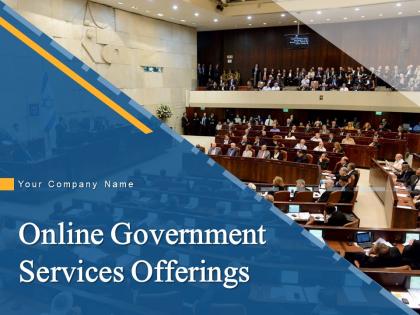
Slide 1: This slide introduces Online Government Services Offerings. State Your Company Name and begin.
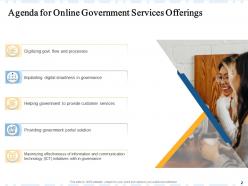
Slide 2: This slide presents Agenda for Online Government Services Offerings describing Digitizing govt. flow and processes, Implanting digital smartness in governance, etc.
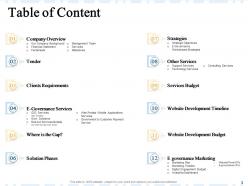
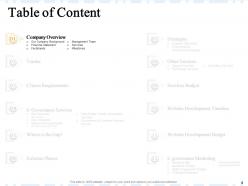
Slide 3: This slide shows Table of contents for the presentation.
Slide 4: This slide displays Company Overview describing- Our Company background, Financial statement, Factsheets, etc.
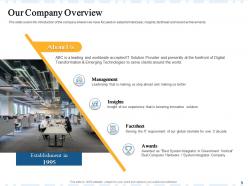
Slide 5: This slide displays Our Company Overview describing - Management, Insights, Factsheet, etc.
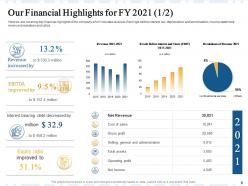
Slide 6: This slide represents Our Financial Highlights for FY 2019 showing data with the of bar graphs and pie charts.
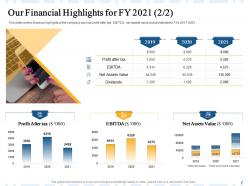
Slide 7: This slide showcases Our Financial Highlights for FY 2019 showing data in tabular form.
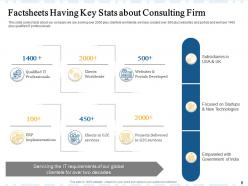
Slide 8: This slide shows Factsheets Having Key Stats about Consulting Firm.
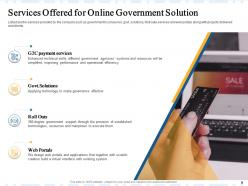
Slide 9: This slide presents Services Offered for Online Government Solution describing- G2C payment services, Roll Outs, Web Portals, etc.
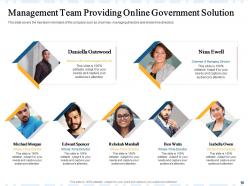
Slide 10: This slide displays Management Team Providing Online Government Solution.
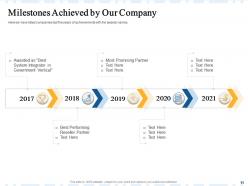
Slide 11: This slide represents Milestones Achieved by our Company with related icons.
Slide 12: This slide represents Tender and Clients Requirements with related imagery.
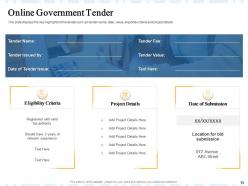
Slide 13: This slide showcases Online Government Tender describing- Project Details, Eligibility Criteria, etc.
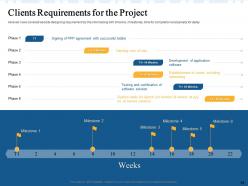
Slide 14: This slide shows the Clients Requirements for the Project with weekly milestones.
Slide 15: This slide shows E-Governance Services with related imagery.
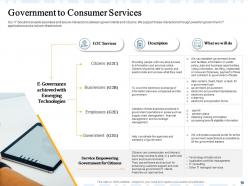
Slide 16: This slide represents Government to Consumer Services describing- G2C Services, Description, etc.
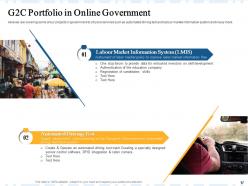
Slide 17: This slide showcases G2C Portfolio in Online Government describing - Automated Driving Test and Labour Market Information System (LMIS).
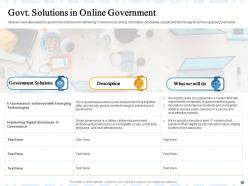
Slide 18: This slide shows Govt. Solutions in Online Government with related icons and text.
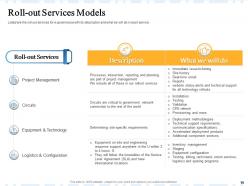
Slide 19: This slide presents Roll-out Services Models describing-- Roll-out Services, Description, etc.
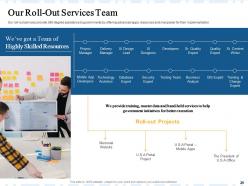
Slide 20: This slide displays Our Roll-Out Services Team with related imagery .
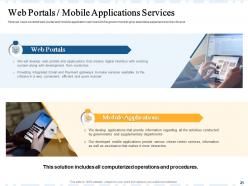
Slide 21: This slide represents Web Portals / Mobile Applications Services.
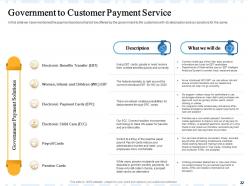
Slide 22: This slide showcases Government to Customer Payment Service.
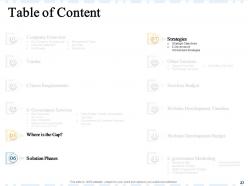
Slide 23: This slide displays titles as-Where is the Gap? Solution Phases, and Strategies.
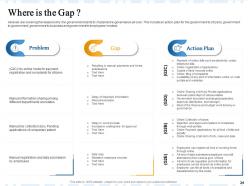
Slide 24: This slide represents Where is the Gap ? describing Problem, Gap, and Action plan.
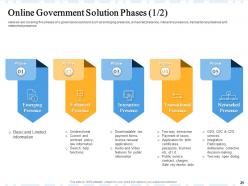
Slide 25: This slide showcases Online Government Solution Phases like Emerging Presence, Enhanced Presence, Interactive Presence, etc.
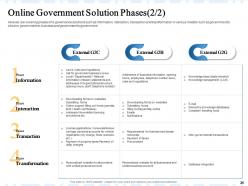
Slide 26: This is another slide showing Online Government Solution Phases.
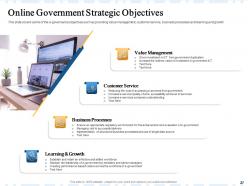
Slide 27: This slide presents Online Government Strategic Objectives as Value Management, Customer service, Business processes, and Learning & growth.
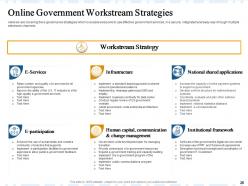
Slide 28: This slide displays Online Government Workstream Strategies as E services, Infrastructure, E-participation, etc.
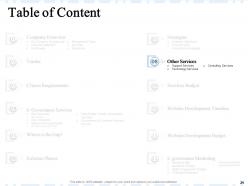
Slide 29: This slide shows Other Services describing- Support Services, Technology Services, and Consulting Services.
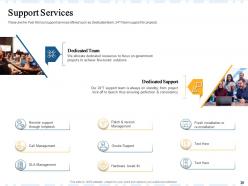
Slide 30: This slide presents Support Services describing- Call Management, Remote support through helpdesk, Hardware break fix, etc.
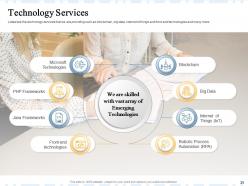
Slide 31: This slide displays Technology Services describing- Microsoft Technologies, PHP Frameworks, Java Frameworks.
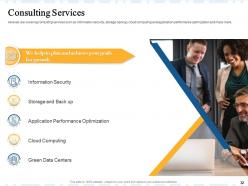
Slide 32: This slide represents Consulting Services describing- Information Security, Storage and Back up, Application Performance Optimization, etc.
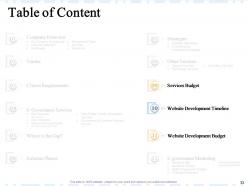
Slide 33: This slide showcases titles as Services Budget, Website Development Timeline, and Website Development Budget.
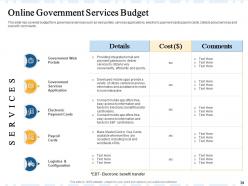
Slide 34: This slide shows Online Government Services Budget describing- Details, Cost, Services, etc.
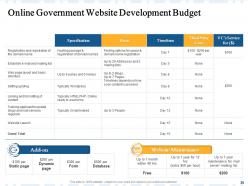
Slide 35: This slide presents Online Government Website Development Budget.
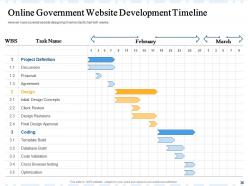
Slide 36: This slide represents Online Government Website Development Timeline.
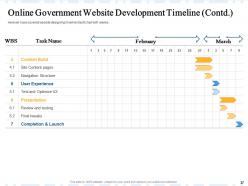
Slide 37: This is another slide continuing Online Government Website Development Timeline.
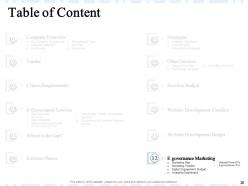
Slide 38: This slide showcases E governance Marketing describing- Marketing Plan, Marketing Timeline, Digital Engagement Budget, etc.
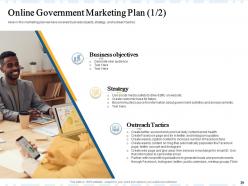
Slide 39: This slide shows Online Government Marketing Plan describing Business objectives, Strategy, etc.
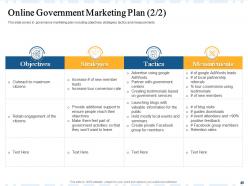
Slide 40: This is another slide showing Online Government Marketing Plan.
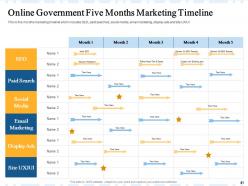
Slide 41: This slide presents Online Government Five Months Marketing Timeline.
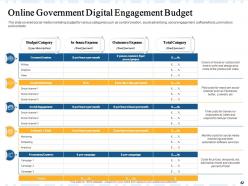
Slide 42: This slide displays Onlinel Government Digital Engagement Budget.
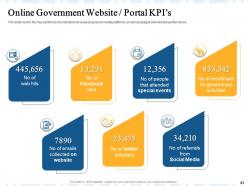
Slide 43: This slide represents Online Government Website / Portal KPI’s with related icons and text.
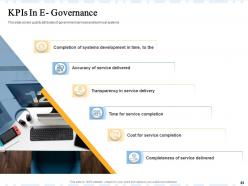
Slide 44: This slide showcases KPIs In Online Government describing- Time for service completion, Cost for service completion, Completeness of service delivered, etc.
Slide 45: This slide displays Icons for Online Government services offerings.
Slide 46: This slide is titled as Additional Slides for moving forward.
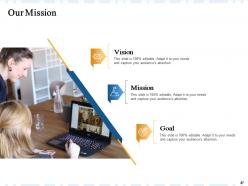
Slide 47: This is Our Mission slide with related imagery and text.
Slide 48: This is About Us slide to show company specifications etc.
Slide 49: This is Our Team slide with names and designation,
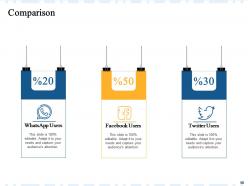
Slide 50: This is a Comparison slide to state comparison between commodities, entities, etc.
Slide 51: This is Our Goal slide. State your firm's goals here.
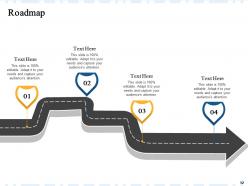
Slide 52: This slide shows Roadmap with additional text boxes.
Slide 53: This slide displays 30 60 90 Days Plan with related icons and text boxes.
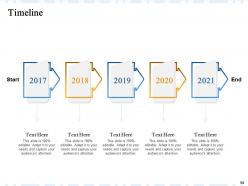
Slide 54: This is a Timeline slide. Show data related to time intervals here.
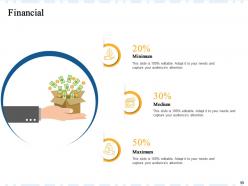
Slide 55: This is a Financial slide. Show your finance related stuff here.
Slide 56: This is a Thank you slide with address, contact numbers, and email address.
Online Government Services Offerings Powerpoint Presentation Slides with all 56 slides:
Use our Online Government Services Offerings Powerpoint Presentation Slides to effectively help you save your valuable time. They are readymade to fit into any presentation structure.

FAQs for Online Government Services Offerings
Online government services deliver enhanced convenience, reduced processing times, 24/7 accessibility, cost savings, and improved transparency for citizens. These digital platforms streamline interactions by eliminating physical visits, minimizing paperwork, and enabling real-time tracking, with many municipalities finding that citizens experience faster approvals, lower administrative costs, and significantly better service satisfaction rates.
Online government services have improved accessibility for marginalized communities by eliminating transportation barriers, providing multilingual interfaces, offering 24/7 availability, and reducing discrimination through standardized digital processes. These platforms enable citizens with disabilities, rural residents, and low-income individuals to access benefits, permits, and services remotely, ultimately delivering greater equity and inclusion in public service delivery.
Cybersecurity serves as the foundation for online government services, encompassing data encryption, multi-factor authentication, secure networks, regular vulnerability assessments, and compliance frameworks. These security measures enable governments to protect sensitive citizen information while delivering efficient digital services, with agencies like tax departments and healthcare systems finding that robust cybersecurity ultimately builds public trust and encourages broader digital adoption.
Online platforms enhance citizen engagement by enabling digital consultations, virtual town halls, real-time feedback collection, participatory budgeting, and transparent policy discussions. These technologies streamline democratic participation by removing geographical barriers, providing 24/7 access to government processes, and facilitating data-driven decision-making, with many municipalities finding that digital engagement tools ultimately deliver higher participation rates and more inclusive governance.
Governments face challenges including legacy system integration, budget constraints, cybersecurity requirements, accessibility compliance, and varying digital literacy levels among citizens. While these obstacles can slow implementation, many agencies are finding that strategic partnerships, phased rollouts, and citizen feedback loops ultimately streamline the transition, delivering faster services and enhanced public satisfaction.
Data analytics enhances online government service delivery by identifying bottlenecks, predicting demand patterns, and optimizing resource allocation across digital platforms. Through predictive modeling and real-time monitoring, agencies streamline citizen interactions, reduce processing times, and personalize service experiences, with many finding that data-driven insights ultimately deliver faster approvals and improved satisfaction rates.
Effective strategies include targeted digital marketing campaigns, community partnerships with local organizations, multilingual outreach programs, simplified user education materials, and social media engagement initiatives. These approaches enhance citizen awareness by meeting people where they are, providing accessible information in multiple formats, and demonstrating clear benefits, with many municipalities finding that community-based promotion significantly increases service adoption rates.
Online government services significantly reduce operational costs through automated processing, reduced paperwork, and streamlined workflows, while traditional methods require extensive manual labor and physical infrastructure maintenance. Digital platforms enable governments to serve more citizens with fewer resources, minimize processing times, and reduce administrative overhead, with many municipalities finding cost savings of 30-60% while delivering faster, more accessible services.
Online government services implement multi-layered privacy protections including end-to-end encryption, secure authentication protocols, data minimization practices, regular security audits, and strict access controls. These measures work together by encrypting personal information during transmission, limiting data collection to essential purposes, and ensuring compliance with privacy regulations, with agencies like healthcare departments and tax authorities finding that robust privacy frameworks ultimately build citizen trust while delivering secure, efficient digital services.
Feedback mechanisms can be integrated through embedded surveys, rating systems, comment sections, analytics tracking, and user journey mapping tools. These systems enable governments to collect real-time insights, identify service bottlenecks, and prioritize improvements, with many agencies finding that continuous feedback loops ultimately enhance citizen satisfaction and streamline digital service delivery.
AI, blockchain, cloud computing, IoT sensors, and robotic process automation are revolutionizing online government services through enhanced security, transparency, and efficiency. These technologies streamline operations by automating routine tasks, securing citizen data, and enabling real-time service delivery, with many agencies finding that strategic implementation ultimately delivers faster processing times and improved citizen experiences.
Countries approach government service digitization through comprehensive digital identity systems, centralized online portals, mobile-first platforms, AI-powered automation, and integrated data sharing across agencies. Estonia leads with blockchain-based e-governance, Singapore emphasizes seamless mobile services, and Denmark focuses on user-centric design, with many nations finding that strategic digital transformation significantly reduces bureaucratic delays while enhancing citizen satisfaction and operational efficiency.
**INPUT**: What best practices can be adopted to enhance the user experience of online government services? **OUTPUT**: Best practices include intuitive interface design, mobile optimization, streamlined authentication processes, clear progress indicators, and comprehensive help resources. These approaches enhance citizen engagement by reducing completion times, minimizing errors, and improving accessibility, with many agencies finding that strategic user-centered design ultimately delivers higher satisfaction rates and increased digital adoption. [Word count: 52 words]
Online government services enhance disaster recovery through real-time emergency alerts, digital damage assessments, online relief applications, centralized resource coordination, and virtual communication platforms. These digital systems streamline response efforts by enabling faster aid distribution, remote damage documentation, and seamless coordination between agencies, while providing citizens immediate access to critical information and support services during emergencies.
Online services facilitate transparency and accountability by providing citizens real-time access to government data, enabling digital tracking of policy implementation, and creating automated audit trails for all transactions. Through digital platforms, agencies streamline public information sharing, enhance citizen engagement through feedback mechanisms, and deliver measurable improvements in service delivery, with many municipalities finding that online transparency tools significantly reduce bureaucratic inefficiencies while building public trust.
-
Excellent work done on template design and graphics.
-
The Designed Graphic are very professional and classic.
-
Colors used are bright and distinctive.
-
Qualitative and comprehensive slides.
-
Out of the box and creative design.
-
Innovative and Colorful designs.
-
Great product with highly impressive and engaging designs.
-
Great quality product.
-
Perfect template with attractive color combination.
-
Wonderful templates design to use in business meetings.
-
Page:
- You're currently reading page 1
- Page 2
-
