

Online Music Distribution Firm Investor Funding Elevator Pitch Deck Ppt Template





Try Before you Buy Download Free Sample Product
 Impress Your
Audience
 100%
Editable
 Save Hours
of Time


Rapchat is an innovative mobile app that empowers aspiring rappers and hip hop artists to create, collaborate, and share their music effortlessly. Check out our professionally designed Online Music Distribution Firm Investor Funding Elevator Pitch Deck. It addresses the challenges faced by customers, including difficulties in selecting the right beats, limited access to recording studios, and challenges in distributing music. Additionally, the Investor Presentation module showcases the solutions provided by Rapchat, which include a designated platform for singing, mixing, and recording music. Moreover, the investors deck provides comprehensive company details, including an introduction, key facts, products, and services. It also displays a unique selling proposition USP, significant milestones achieved, business model, competitive analysis, market potential, and financial performance. Lastly, the pitch deck includes the investment ask, fund allocation, funding history, core team information, exit strategy, and shareholding pattern. Download our pitch deck now.
People who downloaded this PowerPoint presentation also viewed the following :
Content of this Powerpoint Presentation
Slide 1: This slide introduces Online Music Distribution Firm Investor Funding Elevator Pitch Deck. State your company name and begin.
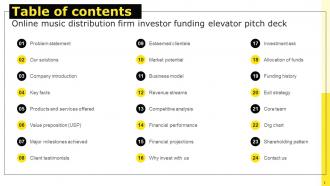
Slide 2: This slide shows Table of Content for the presentation.
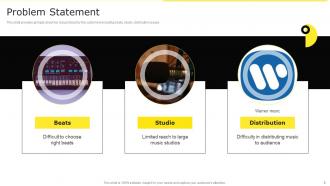
Slide 3: This slide presents key issues faced by the customers including beats, studio, distribution issues.
Slide 4: This slide provides solutions offered by the company to the users such as providing platform for recording and sharing songs.
Slide 5: This slide depicts detailed summary of company. It includes company overview, industry, headquarter, type, founded in, etc.
Slide 6: This slide presents key parameters that shows company’s popularity among its users including MAU, time spent per month, monthly listens.
Slide 7: This slide provides number of products & services on the company’s platform such as Beats,and songs creations.
Slide 8: This slide describes unique value provided by the company including easiest music creation studio, allow collaborating with friends, etc.
Slide 9: This slide presents aspirations achieved by the company including boosting hip hop fans and becoming number one streamed genre.
Slide 10: This slide displays reviews and feedback about company that is given by customers.
Slide 11: This slide represents the ideal customers of the company that chose our products all over the world.
Slide 12: This slide provides glimpse about market potential of hip-hop music and industry in which our company operates.
Slide 13: This slide represents the business model of the company through its website and multiple apps.
Slide 14: This slide describes revenue streams of the company including premium beats, & sponsored content.
Slide 15: This slide provides competitor analysis of company along with their description, founding date, type, tags, location, etc.
Slide 16: This slide presents the financial performance of the company with the aid of graphical representation of revenue generated over the years.
Slide 17: This slide represents the financial projections and revenue growth of the company for upcoming years along with its CAGR.
Slide 18: This slide describes the reasons for why should investors put their money with the company.
Slide 19: This slide provides information to the investors on how much funds are required and how long financing will last.
Slide 20: This slide presents information to the investors on fund allocation strategy of the company for this round of funding.
Slide 21: This slide describes funding history of the company over years.
Slide 22: This slide provides information to the investors about the exit strategy of the company, that is, mergers and acquisitions.
Slide 23: This slide displays founders of the company Rapchat with their key achievements and former titles.
Slide 24: This slide presents organization chart of the company with CEO, head of community, COO, creative marketing director, etc.
Slide 25: This slide displays graphical representation of shareholding structure of the company along with its major shareholders.
Slide 26: This is a contact us slide to show company's contact information.
Slide 27: This slide shows all the icons included in the presentation.
Slide 28: This slide is titled as Additional Slides for moving forward.
Slide 29: This is an Idea Generation slide to state a new idea or highlight information, specifications etc.
Slide 30: This is a Timeline slide. Show data related to time intervals here.
Slide 31: This is About Us slide to show company specifications etc.
Slide 32: This slide provides 30 60 90 Days Plan with text boxes.
Slide 33: This is Our Target slide. State your targets here.
Slide 34: This slide shows SWOT analysis describing- Strength, Weakness, Opportunity, and Threat.
Slide 35: This is a Thank You slide with address, contact numbers and email address.
Online Music Distribution Firm Investor Funding Elevator Pitch Deck Ppt Template with all 43 slides:
Use our Online Music Distribution Firm Investor Funding Elevator Pitch Deck Ppt Template to effectively help you save your valuable time. They are readymade to fit into any presentation structure.











FAQs for Online Music Distribution Firm Investor Funding Elevator Pitch
Startups should consider their business model viability, market size and growth potential, competitive differentiation, financial projections, and team expertise when approaching investors. These elements demonstrate scalability and reduce investment risk, with many venture capitalists finding that startups presenting clear revenue streams, validated market demand, and experienced leadership teams ultimately secure funding more effectively and achieve sustainable growth.
A compelling pitch deck enhances investor interest by clearly articulating the business problem, market opportunity, competitive advantages, and financial projections while demonstrating team expertise and scalability potential. Through strategic storytelling and data-driven insights, startups can effectively communicate their value proposition, address investor concerns about risk and returns, and ultimately secure funding by showcasing measurable growth potential and market validation.
Common mistakes include accepting unfavorable valuation terms, overlooking liquidation preferences, neglecting board composition negotiations, underestimating dilution impacts, and rushing due diligence processes. These oversights often result from inexperience with complex term sheets, with many founders finding that inadequate preparation ultimately compromises their equity stakes and operational control in future funding rounds.
Businesses demonstrate market potential through comprehensive market research, validated customer demand, competitive analysis, scalable business models, and strong financial projections. By presenting clear total addressable market data, customer acquisition strategies, and revenue growth trajectories, companies can showcase their ability to capture market share, with many investors finding that measurable traction and defensible positioning ultimately deliver the strongest investment cases.
Essential due diligence documentation includes financial statements, business plans, legal contracts, intellectual property records, and compliance certificates. These documents enable investors to assess risk, validate business models, and evaluate growth potential across sectors like fintech and healthcare, with many investors finding that comprehensive documentation significantly accelerates funding decisions and enhances valuation outcomes.
Angel investors provide early-stage capital and mentorship, VCs deliver larger funding rounds with strategic guidance and networks, while crowdfunding enables market validation and customer acquisition alongside capital. These funding types accelerate growth differently, with angels supporting initial development, VCs scaling operations and market expansion, and crowdfunding building brand awareness, ultimately enabling companies to access broader resources and expertise.
Investors prioritize revenue growth rate, gross margins, burn rate, runway length, customer acquisition cost, and lifetime value ratios when evaluating startup financial health. These metrics enable venture capitalists and angel investors to assess scalability potential, operational efficiency, and market viability, with many finding that consistent revenue growth combined with controlled burn rates ultimately delivers the strongest indicator of long-term sustainability and competitive advantage.
Startups build strong investor relationships through regular communication, transparent reporting, and proactive updates on milestones, challenges, and strategic pivots. By providing quarterly reports, seeking guidance during critical decisions, and maintaining honesty about both successes and setbacks, companies create trust and partnership dynamics, ultimately securing continued support and valuable strategic insights for scaling operations.
Storytelling transforms investor presentations by creating emotional connections, simplifying complex business models, demonstrating market understanding, and showcasing leadership vision through compelling narratives. Through strategic storytelling, startups and growing companies build investor confidence, differentiate from competitors, and communicate scalable growth potential more effectively, with many successful funding rounds finding that memorable narratives significantly enhance pitch memorability and investment decisions.
Startups can identify suitable investors by researching venture capital firms' portfolio companies, investment thesis, and stage preferences, while leveraging networking events, accelerator programs, and industry connections. Banks, healthcare, and fintech startups particularly benefit from targeting specialized investors who understand regulatory complexities and market dynamics, ultimately securing strategic partnerships that deliver industry expertise, relevant networks, and accelerated growth opportunities.
Giving away equity reduces your ownership percentage and control while potentially limiting future decision-making autonomy and profit distribution. However, strategic investors often bring valuable expertise, networks, and mentorship beyond capital, with many entrepreneurs finding that smaller ownership of a significantly larger, well-funded company ultimately delivers greater returns than maintaining full control of a smaller venture.
Founders can prepare for difficult questions by conducting thorough mock sessions with advisors, researching investors' portfolios and typical concerns, developing clear responses to financial projections challenges, and preparing honest explanations for potential weaknesses. Through comprehensive due diligence on their own business, founders can anticipate skepticism about market size, competitive threats, and scalability challenges, ultimately demonstrating transparency and strategic thinking that investors value.
Innovative funding strategies include revenue-based financing, equity crowdfunding, tokenized securities, convertible notes with dynamic terms, and hybrid debt-equity instruments. These approaches streamline capital access by reducing traditional barriers, accelerating funding timelines, and offering flexible repayment structures, with many startups and growth companies finding enhanced investor alignment and faster deployment.
Startups can leverage their network by engaging existing contacts for introductions, participating in industry events and accelerator programs, utilizing alumni connections, and actively building relationships on professional platforms. Through strategic networking, founders access angel investors, venture capitalists, and industry mentors, while demonstrating credibility through trusted referrals, ultimately increasing funding opportunities and establishing valuable long-term partnerships.
Founders should evaluate investor expertise relevance, decision-making authority levels, board composition changes, operational autonomy boundaries, and strategic alignment compatibility. While experienced investors can provide valuable industry insights, market connections, and scaling guidance, founders must balance this input with maintaining entrepreneurial agility and core vision integrity, ultimately ensuring investor involvement enhances rather than constrains growth potential.
-
SlideTeam’s readymade presentations have landed my unique images with my bosses in the past and it continues to reward me.
-
This design is not only aesthetically pleasing but it has many uses making the cost worthwhile. The graphics look stunning, and you can edit them as per your needs.