

Online targeting target segments example of ppt





Try Before you Buy Download Free Sample Product
 Impress Your
 Audience
 100%
100% Editable
 Save Hours
 of Time


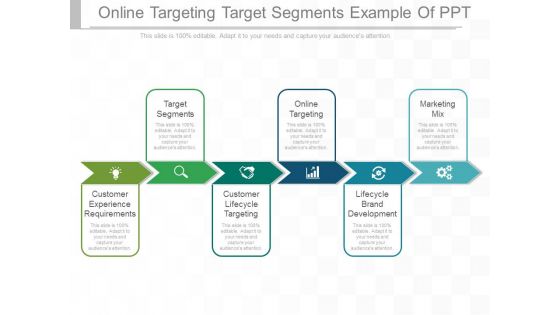
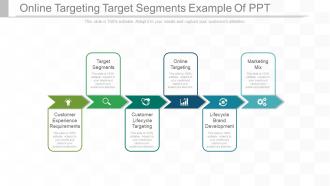
Getting out of PowerPoint presentation is quite easy as it presents the ideas and information in an organized way. Taking this into account we have come up with presentation slide samples of online targeting to illustrate the concept of customer life cycling targeting, target segments and marketing mix. Using this PPT template you can build quality presentation for product line strategy, attractive timeline and many more we have come up with PowerPoint infographics on the core concept like online targeting and customer experience requirements. Our experts have designed wonderful online targeting presentation for the executive involved in conceptualizing target segments. You just click on the design explore your knowledge.
People who downloaded this PowerPoint presentation also viewed the following :
Online targeting target segments example of ppt with all 7 slides:
Our Online Targeting Target Segments Example Of Ppt excel at their craft. They give you the cutting edge.



FAQs for Online targeting target segments
Online targeting is a digital marketing approach that uses data analytics, user behavior tracking, and demographic insights to deliver personalized advertisements to specific audience segments. Unlike traditional marketing's broad, one-size-fits-all campaigns through television, radio, and print media, online targeting enables businesses to reach precise customer groups with tailored messaging, ultimately delivering higher conversion rates and improved return on investment.
Algorithms influence online targeting by analyzing user behavior patterns, demographic data, and browsing history to predict consumer preferences and purchase intent. Through machine learning and data processing, advertisers can deliver personalized campaigns across social media, search engines, and e-commerce platforms, ultimately enhancing conversion rates and reducing advertising costs while improving customer experiences.
Key metrics for measuring online targeting effectiveness include click-through rates, conversion rates, cost per acquisition, return on ad spend, and audience engagement levels. These metrics enable marketers to optimize campaign performance by identifying high-performing segments, adjusting targeting parameters, and reallocating budgets strategically, with many organizations finding that comprehensive measurement ultimately delivers improved ROI and enhanced customer acquisition efficiency.
Businesses ensure online targeting compliance through transparent data collection policies, explicit user consent mechanisms, regular privacy audits, and anonymization techniques that protect individual identities. Many organizations implement privacy-by-design frameworks and automated compliance tools, enabling them to maintain effective targeting while respecting user rights, ultimately building consumer trust and avoiding costly regulatory penalties in an increasingly regulated digital landscape.
Consumer behavior drives online targeting by revealing preferences, purchase patterns, browsing habits, engagement frequencies, and decision-making triggers that inform campaign strategies. Through behavioral analytics, companies in retail, finance, and entertainment can create personalized experiences, optimize ad placement timing, and predict future needs, ultimately delivering higher conversion rates and customer satisfaction while maximizing marketing spend efficiency.
Audience segmentation enhances online targeting accuracy by dividing broad audiences into specific groups based on demographics, behaviors, interests, and purchase history, enabling more precise message delivery. Through advanced analytics and data modeling, marketers can create highly targeted campaigns that resonate with distinct segments, ultimately delivering higher conversion rates and improved ROI.
Common pitfalls in online targeting include over-targeting narrow audiences, ignoring privacy regulations, failing to test ad creatives regularly, neglecting mobile optimization, and relying solely on third-party data. These missteps often result in reduced reach, compliance issues, and poor campaign performance, with many marketers finding that balanced targeting strategies deliver better ROI and sustainable growth.
Retargeting campaigns track website visitors through cookies or pixels, then display targeted ads to these users across other platforms, social media, and websites they visit. This strategic approach delivers higher conversion rates, improved brand recall, and cost-effective advertising by focusing on already-interested prospects, with many e-commerce and service businesses finding significantly better ROI than traditional advertising methods.
Artificial intelligence improves online targeting through predictive analytics, real-time behavioral analysis, dynamic audience segmentation, automated bid optimization, and personalized content delivery. These AI-driven capabilities enable businesses to anticipate customer preferences, reduce ad spend waste, and deliver highly relevant experiences, with many e-commerce and financial services companies finding significantly improved conversion rates and customer engagement.
A/B testing enables businesses to refine online targeting by comparing different audience segments, ad creatives, messaging approaches, and placement strategies simultaneously. Through systematic testing of variables like demographic parameters, behavioral triggers, and content formats, companies can identify high-performing combinations, optimize conversion rates, and reduce acquisition costs, ultimately delivering more precise targeting and improved ROI across campaigns.
Online targeting raises ethical considerations including data privacy protection, transparent consent processes, algorithmic bias prevention, user autonomy preservation, and responsible data collection practices. While these technologies enhance personalized experiences and business efficiency, financial services, healthcare, and retail organizations increasingly find that implementing strong ethical frameworks builds consumer trust, ensures regulatory compliance, and delivers sustainable competitive advantage.
Social media platforms approach online targeting through distinct methods: Facebook emphasizes demographic and behavioral data, LinkedIn focuses on professional attributes and job functions, Instagram prioritizes visual content engagement patterns, while Twitter targets based on interests and real-time conversations. These varied approaches enable businesses to reach specific audiences across different contexts, with retail brands finding success through Instagram's visual targeting and B2B companies leveraging LinkedIn's professional data for more precise lead generation.
Website cookies significantly enhance online targeting effectiveness by tracking user behavior, personalizing content delivery, enabling retargeting campaigns, and improving ad relevance across platforms. Through behavioral data collection, marketers deliver more precise audience segmentation and customized experiences, with e-commerce and digital advertising sectors finding that cookie-based targeting increases conversion rates while reducing acquisition costs, ultimately delivering higher ROI and competitive advantage.
Companies balance personalization with user privacy by implementing transparent data practices, obtaining explicit consent, using anonymized data aggregation, and providing granular privacy controls. Through privacy-first technologies like differential privacy and contextual targeting, organizations in retail, finance, and healthcare deliver relevant experiences while respecting user boundaries, ultimately building trust and ensuring regulatory compliance.
Businesses should monitor privacy-first targeting through first-party data collection, AI-powered predictive analytics, contextual advertising revival, and cross-platform identity resolution. These trends enable companies to maintain effective customer reach while adapting to cookie deprecation and privacy regulations, with retail and financial services finding that strategic data partnerships and enhanced personalization ultimately deliver competitive advantage in an increasingly regulated digital landscape.
-
Great experience, I would definitely use your services further.
-
Great designs, Easily Editable.