

Openfin pitch deck ppt template





Try Before you Buy Download Free Sample Product
 Impress Your
Audience
 100%
Editable
 Save Hours
of Time


Fintech is one of the fastest-growing industries. It is estimated to increase to dollar 326 bn by the year 2026. Openfin is a fintech platform that allows users to operate more efficiently and improve their productivity. Here is an efficiently designed Openfin pitch deck that provides a detailed insight into the companys inner workings and the utilization of funds. In the following PPT presentation, we have covered the following key areas- the problem that has disrupted the industry, bleak outlook of possible solutions, the solution offered, etc. The insightful deck displays details about the workings of an application, the effect of the Network, Digital enabling, deployment of the technology, and more. Moreover, the PPT template presents an overview of the team, the TAM SAM and SOM, and the funds required for various activities. Book a free demo with our research or design team. Customize this 100 percent editable pitch deck now.
People who downloaded this PowerPoint presentation also viewed the following :
Content of this Powerpoint Presentation
Slide 1: This slide displays title i.e. Openfin Pitch Deck.
Slide 2: This slide presents table of contents.
Slide 3: This slide show the key problems that have caused issues in the Industry.
Slide 4: This slide provides an outlook of the overall solution offered by the organization as it highlights the names and features of other apps.
Slide 5: This slide displays the key solution offered by the organization to its client, the provided also displays key features of openfin solution.
Slide 6: This slide displays the working mechanism of the FinTech application as it highlights the language and framework of the application.
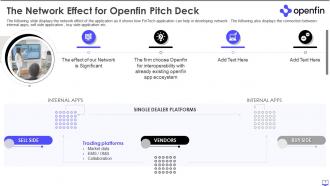
Slide 7: This slide displays the network effect of the application as it shows how FinTech application can help in developing network.
Slide 8: This slide displays how fintech software can help the organization by enabling the digital transformation.
Slide 9: This slide displays how the software can be deployed in the organization.
Slide 10: This slide show the leadership team of the organization as it displays the details of the team members such as name, designation etc.
Slide 11: This slide displays the TAM SAM and SOM of the market as it highlight the market value and how the organization will utilize future fund.
Slide 12: This slide show how the organization will use the funds generated.
Slide 13: This slide presents contact details of the company.
Slide 14: This is the icons slide.
Slide 15: This slide presents title for additional slides.
Slide 16: This slide exhibits defining the target customer.
Slide 17: This slide depicts organizations financials.
Slide 18: This slide highlights competitive landscape.
Slide 19: This slide exhibits yearly sales bar graph for different products. The charts are linked to Excel.
Slide 20: This slide depicts posts for past experiences of clients.
Slide 21: This slide displays puzzle.
Slide 22: This slide exhibits yearly timeline.
Slide 23: This slide displays Venn.
Slide 24: This slide depicts 30-60-90 days plan for projects.
Slide 25: This slide shows roadmap.
Slide 26: This is thank you slide & contains contact details of company like office address, phone no., etc.
Openfin pitch deck ppt template with all 31 slides:
Use our Openfin Pitch Deck Ppt Template to effectively help you save your valuable time. They are readymade to fit into any presentation structure.









FAQs for Openfin pitch
So OpenFin is this desktop runtime thing that lets you build financial apps with regular web stuff - HTML, JavaScript, CSS. Pretty cool actually. You're not stuck doing native development or dealing with browser restrictions. Banks love it because it handles all their compliance nightmares automatically. The apps run like desktop software but you can update them super easily since they're built with web tech. Performance is solid too, which matters for trading platforms. Honestly, if you're doing anything finance-related, their docs are worth checking out. Way better than wrestling with traditional desktop frameworks.
So OpenFin basically creates this shared environment where all your financial apps can actually talk to each other - doesn't matter who built them or what tech they used. It's like having a universal translator but for finance software. Your trading platform suddenly plays nice with your risk tools without needing crazy custom work. Pretty neat, honestly. You get app messaging, shared data context, workflows that span different systems. The big payoff? Traders finally get that integrated desktop they've been bugging you about, and you don't have to rebuild the world to make it happen.
So HTML5 is your way into building desktop apps with OpenFin without touching C++ or any of that heavy stuff. Pretty sweet deal honestly. Take your regular web skills - HTML, CSS, JavaScript - and OpenFin wraps everything in this secure container that actually feels native. You get desktop features like notifications and messaging between apps. Way faster than browser apps too since you're not fighting with a million other tabs (my Chrome always has like 30+ open). I'd suggest starting small - grab a simple web app you've built and convert it first. Gets you familiar with how everything works.
So OpenFin basically lets you upgrade your desktop apps without all the usual pain. Your existing infrastructure stays put while you add web functionality that actually works - no more browser compatibility hell. Security's solid enough for compliance folks, and it plays nice with whatever workflows your traders are already using. Updates happen instantly too, which beats dealing with IT every time. Honestly, I'd just check out their demo first to see if it handles your specific stuff well. Way easier than guessing whether it'll work.
OpenFin's perfect for this stuff - it's literally built for trading apps. You get native desktop speed but with web tech, which is honestly the best of both worlds. The latency is crazy low for real-time data, and it won't choke when you're running multiple feeds like a regular browser would. Security and compliance are already sorted since it's made for finance. Window management is smooth too - traders can drag charts wherever they want across monitors. Oh, and they have templates if you want to skip the setup headache. Definitely worth checking out if you need that sub-millisecond performance.
So OpenFin's got pretty solid security - apps run in isolated containers so they can't interfere with each other. Communication happens through encrypted channels, plus you get enterprise authentication controls. Code signing verification is built in too, which I actually think is one of their better features since you know the apps are legitimate. They've got granular permissions so you can control exactly what each app does. Oh, and if you're doing a formal security review, definitely grab their security whitepaper - has all the technical stuff your security team will want to dig into.
So OpenFin basically gives you total control over desktop apps and what users can do with them. Everything gets logged - and I mean everything - which is pretty intense but great for audits. You can push security policies from one central spot, monitor all activity, and keep data locked down so it doesn't accidentally escape your environment. The instant updates are clutch too. When regulations shift (which happens way too often), you're not stuck manually updating a bunch of desktops. Definitely worth showing your compliance team before your next review.
Honestly, OpenFin is pretty solid for this stuff. You can build modern web interfaces that actually talk to your old desktop systems without breaking everything. No more of that annoying copy-paste dance between Excel and trading platforms - data just flows between apps instantly. The notification system is way better than most too, gives you alerts that actually matter. Everything runs in its own secure bubble, so IT won't freak out while your traders get that smooth browser feel they're used to. I'd start by looking at your worst workflow pain points first - that's where you'll see the biggest wins.
So OpenFin's actually pretty solid for hooking up third-party stuff. Their Inter-Application Bus thing is honestly the coolest part - lets all your apps chat with each other without any headaches. You can drop in Bloomberg, Salesforce, Excel, whatever you're already using. No need to rebuild from scratch. The Container API gives you control over how everything behaves too. I'd peek at their app directory first before you start coding anything custom - might save you some time. Oh, and you can embed web apps or even those ancient legacy systems if you need to.
So OpenFin's basically everywhere on trading floors - Bloomberg Terminal, Symphony, all those proprietary trading apps banks build. The drag-and-drop thing between different vendor apps is actually pretty slick, saves traders tons of time when they're bouncing between like 6 screens. Investment firms love building custom dashboards with it too since you can pull in everything from risk data to news feeds. Oh, and their app directory is worth browsing if you're working on finance desktop stuff - shows you what's already out there so you don't reinvent the wheel.
OpenFin's Chromium engine handles memory way better than regular web apps - honestly night and day difference. Start with their InterApplicationBus for component communication, that's probably your biggest win. Native API access speeds up file operations too. You can preload components that get used a lot, and the runtime shares resources between windows which cuts down overhead. Oh and optimize how you load assets - that matters more than you'd think. The whole setup just runs smoother once you get these pieces working together.
Yeah, OpenFin's actually pretty decent for beginners. Their docs are solid - lots of tutorials and code samples to mess around with. I'd start with the "Hello OpenFin" thing to get the basics down. They do these webinars too that are way less painful than most corporate training (surprisingly). The GitHub sample apps are helpful once you're ready to dig deeper. Oh, and their developer forum is active if you get stuck - both their engineers and random devs will usually jump in to help. Not gonna lie, it's one of the smoother onboarding experiences I've seen.
So basically OpenFin lets you chop up those monster trading platforms into bite-sized pieces that teams can work on independently. Way less painful than dealing with one massive codebase - trust me on this one. Your risk guys can push updates while derivatives is still figuring out their stuff. Each piece runs separately but they all talk to each other across the desktop. Banks love it because development gets way faster and there's less "wait, who broke what?" drama. Plus you can actually try new things without everything exploding. I'd start by picking one workflow that's driving everyone crazy and see if you can break it down.
So OpenFin basically flips deployment on its head - everything's web-based now. You can push updates instantly without dealing with those awful MSI installers we all hate. Users get auto-updates in the background, no more waiting for IT approval or manual installs. Pretty nice change honestly. A/B testing becomes possible too, plus you can rollback if things go sideways. The catch? You'll need to redesign your whole deployment pipeline around web tech instead of desktop stuff. Takes some getting used to but way less painful than the old compatibility nightmare days.
So OpenFin basically lets you build financial apps that feel like desktop software but actually run in the cloud. Pretty clever stuff. You get all that native performance traders are obsessed with, but you're not stuck dealing with ancient legacy systems anymore. Developers can use regular web tech to create trading platforms that connect to real-time data and cloud APIs - honestly way easier than the old way of doing things. The whole fintech space is moving toward better UX and faster development cycles anyway. Check out their app directory, there's some wild stuff already built on it.
-
Professional and unique presentations.
-
Good research work and creative work done on every template.