

Operational checklist for fast food restaurant business ppt powerpoint tips





Try Before you Buy Download Free Sample Product
 Impress Your
Audience
 100%
Editable
 Save Hours
of Time


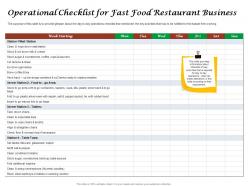
The purpose of this slide is to provide glimpse about the day to day operations checklist that mentioned the key activities that has to be fulfilled for the hassle free working
People who downloaded this PowerPoint presentation also viewed the following :
Operational checklist for fast food restaurant business ppt powerpoint tips with all 2 slides:
Use our Operational Checklist For Fast Food Restaurant Business Ppt Powerpoint Tips to effectively help you save your valuable time. They are readymade to fit into any presentation structure.

FAQs for Operational checklist for fast food restaurant business
Fast food restaurants should monitor daily KPIs including average order time, customer wait duration, food waste percentages, labor cost ratios, and sales per hour metrics. These indicators streamline operations by identifying bottlenecks, optimizing staff scheduling, and minimizing waste, with many franchises finding that consistent tracking delivers faster service, reduced costs, and enhanced customer satisfaction across locations.
Staff training programs can be structured through standardized modules covering food safety protocols, preparation techniques, customer interaction standards, and quality control procedures. These programs enhance operational consistency by implementing hands-on practice sessions, regular competency assessments, and mentorship pairing, with many fast food chains finding that structured certification tracks ultimately deliver faster service times and improved customer satisfaction scores.
Food safety best practices include regular hand washing protocols, proper food storage temperatures, sanitized surface cleaning, employee health monitoring, and documented HACCP procedures. These measures streamline operations by preventing contamination, reducing waste, and ensuring regulatory compliance, with many fast food chains finding that systematic hygiene protocols ultimately deliver customer trust and operational efficiency.
Fast food restaurants can optimize menus by analyzing sales data to identify high-margin items, streamlining offerings to reduce complexity, and strategically pricing popular combinations. Through menu engineering techniques, restaurants balance customer favorites with profitable items, implement dynamic pricing during peak hours, and regularly test new products while removing underperformers, ultimately enhancing operational efficiency and customer experience.
Technology solutions include mobile ordering apps, contactless payment systems, AI-powered drive-thru assistants, self-service kiosks, and integrated POS platforms. These technologies streamline operations by reducing wait times, minimizing order errors, and automating payment processing, with many fast food chains finding that customers experience faster service while restaurants achieve lower labor costs and improved operational efficiency.
Effective inventory management requires implementing automated tracking systems, establishing par levels for each ingredient, conducting regular cycle counts, and using first-in-first-out rotation protocols. Through predictive analytics and real-time monitoring, restaurants can minimize food waste by up to 30%, ensure consistent availability of high-demand items like popular burgers and fries, ultimately delivering improved profit margins and customer satisfaction.
**INPUT**: What strategies can be employed to improve the speed of service during peak hours? **OUTPUT**: Effective peak-hour strategies include streamlined prep workflows, strategic staff positioning, pre-order technology integration, menu optimization, and cross-trained team deployment. These approaches enhance operational efficiency by reducing wait times, maximizing kitchen throughput, and improving customer flow management, with many fast-food chains finding that strategic combination of technology and workforce planning ultimately delivers faster service and increased customer satisfaction.
Effective communication enhances restaurant operations by streamlining order accuracy, coordinating kitchen timing, and ensuring seamless customer service delivery across all touchpoints. Through clear protocols and real-time updates, fast food teams minimize errors, reduce wait times, and maintain consistent quality standards, with many establishments finding that structured communication systems ultimately deliver faster service and improved customer satisfaction.
Restaurant layout significantly impacts workflow efficiency and customer satisfaction by optimizing kitchen placement, streamlining service paths, managing queue flow, and creating intuitive dining spaces. Strategic design enables faster order processing, reduces staff movement time, and enhances customer comfort, with many fast food chains finding that well-planned layouts deliver shorter wait times and improved operational efficiency.
Customer feedback can be effectively gathered through digital surveys, mobile apps, social media monitoring, comment cards, and direct staff interactions during service. Fast food restaurants like McDonald's and Subway use these methods to identify popular menu items, service pain points, and operational inefficiencies, ultimately enhancing customer satisfaction, streamlining operations, and driving repeat business.
Fast food restaurants can ensure compliance with local health and safety regulations through regular staff training on food handling protocols, maintaining detailed temperature logs for food storage and preparation, conducting frequent equipment sanitization, implementing proper waste disposal procedures, and scheduling routine internal audits. These systematic approaches streamline operations while minimizing health violations, with many establishments finding that consistent compliance protocols ultimately deliver improved customer trust, reduced liability risks, and enhanced operational efficiency in an increasingly regulated food service environment.
Aligning marketing initiatives with operational capabilities requires strategic coordination between promotional campaigns, staffing levels, inventory management, and kitchen capacity to ensure seamless execution. Fast food restaurants achieve this balance by implementing phased campaign rollouts, cross-training staff for peak periods, and utilizing data analytics to predict demand surges, ultimately delivering enhanced customer experiences while maintaining operational efficiency and profitability.
Effective staff motivation methods include competitive compensation packages, flexible scheduling options, performance-based incentives, clear advancement pathways, and regular recognition programs. These approaches streamline retention by creating workplace stability, reducing recruitment costs, and maintaining service consistency, with many fast-food chains finding that investing in employee development and team-building activities ultimately delivers improved customer satisfaction and operational efficiency.
Emergency procedures should be developed through comprehensive risk assessment, clear evacuation protocols, staff training programs, regular safety drills, and coordination with local emergency services. Fast food restaurants benefit from practicing these procedures monthly, with managers conducting fire drills, medical emergency simulations, and security threat responses, ultimately ensuring swift action during crises while maintaining customer confidence and regulatory compliance.
Fast food restaurants can leverage data analytics through sales pattern analysis, customer behavior tracking, inventory optimization, staffing predictions, and performance monitoring across locations. These data-driven insights enable operators to adjust menu offerings, optimize supply chains, schedule staff efficiently, and enhance customer experiences, while many restaurant chains finding that strategic analytics implementation delivers reduced waste, faster service times, and significantly improved operational efficiency.
-
Graphics are very appealing to eyes.
-
Great designs, Easily Editable.
-
Attractive design and informative presentation.
-
Wonderful templates design to use in business meetings.