


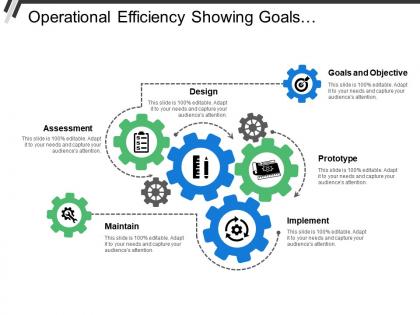
Operational efficiency showing goals assessment design prototype and implement




Try Before you Buy Download Free Sample Product
 Impress Your
 Audience
 100%
100% Editable
 Save Hours
 of Time


Exercise better control with our Operational Efficiency Showing Goals Assessment Design Prototype And Implement. You will get the firmest of grips.
People who downloaded this PowerPoint presentation also viewed the following :
Operational efficiency showing goals assessment design prototype and implement with all 5 slides:
Our Operational Efficiency Showing Goals Assessment Design Prototype And Implement team are real eager beavers. All agog to create a structure for your thoughts.




FAQs for Operational efficiency showing goals assessment design
Key performance indicators for operational efficiency include throughput rates, resource utilization ratios, cycle time reductions, cost per unit produced, and overall equipment effectiveness (OEE). These metrics enable organizations to streamline workflows, minimize waste, and enhance productivity across manufacturing, healthcare, and financial services, with many companies finding that tracking these KPIs delivers measurable competitive advantage.
Businesses can leverage technology to enhance operational efficiency through automation software, cloud computing, data analytics, artificial intelligence, and integrated management systems. These technologies streamline workflows by eliminating manual tasks, optimizing resource allocation, and providing real-time insights, with many organizations finding that strategic technology adoption delivers faster processes, reduced costs, and improved competitive positioning.
Employee training and development enhance operational efficiency by building essential skills, reducing errors, streamlining workflows, and increasing productivity across all business functions. Well-trained employees in manufacturing, healthcare, and financial services deliver faster task completion, improved quality control, and better resource utilization, ultimately reducing operational costs while enhancing customer satisfaction and competitive advantage.
Process mapping contributes to identifying operational inefficiencies by visualizing workflows, revealing bottlenecks, redundant steps, and resource allocation gaps that often remain hidden in daily operations. Through detailed workflow analysis, organizations across manufacturing, healthcare, and financial services streamline processes, reduce cycle times, and eliminate waste, ultimately delivering cost savings and enhanced productivity while enabling data-driven optimization decisions.
Best practices for streamlining supply chain operations include demand forecasting analytics, supplier relationship optimization, inventory management automation, real-time tracking systems, and integrated logistics platforms. These approaches enhance operational efficiency by reducing costs, minimizing delays, and improving transparency across the entire chain, with many manufacturing and retail organizations finding that strategic supplier partnerships and predictive analytics ultimately deliver faster response times and competitive advantage.
Data analytics transforms operational decision-making by providing real-time insights, predictive modeling, and performance benchmarking that eliminate guesswork from efficiency strategies. Through advanced analytics platforms, organizations streamline resource allocation, identify bottlenecks before they impact productivity, and optimize workflows based on data-driven evidence, ultimately delivering faster response times and measurable cost reductions.
Automation can be integrated through process mapping, task prioritization, workflow orchestration, data synchronization, and performance monitoring systems. These technologies streamline operations by eliminating manual bottlenecks, reducing processing times, and minimizing errors, with many organizations finding that strategic automation delivers faster service delivery, lower operational costs, and enhanced competitive advantage.
Organizations face challenges including resistance to change, inadequate technology infrastructure, insufficient data analytics capabilities, lack of cross-departmental coordination, and limited employee training resources. These obstacles often result in fragmented implementation across departments, with many companies finding that successful initiatives require strategic leadership commitment, comprehensive change management, and phased rollouts that demonstrate early wins while building organizational momentum.
Continuous improvement methodologies like Lean and Six Sigma foster operational efficiency by eliminating waste, reducing process variation, and streamlining workflows through systematic data analysis and standardization. These approaches enable organizations across manufacturing, healthcare, and financial services to minimize costs, accelerate delivery times, and enhance quality control, ultimately delivering measurable productivity gains and competitive advantage.
Poor operational efficiency creates cascading impacts including delayed service delivery, inconsistent product quality, higher costs passed to customers, reduced responsiveness to complaints, and limited resources for customer experience improvements. These inefficiencies directly erode customer satisfaction, with many businesses finding that operational bottlenecks lead to increased churn rates, negative reviews, and ultimately diminished competitive advantage in increasingly demanding markets.
Cross-departmental collaboration improves operational efficiency by eliminating silos, streamlining workflows, and reducing redundant processes across teams. Organizations implementing collaborative frameworks, particularly in manufacturing and financial services, experience faster decision-making, enhanced resource allocation, and improved project outcomes, while minimizing bottlenecks and ultimately delivering significant cost reductions and competitive advantage.
Small businesses can enhance operational efficiency through process automation, workflow standardization, digital tool integration, employee cross-training, and strategic vendor partnerships. These approaches streamline daily operations by reducing manual tasks, minimizing errors, and optimizing resource allocation, with many small enterprises finding that simple technology adoption and process improvements deliver significant cost savings and competitive advantages.
Outsourcing non-core functions enhances operational efficiency by allowing organizations to focus internal resources on strategic activities, reduce overhead costs, and access specialized expertise. Companies in manufacturing, healthcare, and financial services streamline operations through outsourced IT support, payroll processing, and customer service, ultimately delivering faster decision-making and improved competitive positioning.
Effective operational efficiency tools include enterprise resource planning (ERP) systems, business intelligence platforms, process automation software, performance dashboards, and workflow management applications. These technologies streamline operations by providing real-time visibility, automating repetitive tasks, and identifying bottlenecks, with manufacturing and retail organizations finding that integrated monitoring delivers faster decision-making and significantly reduced operational costs.
Organizational culture and leadership significantly influence operational efficiency by establishing clear expectations, promoting continuous improvement mindsets, and fostering employee engagement across all levels. Strong leaders drive efficiency initiatives through strategic resource allocation, transparent communication, and accountability systems, while positive cultures encourage collaboration and innovation, ultimately delivering streamlined processes and sustainable competitive advantage.
-
Excellent design and quick turnaround.
-
Amazing product with appealing content and design.