

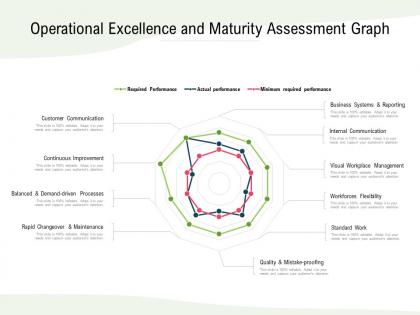
Operational excellence and maturity assessment graph




Try Before you Buy Download Free Sample Product
 Impress Your
Audience
 100%
Editable
 Save Hours
of Time


Come across as discerning with our Operational Excellence And Maturity Assessment Graph. You will display a feel for the exclusive.
People who downloaded this PowerPoint presentation also viewed the following :
Operational excellence and maturity assessment graph with all 2 slides:
Display a feel for the exclusive with our Operational Excellence And Maturity Assessment Graph. You will come across as discerning.


FAQs for Operational excellence and
Key dimensions include leadership commitment, process standardization, continuous improvement culture, performance measurement systems, and employee engagement capabilities. These dimensions work synergistically by establishing clear governance structures, standardizing workflows across operations, and fostering data-driven decision making, with many organizations finding that balanced development across all dimensions accelerates their transformation journey.
The Operational Excellence Maturity Model differs from traditional continuous improvement frameworks by providing structured progression stages, comprehensive organizational assessment capabilities, and strategic alignment across all business functions rather than focusing on isolated process improvements. While traditional frameworks often emphasize incremental gains through specific methodologies, maturity models enable organizations to systematically evaluate their current state, identify capability gaps, and develop strategic roadmaps that ultimately deliver sustained competitive advantage and organizational transformation.
The stages include Reactive (firefighting and ad-hoc responses), Defined (standardized processes and documentation), Managed (metrics-driven performance monitoring), Optimized (continuous improvement initiatives), and Innovation-Driven (proactive transformation and breakthrough thinking). These progressive stages enable organizations to evolve from crisis management to strategic advantage, with many manufacturing and service companies finding that advancing through each level delivers measurable cost reductions, enhanced efficiency, and sustainable competitive positioning.
Organizations assess operational excellence maturity through comprehensive evaluations covering process standardization, performance metrics, continuous improvement capabilities, employee engagement levels, and technology integration across departments. These assessments typically involve benchmarking against industry standards, conducting gap analyses, and measuring key indicators like defect rates, cycle times, and customer satisfaction, with many finding that structured maturity models ultimately deliver clearer improvement roadmaps and enhanced competitive positioning.
Leadership drives operational excellence maturity by establishing clear vision, allocating resources strategically, and fostering continuous improvement cultures across organizations. Through executive sponsorship and middle management engagement, leaders enable cross-functional collaboration, data-driven decision making, and systematic process optimization, with many companies finding that sustained leadership commitment ultimately delivers measurable performance improvements and competitive advantage.
Cross-functional teams drive operational excellence by breaking down silos, accelerating decision-making, and combining diverse expertise to solve complex challenges more effectively. These collaborative structures enable organizations to streamline processes, reduce handoff delays, and implement improvements faster, with many companies finding that integrated teams deliver significantly better customer outcomes and operational efficiency.
Key metrics include process efficiency ratios, defect rates, cycle times, customer satisfaction scores, employee engagement levels, and cost per unit measurements. These indicators enable organizations to track advancement across maturity stages, with manufacturing companies, healthcare systems, and financial services finding that comprehensive dashboards combining operational, quality, and financial metrics ultimately deliver measurable improvements and competitive advantage.
Cultural change fundamentally drives operational excellence success by fostering employee engagement, establishing continuous improvement mindsets, and aligning organizational behaviors with excellence principles. Companies implementing these initiatives find that strong leadership commitment, clear communication of benefits, and employee empowerment create sustainable transformation, while resistance to change can significantly hinder progress and long-term adoption.
Operational Excellence Maturity Models typically integrate Lean Six Sigma, Total Quality Management, continuous improvement frameworks, process mapping tools, and performance management systems. These methodologies work together by eliminating waste, standardizing processes, and measuring outcomes, with organizations across manufacturing, healthcare, and financial services finding that this strategic combination delivers enhanced efficiency, reduced costs, and sustainable competitive advantage.
Technology and automation accelerate operational excellence by streamlining workflows, eliminating manual errors, and providing real-time data analytics for informed decision-making. Through AI-powered systems, organizations enhance quality control, optimize resource allocation, and automate routine processes, with manufacturing and financial services finding these solutions deliver faster throughput, reduced costs, and improved customer experiences while maintaining competitive advantage.
Common challenges include resistance to change, insufficient leadership commitment, inadequate resource allocation, lack of clear performance metrics, and siloed organizational structures. While these obstacles can initially slow progress, organizations in manufacturing, healthcare, and financial services find that addressing cultural barriers early, establishing cross-functional teams, and implementing phased approaches ultimately delivers sustained operational improvements and competitive advantage.
Businesses can create an operational excellence roadmap by conducting comprehensive current-state assessments, defining specific maturity targets, identifying capability gaps, and establishing phased implementation timelines with measurable milestones. Through strategic planning and resource allocation, organizations systematically advance from basic standardization to advanced optimization, with many finding that structured progression delivers sustained competitive advantage and measurable performance improvements.
Manufacturing, healthcare, financial services, aerospace, and energy sectors have successfully applied the Operational Excellence Maturity Model, with many organizations finding significant improvements in efficiency, quality, and cost reduction. These industries demonstrate that systematic progression through maturity levels enables streamlined processes, enhanced customer satisfaction, and competitive advantage, while emphasizing the importance of leadership commitment and cultural transformation.
Employee engagement significantly impacts operational excellence by driving higher productivity, improved quality outcomes, reduced error rates, and enhanced continuous improvement participation. Engaged employees in manufacturing, healthcare, and service organizations actively identify process inefficiencies, propose innovative solutions, and sustain improvement initiatives more effectively, with many companies finding that workforce engagement directly correlates with operational performance metrics and competitive advantage.
A systematic approach to operational excellence maturity delivers enhanced process standardization, improved resource allocation, reduced operational variability, increased organizational alignment, and measurable performance improvements. This structured methodology enables organizations across manufacturing, healthcare, and financial services to achieve sustained cost reductions, accelerated service delivery, and competitive advantage, with many finding that systematic maturity assessment drives continuous improvement culture.
No Reviews