

Operational Methods Powerpoint Presentation Slides




Try Before you Buy Download Free Sample Product
 Impress Your
 Audience
 100%
100% Editable
 Save Hours
 of Time


To achieve the organizational goals, it is essential to use some effective business operational strategies. Utilize our expertly designed operational methods PowerPoint presentation slides. It would further help you to make and describe the relevance of these methods for business success and help in making a result-oriented business strategy. You can use this operational methods PPT slide to build an effective operational strategy for the diverse business operations such as human resources, productions, procurement, store, accounts, it and many more. Thus this operational methods PowerPoint design helps in improving the overall efficiency of the business operations also. With this example PPT design you will be ready to speak in various ways which causes you to build the income of your organization with the powerful operational strategy, for example, it enhances the operational productivity, it's extremely savvy and so on. In this manner simply start working once again this PowerPoint template. Thus download it now. Our Operational Methods Powerpoint Presentation Slides ensure continuous activity. They don't allow anything to come to a halt.
People who downloaded this PowerPoint presentation also viewed the following :
Content of this Powerpoint Presentation
Slide 1: This slide introduces Operational Methods. State Your Company Name and get started.
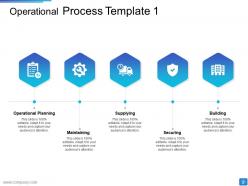
Slide 2: This slide shows Operational Process Template with the following subheadings- Maintaining, Securing, Operational Planning, Supplying, Building.
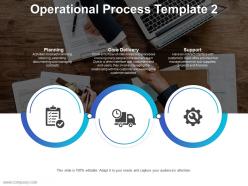
Slide 3: This slide shows Operational Process Template with the following subheadings- Planning, Core Delivery, Support.
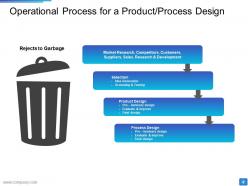
Slide 4: This slide showcases Operational Process for a Product/Process Design with the subheading- Rejects to Garbage: Market Research, Competitors, Customers, Suppliers, Sales, Research & Development Selection (Idea Generation, Screening & Testing) Product Design (Pre – luminary design, Evaluate & improve, Final design) Process Design (Pre – luminary design Evaluate & improve Final design).
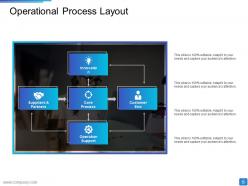
Slide 5: This slide presents Operational Process Layout with- Operation Support, Innovation, Core Process, Suppliers & Partners, Customer End.
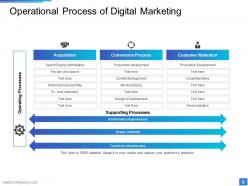
Slide 6: This slide presents Operational Process of Digital Marketing with- Operating Processes and Supporting Processes divided into: Acquisition, Conversion Process, Customer Retention.
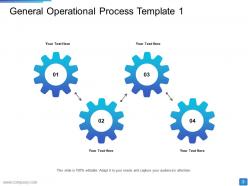
Slide 7: This slide presents the first General Operational Process Template.
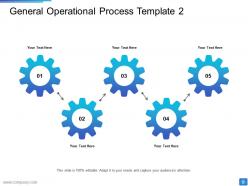
Slide 8: This slide presents the second General Operational Process Template.
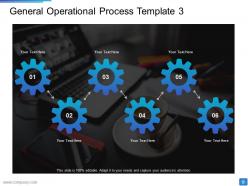
Slide 9: This slide presents the third General Operational Process Template.
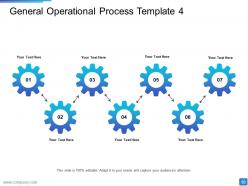
Slide 10: This slide shows the fourth General Operational Process Template.
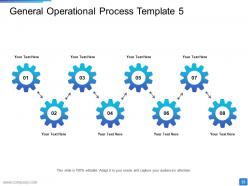
Slide 11: This slide shows the fifth General Operational Process Template.
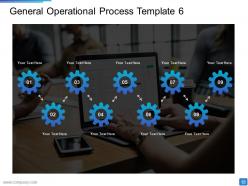
Slide 12: This slide shows the sixth General Operational Process Template.
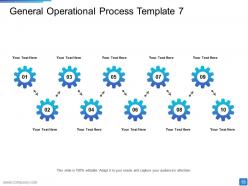
Slide 13: This slide presents the seventh General Operational Process Template.
Slide 14: This is an Icon Slide for the topic. Use them as per your need.
Slide 15: This is a Coffee Break slide to halt. You can change the slide content as per requirement.
Slide 16: This slide is titled Graphs and Charts to move forward.
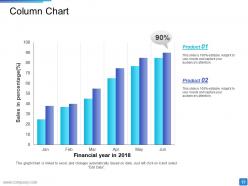
Slide 17: This is a Column Chart to show product/entity comparison etc.
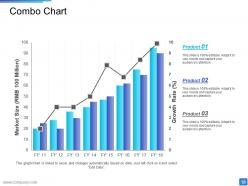
Slide 18: This is a Combo Chart to show product/entity comparison etc.
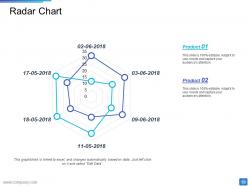
Slide 19: This is a Radar Chart to show product/entity comparison etc.
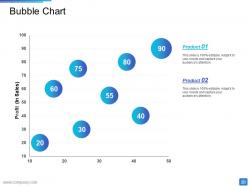
Slide 20: This is a Bubble Chart to show product/entity comparison etc.
Slide 21: This slide is titled Additional Slides to move forward.
Slide 22: This is Our Mission slide with Mission, Vision and Goal. State them here.
Slide 23: This is an About Us slide. State company/team specifications here.
Slide 24: This is a Thank You slide with Email Address:Contact Numbers, Address# street number, city, state.
Operational Methods Powerpoint Presentation Slides with all 24 slides:
Expose the facts hidden beneath with our Operational Methods Powerpoint Presentation Slides. It helps brush away the dirt.







FAQs for Operational Methods
Key operational methods in manufacturing include lean manufacturing, Six Sigma, just-in-time production, total productive maintenance, and automation integration. These approaches streamline operations by eliminating waste, reducing defects, and optimizing resource allocation, with many automotive and electronics manufacturers finding that strategic combination of these methods delivers significantly lower costs, faster production cycles, and enhanced competitive advantage.
Service-oriented businesses can implement operational methods by standardizing service processes, automating customer interactions, implementing feedback systems, optimizing resource allocation, and establishing quality control measures. These approaches streamline service delivery through reduced wait times, personalized experiences, and consistent service quality, with many hospitality, healthcare, and financial services organizations finding that structured operational frameworks ultimately deliver higher customer retention and competitive advantage.
Data analytics optimize operational methods by identifying inefficiencies, predicting maintenance needs, streamlining workflows, and enabling real-time decision-making across organizational processes. Through advanced analytics platforms, companies in manufacturing, healthcare, and retail enhance resource allocation, reduce operational costs, and improve service delivery, while ultimately gaining competitive advantage in increasingly data-driven markets.
Agile operational methods revolutionize tech project management by enabling iterative development, continuous feedback loops, cross-functional collaboration, and adaptive planning cycles. These approaches streamline delivery timelines, enhance product quality, and improve team responsiveness, with many software companies finding that agile frameworks ultimately deliver faster market entry and superior customer satisfaction.
Best practices for developing SOPs include conducting thorough process mapping, engaging frontline employees in documentation, using clear visual aids and flowcharts, implementing regular review cycles, and ensuring accessibility across teams. These approaches streamline operations by reducing errors, accelerating training, and maintaining consistency, with many organizations finding that well-designed SOPs ultimately deliver improved compliance and operational efficiency.
Lean operational methods reduce supply chain waste by eliminating non-value-added activities, optimizing inventory levels, and streamlining processes through just-in-time delivery and continuous improvement practices. Manufacturing companies and retailers increasingly find that these approaches minimize excess inventory, reduce transportation costs, and enhance supplier coordination, ultimately delivering faster responsiveness and improved operational efficiency.
Employee training significantly enhances operational method effectiveness by improving skill proficiency, reducing errors, and accelerating process adoption across teams. Well-trained employees in manufacturing, healthcare, and financial services consistently deliver faster project completion, higher quality outputs, and better customer satisfaction, with organizations finding that comprehensive training programs ultimately reduce operational costs while boosting competitive advantage.
Companies integrate sustainability into operational methods through energy-efficient technologies, waste reduction programs, sustainable supply chain partnerships, circular economy practices, and carbon footprint monitoring systems. These approaches streamline resource utilization while reducing costs, with many manufacturing and retail organizations finding that sustainable operations enhance brand reputation, attract environmentally conscious customers, and ultimately deliver competitive advantage in an increasingly eco-focused marketplace.
Implementing operational methods remotely presents challenges including communication barriers, technology integration complexities, performance monitoring difficulties, team coordination issues, and maintaining company culture consistency. While organizations face obstacles with standardizing processes across distributed teams, many are finding that strategic digital tool adoption, enhanced virtual collaboration frameworks, and flexible methodology adaptations ultimately deliver improved operational efficiency and competitive advantage.
Kaizen integrates seamlessly into operational methods by embedding systematic, incremental improvements throughout daily workflows, processes, and team practices. This philosophy transforms routine operations through employee-driven innovation, waste reduction, and standardized problem-solving protocols, with manufacturing companies, healthcare systems, and service organizations finding that continuous small enhancements ultimately deliver significant cost savings and competitive operational advantages.
Operational methods to enhance safety protocols include automated monitoring systems, predictive maintenance programs, real-time risk assessment tools, comprehensive training simulations, and integrated communication networks. These approaches streamline safety management by minimizing human error, accelerating incident response, and enhancing compliance tracking, with many chemical plants and oil refineries finding that strategic combinations ultimately deliver reduced workplace accidents and operational efficiency.
Automation technologies augment traditional operational methods by streamlining repetitive tasks, enhancing data accuracy, and accelerating decision-making processes across organizations. Through robotic process automation and AI-driven analytics, companies in manufacturing, financial services, and healthcare significantly reduce manual errors, optimize resource allocation, and deliver faster customer responses, ultimately achieving competitive advantage in increasingly demanding markets.
Cross-functional teams leverage operational methods like design thinking, agile frameworks, lean startup principles, process mapping, and data-driven decision making for innovation. These approaches streamline collaboration by breaking down silos, accelerating prototype development, and minimizing resource waste, with many organizations finding that diverse expertise combined with structured methodologies delivers faster innovation cycles and more market-responsive solutions.
Organizations should evaluate operational methods using key performance indicators including efficiency ratios, cost per unit, cycle time reduction, quality scores, and customer satisfaction ratings. These metrics enable businesses to identify bottlenecks, optimize resource allocation, and streamline processes, with many companies finding that comprehensive measurement ultimately delivers improved profitability and competitive advantage.
Cultural differences significantly impact operational method adoption through varying communication styles, hierarchy preferences, decision-making processes, and change resistance levels across regions. While some cultures embrace rapid standardization, others require localized approaches, with many multinational companies finding that flexible implementation strategies, cultural training programs, and regional leadership involvement ultimately deliver smoother transitions and sustained operational excellence.
-
Professional and unique presentations.
-
Helpful product design for delivering presentation.