

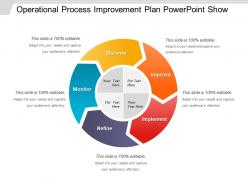
Operational process improvement plan powerpoint show





Try Before you Buy Download Free Sample Product
 Impress Your
 Audience
 100%
100% Editable
 Save Hours
 of Time


Deliver empowering advice with our Operational Process Improvement Plan Powerpoint Show. They will find your coaching beneficial.
People who downloaded this PowerPoint presentation also viewed the following :
Operational process improvement plan powerpoint show with all 5 slides:
Collate all the individual bits of evidence with our Operational Process Improvement Plan Powerpoint Show. It helps handle judicial affairs.



FAQs for Operational process improvement
Key components of an effective Operational Improvement Plan include process mapping, performance metrics, resource allocation, timeline milestones, and stakeholder accountability frameworks. These elements work together by identifying bottlenecks, establishing measurable targets, and creating systematic implementation pathways, with many organizations finding that this structured approach delivers enhanced efficiency, reduced costs, and sustainable competitive advantage.
Data analytics enhances operational improvement decisions by providing real-time insights, predictive modeling, and performance benchmarking that eliminate guesswork from strategic planning. Through advanced analytics platforms, organizations streamline resource allocation, identify bottlenecks before they impact productivity, and optimize workflows based on actual performance data, ultimately delivering faster implementation cycles and measurable ROI improvements.
Organizations should avoid inadequate change management, unrealistic timelines, insufficient employee training, and lack of leadership commitment when implementing operational improvement plans. These pitfalls often result in resistance to change, failed initiatives, and wasted resources, with many companies finding that comprehensive stakeholder engagement, phased implementation approaches, and continuous monitoring ultimately deliver sustainable improvements and lasting competitive advantage.
Aligning an Operational Improvement Plan with business strategy requires establishing clear connections between operational metrics and strategic objectives, integrating improvement initiatives with long-term goals, and ensuring resource allocation supports priority areas. This strategic alignment enables organizations to streamline processes while advancing market position, with many companies finding that synchronized operational improvements ultimately deliver measurable competitive advantages and sustainable growth.
Employee engagement drives operational improvement success by ensuring staff buy-in, reducing resistance to change, enhancing implementation quality, and accelerating adoption rates. Engaged employees actively contribute ideas, identify process inefficiencies, and maintain momentum during transitions, with organizations finding that high engagement levels deliver faster implementation timelines, better sustainability of improvements, and ultimately stronger competitive advantage through enhanced operational efficiency.
Effective KPIs for operational improvement plans should be specific, measurable, time-bound metrics aligned with strategic objectives, including productivity ratios, cost reduction percentages, quality scores, and customer satisfaction indices. Organizations typically establish baseline measurements, set realistic targets, and implement regular monitoring cycles, with manufacturing companies tracking throughput rates and service sectors measuring response times, ultimately enabling data-driven decision making and continuous performance optimization.
Lean, Six Sigma, Kaizen, Total Quality Management, and Agile methodologies are most effective for operational improvement, each targeting waste reduction, process optimization, and quality enhancement. These approaches streamline operations by identifying bottlenecks, standardizing workflows, and implementing data-driven solutions, with manufacturing, healthcare, and financial services organizations finding that strategic combinations deliver significant cost reductions and competitive advantage.
Cross-departmental collaboration during Operational Improvement Plan implementation can be facilitated through regular inter-departmental meetings, shared project management platforms, cross-functional teams, and unified performance metrics that align all departments toward common goals. These collaborative approaches streamline communication, minimize silos, and enhance coordination across functions like operations, finance, and HR, ultimately delivering faster implementation timelines and more comprehensive operational improvements.
Emerging technologies essential for operational improvement include artificial intelligence and machine learning, robotic process automation, IoT sensors and analytics, cloud computing platforms, and predictive maintenance systems. These technologies enhance operational efficiency by automating routine tasks, providing real-time data insights, and enabling predictive decision-making, with manufacturing and logistics companies finding significant cost reductions and streamlined workflows.
Change management principles ensure smooth operational improvement implementation by establishing clear communication channels, securing leadership buy-in, providing comprehensive training, and creating feedback mechanisms for continuous adjustment. These approaches minimize resistance through stakeholder engagement, phased rollouts, and transparent progress tracking, with many organizations finding that early employee involvement and celebrating quick wins ultimately delivers higher adoption rates and sustainable operational excellence.
Toyota's lean manufacturing system revolutionized automotive production by eliminating waste, implementing just-in-time delivery, and empowering employee feedback, while Amazon's warehouse automation and predictive analytics streamlined fulfillment operations. These operational transformations delivered significant cost reductions, faster cycle times, and enhanced customer experiences, with many organizations finding that systematic process optimization ultimately provides sustainable competitive advantage.
Operational improvement plans should be reviewed quarterly for progress tracking and updated annually for strategic alignment, with additional reviews triggered by significant market changes, technology shifts, or performance gaps. Many organizations find that quarterly assessments enable rapid course corrections while annual updates ensure long-term strategic relevance, ultimately delivering sustained operational excellence and competitive advantage.
Key metrics include operational efficiency ratios, cost reduction percentages, cycle time improvements, quality scores, and customer satisfaction indices. These measurements enable organizations to track tangible outcomes like faster processing times, reduced waste, and enhanced service delivery, with many companies finding that balanced scorecards combining financial and operational metrics provide comprehensive visibility into improvement impact.
Organizations ensure sustainability in operational improvement efforts by embedding changes into company culture, establishing continuous monitoring systems, providing ongoing employee training, and creating feedback loops for iterative refinement. Through systematic change management approaches, companies develop lasting operational excellence that adapts to evolving business needs, with many finding that regular performance reviews and stakeholder engagement ultimately deliver sustained competitive advantage.
Staff involved in operational improvement initiatives require training in process mapping, data analysis, lean methodologies, project management, and change management principles. These skills enable employees to identify inefficiencies, implement streamlined workflows, and drive sustainable improvements, with many organizations finding that cross-functional training ultimately delivers enhanced collaboration and measurable operational results.
-
Unique research projects to present in meeting.
-
Commendable slides with attractive designs. Extremely pleased with the fact that they are easy to modify. Great work!