

Operational Risk Management And Assessment Organizational Risk Management DTE SS




Try Before you Buy Download Free Sample Product
 Impress Your
Audience
 100%
Editable
 Save Hours
of Time


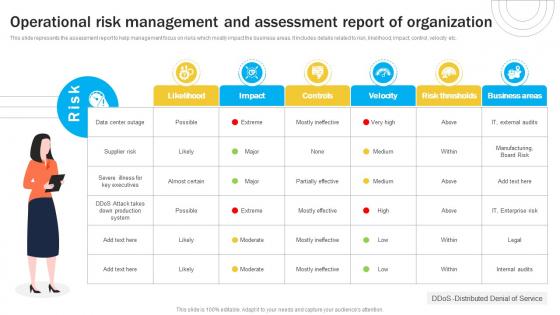
This slide represents the assessment report to help management focus on risks which mostly impact the business areas. It includes details related to risk, likelihood, impact, control, velocity etc.
People who downloaded this PowerPoint presentation also viewed the following :
Operational Risk Management And Assessment Organizational Risk Management DTE SS with all 9 slides:
Use our Operational Risk Management And Assessment Organizational Risk Management DTE SS to effectively help you save your valuable time. They are readymade to fit into any presentation structure.








FAQs for Operational Risk Management And Assessment Organizational Risk
Key components include risk identification processes, comprehensive assessment methodologies, robust control mechanisms, continuous monitoring systems, and clear governance structures. These frameworks enhance organizational resilience by streamlining risk detection, automating compliance tracking, and enabling proactive mitigation strategies, with many financial institutions and healthcare organizations finding that integrated approaches ultimately deliver improved operational efficiency and regulatory compliance.
Organizations identify and assess operational risks through comprehensive risk mapping, process audits, data analysis, stakeholder interviews, and scenario planning exercises. These methodologies enable systematic evaluation by examining workflow vulnerabilities, regulatory compliance gaps, and resource dependencies, with many financial institutions and healthcare organizations finding that regular risk assessments ultimately deliver enhanced operational resilience and strategic competitive advantage.
Technology enhances operational risk management through automated monitoring systems, predictive analytics, real-time data integration, artificial intelligence algorithms, and comprehensive reporting platforms. These solutions streamline risk identification, assessment, and mitigation by enabling continuous surveillance, reducing manual errors, and accelerating response times, with many financial institutions and healthcare organizations finding significantly improved compliance and operational efficiency.
Regulatory requirements shape operational risk management strategies by mandating specific compliance frameworks, reporting standards, and risk assessment protocols across industries. Financial institutions, healthcare organizations, and manufacturing companies must align their risk strategies with evolving regulations, ultimately driving enhanced transparency, systematic risk monitoring, and stronger governance structures that deliver competitive advantage.
Common operational risk indicators include system downtime patterns, employee turnover rates, customer complaint trends, process deviation reports, and compliance audit findings. These warning signals help organizations identify vulnerabilities before they escalate, with many financial institutions and healthcare providers finding that proactive monitoring of these indicators enables faster response times, reduces potential losses, and maintains operational continuity.
Companies foster risk-aware culture through comprehensive training programs, clear communication of risk policies, regular workshops, and leadership modeling of risk-conscious behaviors. By implementing anonymous reporting systems, recognizing proactive risk identification, and integrating risk considerations into daily workflows, organizations create environments where employees actively participate in risk mitigation, ultimately delivering enhanced operational resilience and competitive advantage.
Operational risk measurement tools include key risk indicators (KRIs), loss event databases, scenario analysis, risk control self-assessments, and Monte Carlo simulations. These methodologies enhance risk visibility by tracking performance metrics, analyzing historical losses, and modeling potential scenarios, with many financial institutions finding that combining quantitative models with qualitative assessments delivers comprehensive risk insights and regulatory compliance.
Organizations prioritize operational risks by assessing probability, potential impact, regulatory requirements, business continuity implications, and resource availability. Through comprehensive risk matrices and scenario planning, companies in banking, healthcare, and manufacturing can allocate resources strategically, implement targeted mitigation strategies, and enhance response capabilities, ultimately delivering faster incident resolution and improved operational resilience.
Integrating operational risk management with enterprise risk management presents challenges including data standardization across departments, establishing consistent risk metrics, aligning reporting structures, coordinating governance frameworks, and ensuring seamless communication channels. While these integration efforts require significant coordination and resource allocation, organizations increasingly find that unified risk management delivers enhanced visibility, streamlined decision-making, and stronger regulatory compliance across all business units.
Scenario analysis enhances operational risk understanding by modeling potential disruptions, quantifying financial impacts, and identifying vulnerability patterns across different business units. Through stress-testing various risk scenarios, organizations can evaluate preparedness levels, optimize resource allocation, and develop targeted mitigation strategies, with many financial institutions finding that comprehensive scenario planning significantly improves their operational resilience and regulatory compliance.
Operational risk management significantly enhances organizational resilience by identifying vulnerabilities, establishing mitigation protocols, and creating contingency frameworks that enable rapid recovery from disruptions. Through comprehensive risk assessment and monitoring systems, organizations streamline crisis response, minimize operational downtime, and maintain service continuity, with many institutions finding that proactive risk management ultimately delivers competitive advantage and stakeholder confidence.
Communication and reporting improve operational risk management by establishing clear escalation pathways, enabling real-time risk monitoring, and ensuring stakeholder alignment across all organizational levels. Through integrated reporting systems, organizations streamline incident response, enhance regulatory compliance, and facilitate proactive decision-making, with many financial institutions finding that transparent communication ultimately reduces response times and minimizes potential losses.
High-profile operational risk failures reveal critical lessons including inadequate internal controls, poor risk culture, insufficient oversight mechanisms, technology vulnerabilities, and communication breakdowns. Major incidents across banking, healthcare, and manufacturing sectors demonstrate that organizations with robust risk frameworks, regular stress testing, and proactive monitoring systems significantly reduce exposure while enhancing operational resilience and competitive positioning.
External factors like market volatility, regulatory changes, supply chain disruptions, and economic shifts significantly impact operational risk management by altering risk profiles, compliance requirements, and business continuity plans. Organizations must continuously adapt their risk frameworks, enhance monitoring systems, and update mitigation strategies, with many financial institutions and healthcare providers finding that proactive scenario planning and regulatory tracking ultimately deliver greater resilience and competitive advantage.
Organizations can adopt best practices including regular risk assessments, real-time monitoring systems, cross-functional collaboration, automated reporting tools, and continuous staff training programs. These approaches streamline risk identification and response by enhancing visibility, improving decision-making speed, and strengthening organizational resilience, with many financial services and manufacturing companies finding that integrated risk frameworks ultimately deliver reduced operational losses and sustained competitive advantage.
-
The slides come with appealing color schemes and relevant content that helped me deliver a stunning presentation without any hassle!
-
“Excellent information with easy access.”