


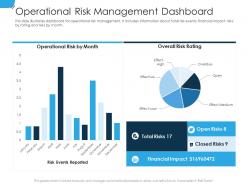
Operational risk management dashboard establishing operational risk framework organization





Try Before you Buy Download Free Sample Product
 Impress Your
Audience
 100%
Editable
 Save Hours
of Time


Our Operational Risk Management Dashboard Establishing Operational Risk Framework Organization are topically designed to provide an attractive backdrop to any subject. Use them to look like a presentation pro.
People who downloaded this PowerPoint presentation also viewed the following :
Operational risk management dashboard establishing operational risk framework organization with all 2 slides:
Use our Operational Risk Management Dashboard Establishing Operational Risk Framework Organization to effectively help you save your valuable time. They are readymade to fit into any presentation structure.

FAQs for Operational risk management dashboard establishing operational
Key components of an effective operational risk framework include risk identification processes, assessment methodologies, control mechanisms, monitoring systems, and incident reporting protocols. These elements work together by establishing clear governance structures, implementing automated detection tools, and creating comprehensive response procedures, with many financial institutions finding that this strategic combination significantly reduces operational losses while enhancing regulatory compliance and organizational resilience.
Organizations prioritize operational risks by conducting comprehensive risk assessments that evaluate probability, potential financial impact, regulatory consequences, and reputational damage across all business units. Through risk matrices, scenario analysis, and quantitative modeling, companies in banking, healthcare, and manufacturing systematically rank threats, enabling strategic resource allocation and ultimately delivering enhanced operational resilience and competitive advantage.
Methodologies for identifying operational risks include risk and control self-assessments, scenario analysis, key risk indicators, process mapping, and incident data analysis. These approaches enhance organizational resilience by systematically evaluating vulnerabilities across departments, enabling proactive risk mitigation, and ultimately delivering improved operational efficiency and regulatory compliance in an increasingly complex business environment.
Technology integration significantly enhances operational risk management by automating risk identification, enabling real-time monitoring, and improving data analytics capabilities across organizational processes. Through AI-powered systems and automated workflows, financial institutions and manufacturing companies streamline compliance reporting, reduce manual errors, and accelerate incident response times, ultimately delivering greater operational efficiency and regulatory transparency.
Staff training and awareness serve as critical frontline defenses against operational risks by ensuring employees recognize potential threats, understand proper procedures, and respond appropriately to emerging situations. Through comprehensive education programs, organizations significantly reduce human error incidents, enhance compliance adherence, and create a risk-aware culture, with many financial institutions finding that well-trained staff proactively identify vulnerabilities before they escalate into costly operational failures.
Companies measure operational risk framework effectiveness through key performance indicators like incident frequency reduction, financial loss minimization, regulatory compliance rates, and risk response times. These metrics enable organizations to track improvements across departments, identify emerging vulnerabilities, and demonstrate ROI to stakeholders, with many financial institutions and healthcare systems finding that regular assessment cycles ultimately deliver enhanced operational resilience and competitive advantage.
Organizations should implement standardized reporting templates, establish clear escalation procedures, maintain real-time incident tracking systems, ensure comprehensive root cause analysis, and create centralized documentation repositories. Through automated workflows and defined timelines, companies in banking, healthcare, and manufacturing streamline incident response, enhance regulatory compliance, and ultimately deliver faster resolution times while building robust knowledge bases for future risk prevention.
Regulatory requirements significantly shape operational risk frameworks by mandating specific risk identification processes, reporting standards, capital adequacy measures, and governance structures that organizations must implement. Financial institutions, healthcare systems, and energy companies increasingly find that compliance-driven frameworks enhance overall risk management capabilities, streamline audit processes, and deliver improved operational transparency, ultimately providing competitive advantage through stronger stakeholder confidence.
Essential metrics for monitoring operational risk include key risk indicators (KRIs), loss frequency and severity rates, control effectiveness scores, incident response times, and regulatory compliance percentages. These metrics enable organizations to track risk trends, measure control performance, and identify emerging vulnerabilities across departments, with many financial institutions finding that comprehensive dashboards ultimately deliver enhanced decision-making and reduced operational losses.
Organizations should establish clear risk appetite statements defining acceptable operational risk levels across key business areas, supported by quantitative tolerance thresholds for specific risk categories like technology failures, process breakdowns, and compliance breaches. This strategic combination enables management to make informed decisions about resource allocation and control investments, while providing clear escalation triggers, ultimately delivering consistent risk-based decision making and enhanced operational resilience across the enterprise.
Common challenges include inadequate data quality, resistance to cultural change, resource constraints, complex regulatory requirements, and siloed organizational structures. These obstacles often create implementation delays and reduced effectiveness, with many financial institutions finding that addressing data governance early, securing executive sponsorship, and establishing cross-functional collaboration ultimately delivers smoother rollouts and better risk visibility.
Scenario analysis enhances operational risk assessment by modeling potential loss events, stress-testing business continuity plans, and quantifying impacts across different operational disruptions. Through structured what-if modeling, organizations evaluate cybersecurity breaches, system failures, and regulatory changes, enabling proactive risk mitigation strategies and more accurate capital allocation decisions.
Organizations can foster risk awareness through comprehensive training programs, regular risk communication sessions, leadership modeling of risk-conscious behavior, integration of risk metrics into performance evaluations, and establishing clear escalation protocols. These strategies enhance transparency and accountability across departments, with many financial institutions and healthcare organizations finding that employee engagement in risk identification increases significantly, ultimately delivering stronger operational resilience and competitive advantage.
Third-party relationships introduce operational risks through vendor failures, data breaches, compliance gaps, and service disruptions that can impact business continuity. Organizations manage these risks by implementing comprehensive due diligence processes, continuous monitoring systems, and contractual safeguards, while establishing backup vendors and regular performance assessments, ultimately delivering enhanced operational resilience and competitive advantage.
Operational risk frameworks can be tailored through industry-specific risk assessments, customized control measures, sector-relevant compliance requirements, and specialized monitoring systems. Financial services focus on regulatory capital and fraud prevention, while manufacturing emphasizes supply chain disruptions and safety protocols, with healthcare prioritizing patient data security and regulatory compliance, ultimately enabling organizations to address their unique operational challenges while maintaining strategic competitive advantage.
-
Illustrative design with editable content. Exceptional value for money. Highly pleased with the product.
-
Perfect template with attractive color combination.
-
Understandable and informative presentation.
-
Great designs, Easily Editable.
-
Excellent work done on template design and graphics.