

Opportunities And Risks Of ChatGPT In Cybersecurity AI CD V




Try Before you Buy Download Free Sample Product
 Impress Your
Audience
 100%
Editable
 Save Hours
of Time


Our Opportunities And Risks Of ChatGPT In Cybersecurity AI CD V are topically designed to provide an attractive backdrop to any subject. Use them to look like a presentation pro.
People who downloaded this PowerPoint presentation also viewed the following :
Content of this Powerpoint Presentation
Slide 1: The slide represents Opportunities and risks of ChatGPT in cybersecurity. State your firm name.
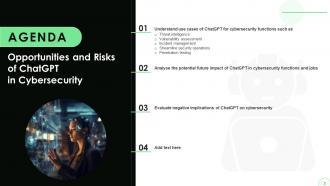
Slide 2: This is an Agenda slide. State your agendas here.
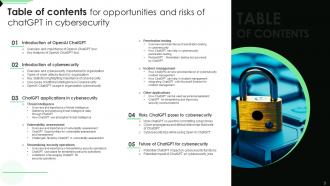
Slide 3: The slide displays Table of Contents.
Slide 4: The slide continues Table of Contents.
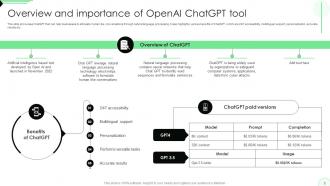
Slide 5: This slide exhibits ChatGPT that can help businesses to stimulate human like conversations through natural language processing.
Slide 6: This slide shows various features of OpenAI ChatGPT tool.
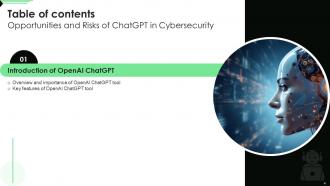
Slide 7: The slide exhibits another Title of Contents.
Slide 8: This slide renders cybersecurity overview that can help organization to safeguard data from different types of cyber attacks.
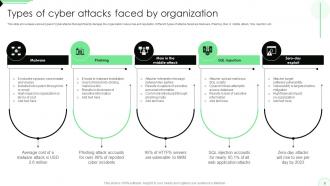
Slide 9: This slide displays various types of cyber attacks that significantly damage the organization resources and reputation.
Slide 10: This slide shows various statistics that highlights the importance of cybersecurity in organization.
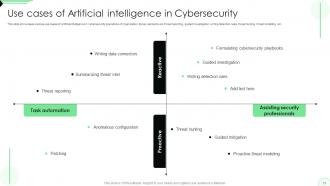
Slide 11: This slide demonstrates various use cases of Artificial intelligence in cybersecurity operations of organization.
Slide 12: This slide describes various use cases of ChatGPT for cybersecurity in organization.
Slide 13: The slide renders Title of Contents further.
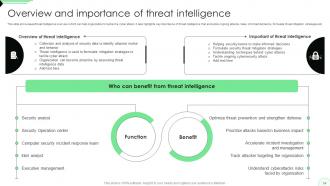
Slide 14: This slide shows threat intelligence overview which can help organization to tackle the cyber attack.
Slide 15: This slide represents various data sources that are leveraged by ChatGPT for threat intelligence to tack cyber attack on organization.
Slide 16: This slide shows ChatGPT usage for threat intelligence for tackling cyber attacks on organizations.
Slide 17: The slide highlights Title of Contents further.
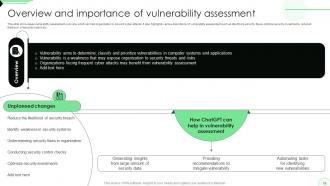
Slide 18: This slide illustrates vulnerability assessment overview which can help organization to prevent cyber attacks.
Slide 19: This slide showcases various ChatGPT opportunities for vulnerability assessment which can help to tackle cyber attack.
Slide 20: This slide describes various challenges faced by ChatGPT for effective vulnerability assessment and tackling cyber attacks.
Slide 21: The slide renders another Title of Contents.
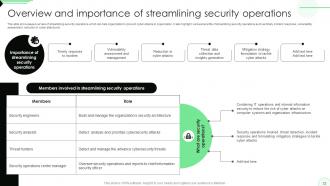
Slide 22: This slide displays overview of streamlining security operations which can help organization to prevent cyber attacks in organization.
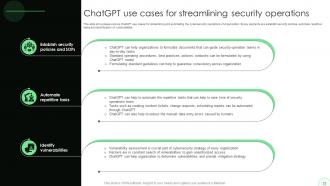
Slide 23: This slide presents various ChatGPT use cases for streamlining and automating the cybersecurity operations of organization.
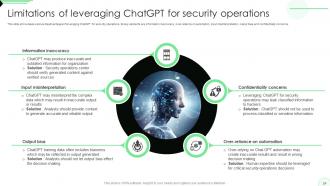
Slide 24: This slide showcases various disadvantages of leveraging ChatGPT for security operations.
Slide 25: The slide displays title of Contents further.
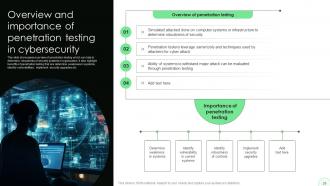
Slide 26: This slide exhibits overview of penetration testing which can help to determine robustness of security systems in organization.
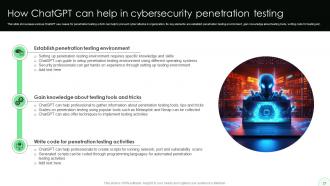
Slide 27: This slide contains various ChatGPT use cases for penetration testing which can help to prevent cyber attacks in organization.
Slide 28: This slide shows overview of PentestGPT tool that can help organization in penetration testing and reduce cyber attacks in organization.
Slide 29: The slide exhibits title of Contents further.
Slide 30: This slide highlights overview of incident management that can help organization in tackling cyber attacks.
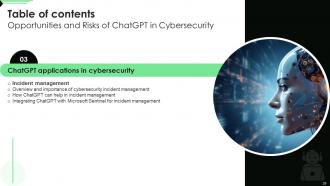
Slide 31: This slide represents various ChatGPT use cases that can help organization in incident management and tackling cyber attacks.
Slide 32: This slide showcases process that can help organization to integrate ChatGPT with Microsoft Sentinel which can help in incident management.
Slide 33: The slide represents title of Contents further.
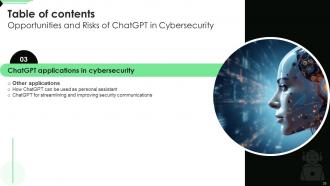
Slide 34: This slide shows various use cases of ChatGPT that can help in assisting cybersecurity professionals for tackling cyber attacks.
Slide 35: This slide depicts overview of ChatGPT for streamlining and optimizing the security operations in organizations.
Slide 36: The slide displays Title of Contents further.
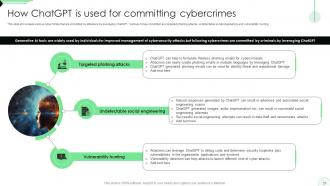
Slide 37: This slide highlights various cybercrimes that are committed by attackers by leveraging ChatGPT.
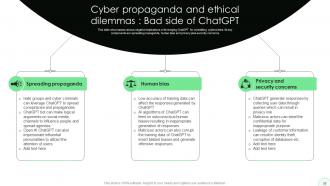
Slide 38: This slide renders various negative implications of leveraging ChatGPT for committing cybercrimes.
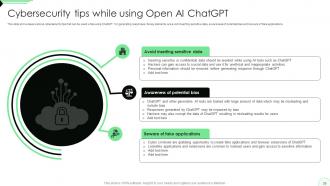
Slide 39: This slide shows various cybersecurity tips that can be used while using ChatGPT for generating responses.
Slide 40: The slide renders another title of Contents.
Slide 41: This slide showcases potential impact of ChatGPT on cybersecurity functions of organization in future.
Slide 42: This slide highlights potential impact of ChatGPT on cybersecurity jobs in future.
Slide 43: This slide shows all the icons included in the presentation.
Slide 44: This slide is titled as Additional Slides for moving forward.
Slide 45: The slide illustrates ChatGPT use cases for organization cybersecurity.
Slide 46: This slide contains Puzzle with related icons and text.
Slide 47: This slide presents Roadmap with additional textboxes.
Slide 48: This is a Timeline slide. Show data related to time intervals here.
Slide 49: This slide shows Post It Notes. Post your important notes here.
Slide 50: This is an Idea Generation slide to state a new idea or highlight information, specifications etc.
Slide 51: This is a Thank You slide with address, contact numbers and email address.
Opportunities And Risks Of ChatGPT In Cybersecurity AI CD V with all 59 slides:
Use our Opportunities And Risks Of ChatGPT In Cybersecurity AI CD V to effectively help you save your valuable time. They are readymade to fit into any presentation structure.































FAQs for Opportunities And Risks Of ChatGPT In Cybersecurity
ChatGPT enhances cybersecurity through threat detection and analysis, incident response automation, security awareness training, vulnerability assessment, and compliance documentation. These capabilities streamline cybersecurity operations by accelerating threat identification, automating routine security tasks, and improving employee security awareness, with many organizations finding that AI-powered security tools ultimately deliver faster response times and more comprehensive protection.
ChatGPT enhances threat intelligence by analyzing vast security data, identifying attack patterns, generating threat reports, and correlating indicators across multiple sources in real-time. During incident response, it streamlines workflows by automating documentation, providing contextual analysis of security events, and enabling faster decision-making, with many cybersecurity teams finding that AI-powered assistance significantly reduces response times and improves threat detection accuracy.
ChatGPT's cybersecurity limitations include potential data privacy risks, inability to process real-time threat intelligence, lack of specialized security training, and possible generation of inaccurate threat assessments. While these challenges present concerns, many organizations are finding that strategic implementation with human oversight, proper data handling protocols, and integration with dedicated security tools can minimize risks while leveraging AI's analytical capabilities for enhanced threat detection.
ChatGPT enhances cybersecurity training by creating interactive simulations, generating personalized phishing scenarios, developing role-specific security protocols, and providing real-time Q&A support for complex threats. Through adaptive learning modules, organizations streamline employee education, reduce human error incidents, and strengthen security awareness across departments, with many companies finding that AI-powered training delivers faster comprehension and better retention than traditional methods.
ChatGPT assists in automating vulnerability assessments by analyzing security logs, generating comprehensive scan reports, prioritizing threats based on risk levels, and creating automated remediation scripts. Through natural language processing, organizations streamline their security workflows, reduce manual analysis time, and enhance threat detection accuracy, with many cybersecurity teams finding that AI-driven assessments deliver faster incident response and improved security postures.
Deploying ChatGPT in cybersecurity presents ethical considerations including data privacy protection, algorithmic bias in threat detection, transparency in automated decisions, and potential misuse for malicious purposes. Organizations must balance enhanced security capabilities with responsible AI governance, ensuring human oversight remains integral to critical security decisions while maintaining user trust and regulatory compliance in an increasingly complex digital landscape.
ChatGPT improves security team communication by standardizing incident reports, translating technical findings into executive summaries, and facilitating real-time threat intelligence sharing across departments. Through automated documentation and multilingual support, security teams streamline cross-functional collaboration, enhance stakeholder briefings, and accelerate incident response coordination, ultimately delivering faster threat resolution and improved organizational security posture.
Potential risks include data exposure through training vulnerabilities, adversarial prompt manipulation, false positive generation, over-reliance reducing human oversight, and integration complexities with existing security frameworks. While these challenges present legitimate concerns, organizations in banking, healthcare, and financial services increasingly find that proper implementation protocols, continuous monitoring, and strategic human-AI collaboration ultimately deliver enhanced threat detection capabilities and operational efficiency.
Machine learning enhancements improve ChatGPT's cybersecurity effectiveness by enabling advanced pattern recognition, real-time threat detection, and adaptive response capabilities through neural network optimization and deep learning algorithms. These enhancements streamline threat analysis, automate incident response protocols, and enhance predictive security modeling, with many financial institutions and healthcare organizations finding that ML-powered ChatGPT delivers faster threat identification and significantly reduced response times.
ChatGPT supports phishing detection through email content analysis, suspicious link identification, real-time threat pattern recognition, automated response generation, and security awareness training content creation. These applications enable organizations to enhance their cybersecurity posture by streamlining threat identification, accelerating incident response times, and delivering more effective employee education, with many financial institutions and healthcare organizations finding that AI-powered phishing prevention significantly reduces successful attack rates.
ChatGPT can contribute to predictive cybersecurity models by analyzing threat patterns, processing security logs, and identifying anomalies, though it requires integration with specialized security tools and datasets. While promising for pattern recognition and automated threat intelligence, organizations like financial institutions and healthcare providers find that combining ChatGPT with dedicated cybersecurity platforms delivers more accurate predictions and faster incident response capabilities.
ChatGPT complements traditional cybersecurity solutions like SIEM and IDS by enhancing threat analysis, automating incident response workflows, and providing natural language insights from complex security data. While SIEM systems excel at log aggregation and IDS monitors network traffic, ChatGPT streamlines threat intelligence interpretation and accelerates decision-making processes, ultimately delivering faster response times and more intuitive security operations management.
Organizations must address data residency requirements, employee training on sensitive information sharing, third-party data processing agreements, regulatory compliance frameworks, and potential data exposure through AI model interactions. These considerations become critical when handling financial records, customer databases, or proprietary security protocols, with many enterprises finding that establishing clear data governance policies and implementing zero-trust architectures ultimately delivers enhanced protection while maintaining operational efficiency.
ChatGPT enhances user behavior analytics by analyzing complex behavioral patterns, identifying subtle anomalies, and providing natural language insights from security data. Through advanced pattern recognition, organizations can detect insider threats, unusual access patterns, and potential security breaches more accurately, while ChatGPT's conversational interface enables security teams to query findings intuitively, ultimately delivering faster threat response and enhanced organizational security posture.
ChatGPT assists SMEs in cybersecurity through automated threat detection, employee training simulations, incident response guidance, security policy development, and phishing email identification. These AI-powered capabilities enable smaller organizations to access enterprise-level security insights without extensive IT teams, with many finding that ChatGPT streamlines threat analysis and enhances their overall security posture cost-effectively.
-
I'm happy to discover your PowerPoint presentations and templates. They met my expectations precisely. Very innovative!
-
A library of engaging, customizable and content-ready templates.