

Organizational Efficiency Powerpoint Template Bundles Ppt Slide





Try Before you Buy Download Free Sample Product
 Impress Your
Audience
 100%
Editable
 Save Hours
of Time


Our Organizational Efficiency Powerpoint Template Bundles Ppt Slide are topically designed to provide an attractive backdrop to any subject. Use them to look like a presentation pro.
People who downloaded this PowerPoint presentation also viewed the following :
Content of this Powerpoint Presentation
Slide 1: This is the cover slide of the presentation "Organizational Efficiency."
Slide 2: This slide represents effective and sustainable organization achieving goals while remaining competitive in dynamic landscape.
Slide 3: This slide showcases evaluating employee growth metrics for driving continuous improvement, optimizing resource allocation and organization success.
Slide 4: This slide highlights providing valuable insights into effectiveness and efficiency of sales process and strategies.
Slide 5: This slide exhibits leveraging expertise and resources of IT team for effectively driving technological needs of organization.
Slide 6: This slide focuses on organizations optimizing their operations, improving overall efficiency, and achieving better business outcomes for process functioning.
Slide 7: This slide displays data-driven insights into HR processes and initiatives for enhancing organizational performance.
Slide 8: This slide covers identifying, developing and preparing potential successors for key leadership positions.
Slide 9: This slide outlines fostering positive work environment for employees to be committed and aligned with organizational goals.
Slide 10: This slide demonstrates skilled and collaborative workforce leading to streamlined operations by increasing employee engagement and ownership.
Slide 11: This slide illustrates gaining insights into financial resources allocation and utilization within organization to achieve strategic objectives.
Slide 12: This slide highlights leveraging technology to streamline processes and driving overall effectiveness across various functions.
Slide 13: This slide represents insights generated from organization raw data into actionable information using various tools.
Slide 14: This slide showcases optimizing processes, utilizing resources effectively and maximizing productivity across all levels.
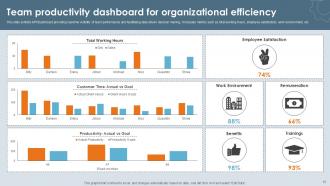
Slide 15: This slide exhibits KPI/Dashboard providing real-time visibility of team performance and facilitating data-driven decision making.
Slide 16: This slide displays systematic assessment of organization’s operations, processes and resources for enhancing overall efficiency.
Slide 17: This slide illustrates visual representation of KPI/dashboard to measure efficiency and effectiveness of various organization operations.
Slide 18: This is Organizational efficiency for performance evaluation icon slide.
Slide 19: This is Organizational efficiency to improve employee morale icon slide.
Slide 20: This is Streamline time management icon slide through organizational efficiency.
Slide 21: This is a Thank You slide with address, contact numbers and email address.
Organizational Efficiency Powerpoint Template Bundles Ppt Slide with all 29 slides:
Use our Organizational Efficiency Powerpoint Template Bundles Ppt Slide to effectively help you save your valuable time. They are readymade to fit into any presentation structure.












FAQs for Organizational Efficiency Powerpoint Template
Key organizational efficiency metrics include productivity ratios, cost per unit, employee utilization rates, cycle times, and resource allocation effectiveness. These metrics vary significantly across industries, with manufacturing focusing on throughput and waste reduction, healthcare emphasizing patient outcomes and bed turnover, and financial services prioritizing transaction processing speeds, ultimately enabling organizations to benchmark performance and identify strategic improvement opportunities.
Technology implementation enhances organizational efficiency by automating routine tasks, streamlining workflows, and enabling data-driven decision making across departments. Through cloud computing, AI-powered analytics, and integrated management systems, organizations significantly reduce operational costs, accelerate project timelines, and improve resource allocation, with many finding that strategic technology adoption delivers competitive advantages and measurable productivity gains.
Employee engagement enhances organizational efficiency by driving higher productivity, reducing turnover costs, and improving quality outcomes. Engaged employees demonstrate greater initiative, collaborate more effectively, and deliver superior customer service, with companies like Google and Microsoft finding that highly engaged teams achieve 21% higher profitability and significantly faster project completion rates.
Standard operating procedures enhance workplace consistency by establishing uniform workflows, reducing errors, minimizing training time, and ensuring quality standards across all operations. Through documented processes, organizations streamline task execution, accelerate employee onboarding, and maintain service reliability, with many companies finding that SOPs significantly reduce operational costs while improving customer experiences and competitive positioning.
Common obstacles hindering organizational efficiency include poor communication systems, outdated processes, inadequate resource allocation, lack of employee training, and resistance to change. These challenges can be overcome by implementing streamlined communication platforms, automating routine tasks, optimizing workflow management, and fostering a culture of continuous improvement, with many organizations finding that strategic technology adoption and employee engagement initiatives ultimately deliver enhanced productivity and competitive advantage.
Effective communication enhances organizational efficiency by reducing misunderstandings, accelerating decision-making processes, and streamlining workflow coordination across departments. Through clear information sharing, teams eliminate redundant tasks, minimize project delays, and improve resource allocation, with many organizations finding that structured communication protocols ultimately deliver faster project completion and significantly reduced operational costs.
Performance reviews can be optimized through continuous feedback systems, goal-aligned metrics, structured development planning, peer input integration, and data-driven analytics. These approaches streamline evaluation processes by reducing administrative burden, enhancing employee engagement, and connecting individual performance to organizational objectives, with many companies finding that modernized review systems ultimately deliver improved productivity and stronger talent retention.
Organizations utilize data analytics to drive efficiency by identifying process bottlenecks, optimizing resource allocation, predicting maintenance needs, and automating routine decision-making processes. Through advanced analytics platforms, companies across sectors like manufacturing, healthcare, and financial services streamline operations, reduce operational costs, and enhance productivity, with many finding that data-driven insights ultimately deliver measurable competitive advantages and faster response times.
Organizations can streamline workflows by implementing process automation, adopting collaborative digital platforms, establishing clear communication protocols, conducting regular bottleneck assessments, and creating standardized procedures across departments. These strategies enhance operational efficiency by eliminating redundant tasks, accelerating decision-making, and improving resource allocation, with many companies finding that systematic workflow optimization delivers faster project completion and significant cost reductions.
Decentralized structures enhance efficiency by enabling faster decision-making, reducing bureaucratic bottlenecks, and empowering local teams to respond quickly to market changes. While centralized structures streamline coordination and resource allocation, many organizations find that hybrid approaches deliver optimal results, with financial services and retail companies leveraging decentralized customer-facing operations while maintaining centralized strategic oversight for competitive advantage.
Continuous improvement methodologies like Lean and Six Sigma are crucial for organizational efficiency because they systematically eliminate waste, reduce variability, and optimize processes through data-driven analysis. These approaches enable companies to streamline operations, enhance quality control, and accelerate decision-making, with manufacturing firms, healthcare systems, and financial institutions finding significant cost reductions and improved customer satisfaction.
Remote work policies can maintain organizational efficiency through clear performance metrics, structured communication protocols, flexible scheduling frameworks, and robust technology infrastructure. These approaches streamline operations by establishing accountability standards, minimizing coordination delays, and enabling seamless collaboration, with many organizations finding that strategic remote policies ultimately deliver reduced overhead costs and improved employee productivity.
Leadership drives organizational efficiency by establishing clear performance expectations, modeling productive behaviors, and implementing streamlined processes and accountability systems. Effective leaders foster efficiency cultures through strategic resource allocation, empowering teams with decision-making authority, and recognizing achievements, with many organizations finding that leadership commitment to operational excellence ultimately delivers enhanced productivity and competitive advantage.
Cross-functional teams enhance organizational efficiency by breaking down departmental silos, accelerating decision-making processes, and combining diverse expertise to solve complex problems more effectively. These collaborative structures streamline project timelines, reduce redundant communications, and enable faster innovation cycles, with many organizations finding that integrated teams deliver solutions 30-40% faster than traditional departmental approaches.
Best practices for training and onboarding include structured learning pathways, mentorship programs, role-specific skill development, digital learning platforms, and performance tracking systems. These approaches streamline workforce integration by reducing time-to-productivity, enhancing employee retention, and ensuring consistent knowledge transfer across departments, with many organizations finding that comprehensive onboarding programs ultimately deliver faster operational efficiency and stronger competitive positioning.
-
Easy to edit slides with easy to understand instructions.
-
Enough space for editing and adding your own content.