

Optimizing Warehouse Processes Building Excellence In Logistics Operations




Try Before you Buy Download Free Sample Product
 Impress Your
 Audience
 100%
100% Editable
 Save Hours
 of Time


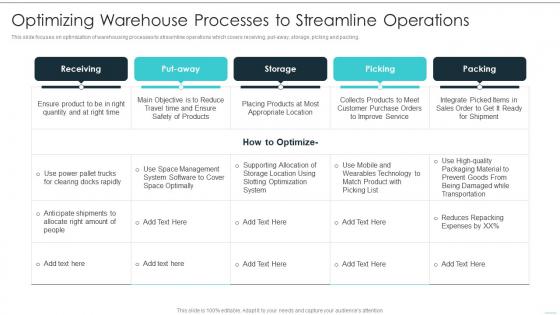
This slide focuses on optimization of warehousing processes to streamline operations which covers receiving, put away, storage, picking and packing.
People who downloaded this PowerPoint presentation also viewed the following :
Optimizing Warehouse Processes Building Excellence In Logistics Operations with all 6 slides:
Use our Optimizing Warehouse Processes Building Excellence In Logistics Operations to effectively help you save your valuable time. They are readymade to fit into any presentation structure.





FAQs for Optimizing Warehouse Processes Building Excellence
Key warehouse efficiency metrics include order accuracy rates, inventory turnover, pick and pack times, storage utilization rates, and labor productivity measures. These indicators streamline operations by identifying bottlenecks, optimizing space allocation, and enhancing fulfillment processes, with many distribution centers finding that strategic metric tracking ultimately delivers faster order processing and significantly reduced operational costs.
Layout design significantly impacts warehouse operations by optimizing picking routes, reducing travel time, and enhancing inventory accessibility through strategic placement of high-turnover items near shipping areas. Well-designed layouts streamline order fulfillment, minimize labor costs, and improve safety protocols, with many distribution centers finding that efficient workflows increase productivity by 20-30% while reducing operational expenses.
Automation streamlines warehouse optimization by reducing manual labor, minimizing errors, accelerating order processing, and enhancing inventory accuracy through technologies like robotics, automated sorting systems, and warehouse management software. These solutions enable faster fulfillment, lower operational costs, and improved scalability, with many logistics companies finding that automation delivers significant competitive advantages in increasingly demanding markets.
Inventory management software enhances warehouse performance by automating stock tracking, optimizing storage locations, and providing real-time visibility into inventory levels. Through advanced analytics and integration capabilities, warehouses achieve faster order fulfillment, reduced carrying costs, and improved accuracy rates, with many distribution centers finding that automated systems ultimately deliver 30-40% efficiency gains.
Strategies to reduce order fulfillment time include automated picking systems, optimized warehouse layouts, real-time inventory tracking, cross-docking operations, and strategic product placement based on demand patterns. These approaches streamline operations by minimizing travel distances, reducing manual errors, and accelerating processing speeds, with many distribution centers finding that strategic automation ultimately delivers 40-60% faster order processing and enhanced customer satisfaction.
Shelving and storage systems significantly affect space utilization by maximizing vertical space, optimizing floor layouts, and enabling systematic organization of inventory. Strategic storage solutions, including high-density racking, automated retrieval systems, and modular shelving, enhance accessibility while minimizing footprint requirements, with many warehouses finding that proper system selection increases capacity by 30-40% without facility expansion.
Best practices for implementing a WMS include conducting thorough needs assessment, ensuring robust data migration, providing comprehensive staff training, establishing clear workflows, and planning phased rollouts. These strategies streamline operations by minimizing disruption, enhancing inventory accuracy, and optimizing resource allocation, with many distribution centers finding that systematic implementation ultimately delivers faster order fulfillment and improved operational efficiency.
Labor management techniques improve warehouse productivity by implementing workforce scheduling optimization, performance tracking systems, task standardization protocols, cross-training programs, and incentive-based compensation structures. These approaches streamline operations by reducing idle time, enhancing worker efficiency, and minimizing bottlenecks, with many distribution centers finding that strategic labor allocation ultimately delivers faster order fulfillment and reduced operational costs.
RFID technology offers real-time inventory visibility, reduced manual counting errors, faster stock audits, automated reorder alerts, and enhanced theft prevention capabilities. These systems streamline warehouse operations by eliminating barcode scanning delays, enabling instant location tracking, and providing accurate stock levels, with many distribution centers finding that RFID ultimately delivers 30% faster inventory processes and significantly improved operational efficiency.
Real-time data analytics enhances warehousing decision-making by providing instant visibility into inventory levels, equipment performance, and operational bottlenecks, enabling managers to respond immediately to changing conditions. Through predictive insights and automated alerts, warehouse operators streamline resource allocation, minimize downtime, and optimize pick routes, ultimately delivering faster fulfillment and reduced operational costs.
Effective methods for reducing warehouse operational costs include automation systems, inventory optimization software, energy-efficient lighting, strategic layout redesigns, and cross-docking operations. These approaches streamline operations by minimizing labor expenses, reducing energy consumption, and accelerating inventory turnover, with many distribution centers finding that strategic combinations of these technologies ultimately deliver 15-30% cost reductions while enhancing operational efficiency.
Proper training and development optimize warehouses by enhancing operational efficiency, reducing errors, and improving safety protocols through skilled workforce management. Well-trained staff streamline inventory processes, minimize product damage, and accelerate order fulfillment, with many distribution centers finding that comprehensive training programs ultimately deliver faster throughput and significantly lower operational costs.
Environmental considerations in warehouse design and operation include energy-efficient lighting systems, sustainable building materials, waste reduction programs, water conservation measures, and renewable energy integration. These green initiatives streamline operational costs by minimizing utility expenses, reducing environmental impact, and enhancing corporate sustainability profiles, with many logistics companies finding that eco-friendly warehouses deliver significant cost savings while meeting increasingly stringent regulatory requirements.
Seasonal fluctuations can be managed through flexible staffing models, scalable storage solutions, predictive inventory planning, and automated systems that adjust to demand variations. These strategies enable warehouses to maintain operational efficiency by optimizing space utilization, minimizing labor costs during low periods, and ensuring rapid fulfillment during peak seasons, ultimately delivering consistent service levels.
Cross-docking eliminates traditional storage by transferring goods directly from incoming to outgoing transportation, reducing handling time, inventory costs, and warehouse space requirements. This strategic approach enables retailers, distributors, and manufacturers to accelerate order fulfillment, minimize storage expenses, and enhance supply chain velocity, ultimately delivering faster customer service and improved operational efficiency.
-
The customer care of SlideTeam is very responsive. I was having a payment issue and they fixed it for me in no time.
-
Easily Understandable slides.