

Capital expenditure details ppt show





Try Before you Buy Download Free Sample Product
 Impress Your
Audience
 100%
Editable
 Save Hours
of Time


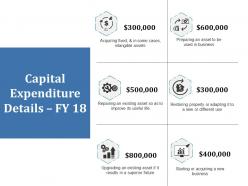
Discourage haphazard approaches with our Capital Expenditure Details Ppt Show. Explain to folks how they are bound to fail.
People who downloaded this PowerPoint presentation also viewed the following :
Capital expenditure details ppt show with all 5 slides:
Feeling jolly becomes a habit due to our Capital Expenditure Details Ppt Show. It helps address your inner most fears.


FAQs for Capital expenditure
So capex is basically big purchases that'll help your business for more than a year - think equipment, buildings, vehicles, major software. Has to hit your company's spending threshold too (whatever that is for you guys). The whole point is it should either make you money or save you costs down the road. Here's the thing though - timing's crucial because this stuff goes on your balance sheet, not as an immediate expense. My rule of thumb? If it's just keeping daily operations running, probably not capex. But if you're still getting value from it next year and beyond, then yeah, that's your answer right there.
So basically, CapEx is stuff you buy that'll stick around for years - like equipment, buildings, fancy software systems. OpEx is just your regular monthly bills. Rent, salaries, utilities, you know the drill. Here's where it gets weird though - CapEx goes on your balance sheet and gets written off slowly over time. OpEx hits your P&L right away. I always forget which is which tbh, but your accountant will definitely care come tax season. Quick test: will this purchase help you beyond this year? If yes, probably CapEx.
Think of capex as your company's crystal ball - it's how you invest in stuff today that'll pay off down the road. Planning 3-5 years out? These decisions literally determine if you'll have the right tech, equipment, and infrastructure when you need it. Honestly, most companies mess this up by not thinking backwards from their goals. What assets do you actually need to hit those targets? Smart timing matters too - you want to sync big purchases with when cash flow looks good and market opportunities pop up. It's probably the biggest way to shape where your business goes next.
Look, start by figuring out what big stuff you'll actually need - new equipment, tech upgrades, facility work. I'd honestly just look at last year's spending vs what you planned first. Always add like 10-15% extra because literally everything costs more than you think it will. Split things into "stuff that's breaking" versus "stuff for growth" so you know what's urgent. Work backwards from your cash flow and see what financing makes sense. Oh and don't just set this once - check it every quarter or you'll be screwed when something unexpected hits.
Honestly, start with ROI and payback period - they're super straightforward to calculate and way easier to explain to your boss. For longer projects, NPV and IRR are worth looking at since they account for time value of money (boring but true). If you're buying equipment, definitely track capacity utilization rates. Oh, and don't ignore the operational stuff like productivity gains or how much you're saving per unit. I mean, those numbers can be pretty telling sometimes. ROI and payback are your best bet to begin with though.
So depreciation is huge for capex decisions - it's all about tax timing and cash flow. Faster depreciation = bigger tax breaks upfront, which boosts your NPV. Some assets qualify for accelerated or bonus depreciation (the tax rules change constantly, it's annoying). Here's the thing though - depreciation doesn't cost you actual cash but still cuts your taxable income. Pretty sweet deal. When you're analyzing capex, don't just look at upfront costs. Factor in the depreciation schedule and when you'll actually get those tax benefits. Timing matters way more than people think.
So there's basically four ways companies pay for big purchases. Most love using their own cash (retained earnings) since there's no interest eating into profits. Bank loans and bonds are solid options too - you're borrowing but at least you keep full ownership. Then there's issuing new stock, though honestly that's a headache because existing shareholders get diluted. Oh, and leasing works great if you don't want the massive upfront hit. Most smart companies mix these approaches depending on what they can afford and how risky the project is. Really depends on your situation.
Dude, tech changes everything for capital spending. Predictive analytics shows you when equipment's about to fail, so you're not stuck buying emergency replacements at terrible prices. IoT sensors are honestly game-changing - you get real-time data on how your assets actually perform. Automation helps you run investment scenarios super fast too. Oh, and cloud stuff shifts you from those massive upfront hardware costs to predictable monthly expenses. I'd start with whatever equipment already generates the most data - that's your lowest-hanging fruit right there.
Honestly, start with the boring stuff first - ROI and payback time. Numbers don't mess around. Strategic fit with your goals matters, plus what cash you've actually got on hand. Some regulatory stuff might not give you a choice anyway. Risk is huge, especially if your team's already swamped. I've seen projects look amazing on spreadsheets but completely destroy everyone's bandwidth. Market timing can make certain moves way more urgent too. Maybe throw together a quick scoring system? Weight it based on what's actually critical for you right now.
So CapEx hits your cash flow pretty hard upfront - you're basically swapping your available cash for equipment or property that'll pay off later. Timing is everything here. If you don't plan it right, you'll suddenly find yourself short on cash for day-to-day stuff like paying suppliers (been there, not fun). I'd say always build these big purchases into your cash flow projections ahead of time. You want either solid reserves sitting around or financing already set up. Otherwise you're just asking for a cash crunch when you least expect it.
So here's the deal - you can't just write off big purchases all at once. The IRS makes you spread it out over years through depreciation. Equipment usually gets 5-7 years, buildings take forever at 39 years. But Section 179 is actually clutch - you can immediately deduct up to $1.18 million on qualifying equipment. Honestly, timing matters a lot here. Your accountant will probably want you to think about when you're making these purchases, especially around year-end. I learned this the hard way with some office equipment last year.
Rank your projects by ROI and payback period first - that'll show you the clear winners. I'd skip anything that's just "nice to have" because honestly, I've watched companies waste so much money on flashy upgrades that don't actually help the bottom line. Focus on stuff that automates processes, boosts production capacity, or gets you into new markets. Being ruthless about saying no is huge here. Oh, and set your metrics upfront so you can actually prove these investments worked. Don't get sucked into vanity projects that look cool but won't move revenue.
Energy companies are probably your biggest capex spenders - oil, gas, renewables, you name it. They're dropping millions on rigs and power plants that'll run for decades. Manufacturing and utilities are right up there too. Telecom's another big one with all those cell towers everywhere (honestly crazy how much those cost). Mining companies obviously can't just rent a coal mine, so they're stuck with huge upfront costs. Same deal with transportation - subway systems don't come cheap. When you're looking at these sectors, capex will absolutely dominate their cash flow statements.
Look, economic cycles totally control your spending timing. When things are booming, go hard on growth projects - demand's up and money's cheap. Recession hits though? Companies freeze everything. Equipment upgrades get pushed back, expansions die, you're only doing absolutely critical stuff. It sucks but that's reality. The trick is planning flexible capex from the start so you can change direction fast. My old boss used to say "cash is king in downturns" and man, he wasn't wrong. Build in wiggle room or you'll get caught scrambling when conditions flip.
Honestly, just start by mapping out where stuff gets stuck in your current process - that'll show you exactly what needs fixing. Set clear spending thresholds so people know who approves what amount. Standardize your workflows too. The thing most companies totally mess up? They never go back to check if their investments actually worked out. Such a missed opportunity. Require proper business cases and ROI forecasting upfront for big purchases - it's a pain initially but you'll thank yourself later. Oh, and don't try to fix everything at once. Pick the biggest bottleneck first.
-
Topic best represented with attractive design.
-
Content of slide is easy to understand and edit.