

Organic Growth Playbook Powerpoint Presentation Slides




Try Before you Buy Download Free Sample Product
 Impress Your
 Audience
 100%
100% Editable
 Save Hours
 of Time


Growth achieved by the organization by enhancing its internal strategy is referred to as organic growth. This growth is essential for any organization willing to sustain itself for the long term. Thus, grab our insightful Operations Playbook, a detailed playbook to serve as a blueprint for your organization and help you achieve organic growth. The following presentation slide is helpful for organizations intending to attain growth organically through internal strategies. This playbook is divided into 4 major parts; these parts serve as a step-by-step guide for the organization. This presentation also provides an overview of organic growth as a strategy. It also helps understand the impact of organic growth by highlighting its critical advantages. The second part of the playbook highlights key stats of how organic growth can help your organization. The third part displays the key strategies that can help your organization attain organic growth. These strategies can be selling your product to existing customers, new customers, etc. The last part of this playbook focuses on identifying the critical KPIs that help the organization track its growth. Get access now.
People who downloaded this PowerPoint presentation also viewed the following :
Content of this Powerpoint Presentation
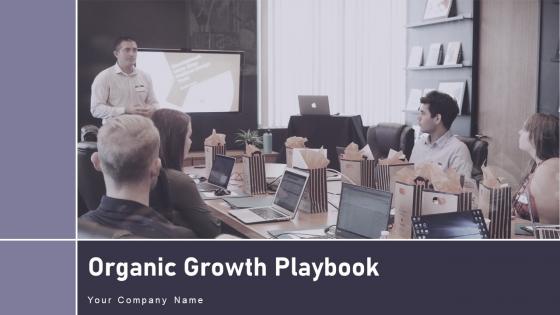
Slide 1: This slide displays title i.e. 'Organic Growth Playbook' and your Company Name.
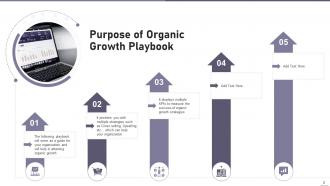
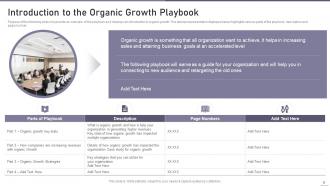
Slide 2: This slide presents purpose of organic growth of playbook.
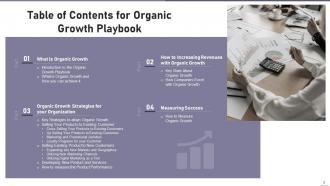
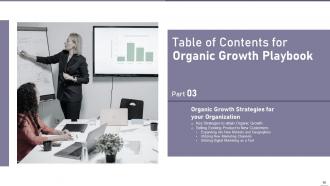
Slide 3: This slide exhibits table of contents.
Slide 4: This slide depicts title for two topics that are to be covered next in the template.
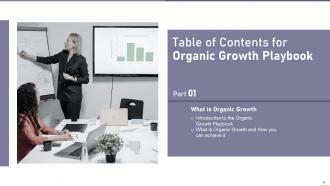
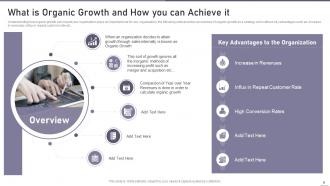
Slide 5: This slide provide an overview of the playbook as it displays an introduction to organic growth.
Slide 6: This slide provides an overview of organic growth as a strategy and outlines key advantages such as: increase in revenues, influx in repeat customer rate etc.
Slide 7: This slide depicts title for two topics that are to be covered next in the template.
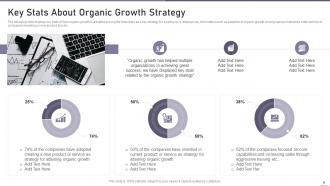
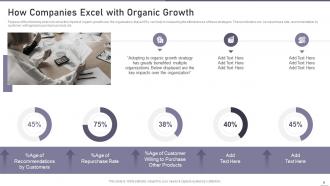
Slide 8: This slide displays key stats of how organic growth is adopted among the Industries as a key strategy for scaling up.
Slide 9: This slide is to show the impact of organic growth over the organization, these KPIs can help in measuring the effectiveness of these strategies.
Slide 10: This slide depicts title for one topic that is to be covered next in the template.
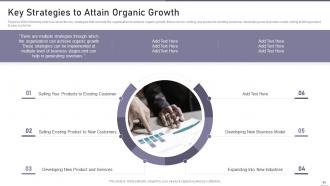
Slide 11: This slide show the key strategies that can help the organization to achieve organic growth, these can be: selling your product to existing customer, etc.
Slide 12: This slide depicts title for five topics that are to be covered next in the template.
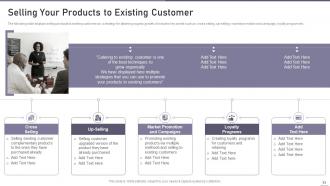
Slide 13: This slide displays selling products to existing customer as a strategy for attaining organic growth.
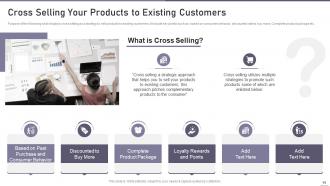
Slide 14: This slide displays cross selling as a strategy to sell products to existing customers.
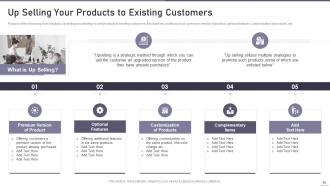
Slide 15: This slide displays Up-selling as a strategy to sell products to existing customers.
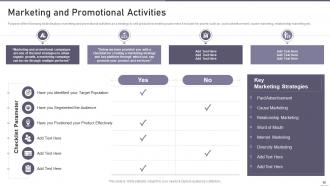
Slide 16: This slide displays marketing and promotional activities as a strategy to sell products to existing customers.
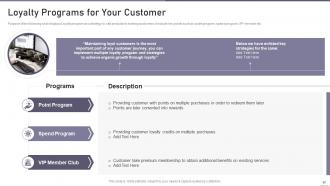
Slide 17: This slide displays Loyalty program as a strategy to sell products to existing customers.
Slide 18: This slide depicts title for four topics that are to be covered next in the template.
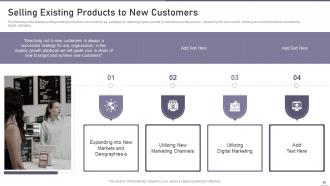
Slide 19: This slide displays selling existing products to new customer as a strategy for attaining organic growth.
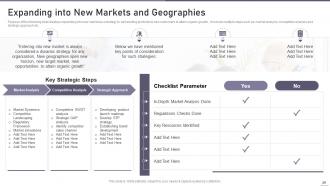
Slide 20: This slide displays expanding into new market as a strategy to sell existing products to new customers to attain organic growth.
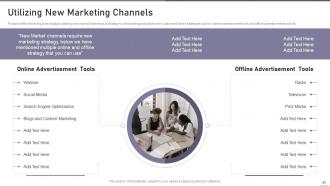
Slide 21: This slide displays utilizing new market channel as a strategy to sell existing products to new customers.
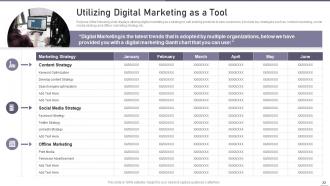
Slide 22: This slide displays utilizing digital marketing as a strategy to sell existing products to new customers.
Slide 23: This slide depicts title for two topics that are to be covered next in the template.
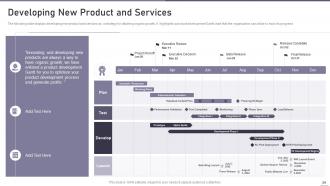
Slide 24: This slide displays developing new product and services as a strategy for attaining organic growth.
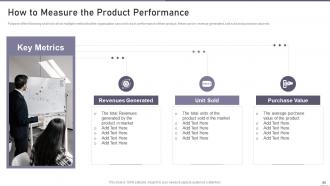
Slide 25: This slide show multiple metrics that the organization can use to track performance of their product.
Slide 26: This slide depicts title for one topic that is to be covered next in the template.
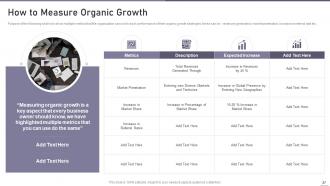
Slide 27: This slide show multiple metrics that the organization can use to track performance of their organic growth strategies.
Slide 28: This is the icons slide.
Slide 29: This slide presents title for additional slides.
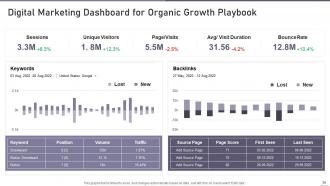
Slide 30: This slide exhibits Digital Marketing Dashboard for Organic Growth Playbook.
Slide 31: This slide shows about your company, target audience and its client's values.
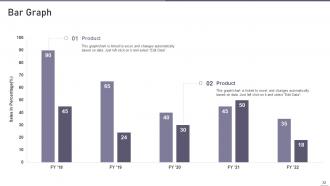
Slide 32: This slide exhibits yearly sales bar graph for different products. The charts are linked to Excel.
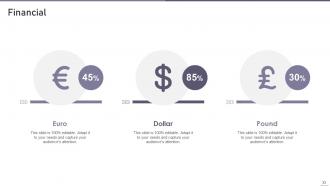
Slide 33: This slide showcases financials.
Slide 34: This slide shows details of team members like name, designation, etc.
Slide 35: This slide displays Venn.
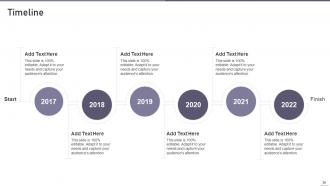
Slide 36: This slide exhibits yearly timeline.
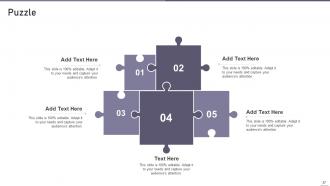
Slide 37: This slide displays puzzle.
Slide 38: This is thank you slide & contains contact details of company like office address, phone no., etc.
Organic Growth Playbook Powerpoint Presentation Slides with all 43 slides:
Use our Organic Growth Playbook Powerpoint Presentation Slides to effectively help you save your valuable time. They are readymade to fit into any presentation structure.










FAQs for Organic Growth Playbook
Key components of a successful organic growth strategy include market penetration, product development, customer retention programs, operational efficiency improvements, and strategic partnerships. These elements work together by expanding existing market share, introducing innovative offerings, and optimizing internal processes, with many organizations finding that combining these approaches delivers sustainable revenue increases and competitive advantage.
Businesses can effectively leverage content marketing for organic growth by creating valuable, SEO-optimized content that addresses customer pain points, establishing thought leadership through blogs and whitepapers, and maintaining consistent publishing schedules across multiple channels. This strategic approach enables companies to build trust, attract qualified leads, and reduce customer acquisition costs, with many organizations finding that quality content ultimately delivers sustainable traffic growth and enhanced brand credibility.
Customer feedback serves as the foundation for organic growth initiatives by identifying product improvements, revealing unmet needs, guiding feature development, and highlighting market expansion opportunities. Through systematic feedback collection and analysis, businesses can enhance customer satisfaction, reduce churn, and develop targeted retention strategies, with many organizations finding that customer-driven improvements generate stronger word-of-mouth referrals and sustainable revenue growth.
Social media drives organic growth through consistent content creation, community engagement, strategic hashtag usage, user-generated content campaigns, and authentic storytelling that builds brand loyalty. These platforms enable businesses to reach targeted audiences, foster meaningful connections, and amplify brand visibility, with many companies finding that regular engagement and value-driven content ultimately delivers increased awareness and customer acquisition.
Key metrics for organic growth effectiveness include customer acquisition cost, customer lifetime value, retention rates, revenue per customer, and market share expansion. These indicators work together by revealing acquisition efficiency, customer profitability, and sustainable scaling potential, with many organizations finding that tracking these metrics simultaneously delivers clearer strategic insights and competitive advantage.
SEO enhances organic reach by improving search engine rankings, increasing website visibility, optimizing content for relevant keywords, and building domain authority through quality backlinks. Through strategic SEO implementation, businesses streamline customer acquisition, reduce paid advertising costs, and deliver sustained traffic growth, with many companies finding that consistent optimization ultimately provides competitive advantage and measurable revenue increases.
Common pitfalls include overextending resources too quickly, neglecting existing customer retention while chasing new markets, underestimating timeline requirements, and lacking systematic measurement frameworks. These challenges often emerge when organizations pursue aggressive expansion without strategic planning, with many businesses finding that sustainable organic growth requires balanced resource allocation, customer-centric approaches, and patience to build lasting competitive advantages.
Influencer partnerships contribute to organic growth by expanding brand reach, building authentic credibility, and driving engagement through trusted voices that resonate with target audiences. These strategic collaborations enable businesses to access new customer segments, enhance brand awareness, and generate user-generated content, with many companies finding that authentic influencer relationships deliver higher conversion rates and sustained community growth.
Innovative tactics for organic user acquisition include content marketing with SEO optimization, social media engagement strategies, referral programs, community building initiatives, and strategic partnerships with complementary businesses. These approaches streamline customer acquisition costs while building authentic relationships, with many companies finding that combining user-generated content campaigns with influencer collaborations ultimately delivers sustainable growth and enhanced brand credibility.
Brand storytelling is crucial for organic growth, creating emotional connections that drive customer loyalty, word-of-mouth referrals, and authentic engagement across digital platforms. Through compelling narratives that showcase values and customer success stories, companies like Patagonia and Airbnb build trust and community, ultimately delivering sustained growth without paid advertising while differentiating themselves in competitive markets.
Website performance optimization best practices include improving page load speeds, ensuring mobile responsiveness, optimizing images and content, implementing clean URL structures, and enhancing user experience design. These technical improvements streamline customer interactions by reducing bounce rates, increasing engagement, and boosting search engine rankings, with many retail and service organizations finding that faster, more accessible websites ultimately deliver higher conversion rates and sustainable competitive advantage.
Community involvement significantly enhances organic growth by building trust, increasing brand visibility, and creating authentic customer relationships through local partnerships, sponsorships, and social initiatives. Companies actively engaging in community programs often experience stronger word-of-mouth referrals, improved reputation management, and deeper customer loyalty, ultimately delivering sustainable growth and competitive differentiation in their markets.
Email marketing serves as a critical touchpoint for building relationships, delivering personalized content, segmenting audiences based on behavior, and guiding prospects through the sales funnel systematically. Through automated sequences and targeted campaigns, businesses across retail, SaaS, and professional services streamline lead nurturing while maintaining consistent engagement, ultimately converting prospects into customers at higher rates than traditional outreach methods.
Businesses foster organic growth culture by encouraging employee initiative, investing in continuous learning programs, implementing cross-functional collaboration, and recognizing innovation contributions. Through mentorship programs and skill development opportunities, organizations like tech companies and consulting firms enhance team capabilities while promoting internal advancement, ultimately delivering higher employee engagement and sustainable competitive advantage.
Changes in consumer behavior create both challenges and opportunities for organic growth strategies, requiring businesses to adapt their market positioning, product development, customer engagement approaches, and digital presence. Companies increasingly find that understanding shifting preferences enables them to pivot their growth initiatives more effectively, with many organizations in retail, financial services, and healthcare leveraging behavioral insights to enhance customer experiences and ultimately deliver sustainable competitive advantages.
-
Excellent products for quick understanding.
-
Awesome use of colors and designs in product templates.