

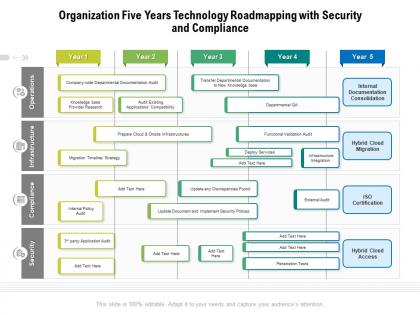
Organization five years technology roadmapping with security and compliance




Try Before you Buy Download Free Sample Product
 Impress Your
Audience
 100%
Editable
 Save Hours
of Time


A well thought out action plan makes execution easier and increases the possibility of success significantly. Ensure hitting all the milestones within the deadlines by introducing our fully customizable Organization Five Years Technology Roadmapping With Security And Compliance. Streamline the work related information, budget, timeframe, key deliverable, landmarks, and major steps involved, all in one place to give an organized overview of the project by utilizing our PowerPoint theme. Minimize time lag and increase work efficiency by providing insight into the process with our comprehensively research roadmap PowerPoint layout. Color coding helps in highlighting the process and grabs the attention of the audience. Download our handy Organization Five Years Technology Roadmapping With Security And Compliance to identify the possible problem areas in a much shorter time and propose solutions. Have a productive brainstorming session with your workforce by utilizing our action plan visualization tool.
People who downloaded this PowerPoint presentation also viewed the following :
Organization five years technology roadmapping with security and compliance with all 2 slides:
Give your audience a fulfilling experience. They will find our Organization Five Years Technology Roadmapping With Security And Compliance elevating.


FAQs for Organization five years technology roadmapping with
Effective technology roadmaps include market analysis, technology assessment, strategic objectives, timeline planning, and resource allocation requirements. These components work together by aligning innovation priorities with business goals, identifying capability gaps, and establishing clear implementation pathways, with many organizations finding that structured roadmapping delivers competitive advantage and accelerated development cycles.
Organizations can align their technology roadmaps with business strategy by establishing clear strategic objectives, conducting regular cross-functional planning sessions, and creating integrated timelines that connect technology investments to business outcomes. Through systematic alignment processes, companies in sectors like manufacturing and financial services streamline resource allocation, enhance operational efficiency, and accelerate strategic initiatives, ultimately delivering competitive advantage.
Best practices for prioritizing technologies include assessing strategic alignment with business objectives, evaluating technical feasibility and resource requirements, analyzing competitive advantage potential, considering implementation timelines, and measuring expected ROI. These approaches enable organizations to systematically evaluate emerging technologies through structured frameworks, ultimately delivering focused resource allocation and strategic positioning in increasingly competitive markets.
Technology roadmaps should be reviewed quarterly and updated annually, with major revisions triggered by significant market shifts, competitive changes, or strategic pivots. Many organizations find that regular quarterly assessments enable timely course corrections while annual updates ensure alignment with evolving business objectives, ultimately maintaining competitive advantage in rapidly changing technological landscapes.
Stakeholder engagement ensures technology roadmaps align with diverse business needs, technical constraints, market requirements, and strategic objectives across all organizational levels. Through collaborative workshops, cross-functional input sessions, and regular feedback cycles, companies like manufacturing firms and financial institutions create more comprehensive roadmaps, ultimately delivering better resource allocation and stronger buy-in for implementation success.
Organizations effectively leverage data analytics in technology roadmaps by analyzing usage patterns, performance metrics, market trends, and resource allocation data to inform strategic decisions. Through predictive analytics and business intelligence tools, companies can identify technology gaps, optimize investment timing, and anticipate future needs, with many enterprises finding that data-driven roadmapping reduces implementation risks while accelerating digital transformation outcomes.
Common pitfalls include inadequate stakeholder engagement, unrealistic timelines, insufficient market research, lack of flexibility for emerging technologies, and poor alignment with business strategy. These challenges often result in roadmaps that become obsolete quickly, with many organizations finding that regular updates, cross-functional input, and scenario planning help maintain relevance and strategic value.
Emerging technologies influence existing roadmaps by triggering reassessment of current priorities, accelerating development timelines, and creating new strategic pathways for innovation. Organizations must continuously evaluate how breakthrough technologies like AI, quantum computing, and biotechnology reshape their planned trajectories, with many companies finding that adaptive roadmapping delivers competitive advantage in rapidly evolving markets.
Effective technology roadmap visualization methodologies include timeline-based charts, layered roadmaps, scenario mapping, capability matrices, and interactive dashboards. These approaches streamline strategic planning by aligning technology investments with business objectives, facilitating stakeholder communication, and enabling dynamic updates, with many organizations finding that visual roadmaps enhance decision-making speed and cross-functional collaboration.
Technology roadmapping facilitates innovation by aligning emerging technologies with strategic business goals, identifying capability gaps, and creating structured pathways for development. Through systematic mapping, organizations can prioritize research investments, coordinate cross-functional teams, and anticipate market needs, with companies like Intel and pharmaceutical firms using roadmaps to accelerate product development cycles and maintain competitive advantage.
Success metrics for technology roadmaps include milestone achievement rates, budget adherence, timeline accuracy, stakeholder alignment scores, and ROI realization against projections. These measurements enable organizations to track strategic progress, resource efficiency, and competitive positioning, with many technology leaders finding that balanced scorecards combining financial, operational, and innovation metrics ultimately deliver the most comprehensive roadmap performance insights.
Cross-departmental collaboration enhances technology roadmapping by integrating diverse perspectives, aligning strategic priorities, and identifying interdependencies across business functions. When engineering, marketing, finance, and operations teams contribute their expertise, organizations develop more comprehensive roadmaps that balance technical feasibility with market demands, ultimately delivering better resource allocation and accelerated innovation timelines.
Recommended technology roadmapping tools include Microsoft Visio, Lucidchart, ProductPlan, Roadmunk, and Aha!, along with collaborative platforms like Miro and specialized software such as ITONICS. These platforms streamline roadmap creation, enhance cross-functional collaboration, and enable real-time updates, with many organizations finding that integrated tools deliver better strategic alignment and faster decision-making processes.
Risk assessment should be incorporated through systematic evaluation of technical uncertainties, market volatility, resource constraints, and competitive threats at each roadmap milestone. Organizations integrate scenario planning, dependency mapping, and contingency strategies throughout their roadmapping process, with many technology-driven companies finding that proactive risk identification enables more resilient innovation pathways and strategic decision-making.
Organizations balance short-term goals with long-term technology planning by establishing phased implementation strategies, creating flexible roadmaps that accommodate immediate needs while supporting future objectives, and prioritizing investments that deliver quick wins alongside foundational capabilities. This strategic approach enables companies to maintain operational efficiency, respond to market pressures, and build scalable technology infrastructure, ultimately delivering competitive advantage in increasingly dynamic business environments.
No Reviews