

Organizational Change Management Overview Historical Development In Change CM SS




Try Before you Buy Download Free Sample Product
 Impress Your
Audience
 100%
Editable
 Save Hours
of Time


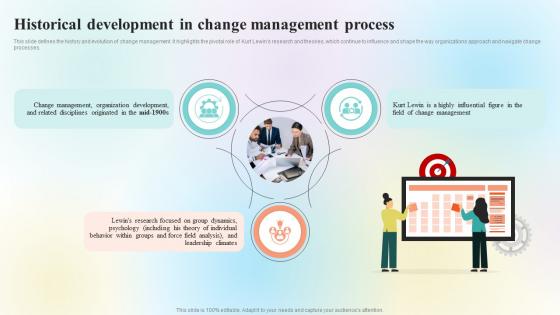
This slide defines the history and evolution of change management. It highlights the pivotal role of Kurt Lewins research and theories, which continue to influence and shape the way organizations approach and navigate change processes.
People who downloaded this PowerPoint presentation also viewed the following :
Organizational Change Management Overview Historical Development In Change CM SS with all 10 slides:
Use our Organizational Change Management Overview Historical Development In Change CM SS to effectively help you save your valuable time. They are readymade to fit into any presentation structure.









FAQs for Organizational Change Management Overview Historical Development In
Key drivers of successful organizational change management include strong leadership commitment, clear communication strategies, employee engagement initiatives, comprehensive training programs, and robust feedback mechanisms. These elements work together by building trust, reducing resistance, and ensuring alignment across all organizational levels, with many companies finding that combining top-down vision with bottom-up participation ultimately delivers faster adoption and sustainable transformation outcomes.
Leadership influences change effectiveness by communicating clear vision, modeling desired behaviors, providing necessary resources, and actively addressing resistance throughout the organization. Strong leaders foster psychological safety, empower teams to adapt, and maintain consistent messaging across all levels, with many organizations finding that visible executive commitment significantly accelerates adoption rates and ultimately delivers sustainable transformation outcomes.
Employee engagement serves as the cornerstone of successful organizational change, directly influencing adoption rates, productivity levels, communication effectiveness, and overall transformation outcomes. Engaged employees become change champions who actively support new initiatives, provide valuable feedback, and help overcome resistance, with many organizations finding that high engagement levels reduce implementation timelines by up to 30% while significantly improving long-term sustainability.
Organizations assess change readiness through stakeholder surveys, leadership capability evaluations, resource availability analyses, cultural adaptability assessments, and communication infrastructure reviews. These comprehensive evaluations enable companies to identify potential resistance points, skill gaps, and resource constraints early, while many manufacturing and healthcare organizations finding that systematic readiness assessments reduce implementation timelines and increase adoption rates significantly.
Effective change communication strategies include transparent multi-channel messaging, stakeholder-specific tailoring, regular feedback loops, leadership visibility, and phased information delivery. These approaches streamline adoption by building trust, addressing concerns proactively, and maintaining engagement throughout transitions, with many organizations finding that consistent, clear communication ultimately delivers smoother implementations and stronger employee buy-in.
Cultural factors significantly impact change management by shaping employee receptivity, communication patterns, decision-making processes, and resistance levels throughout transformation initiatives. Organizations with collaborative cultures often experience smoother transitions, while hierarchical environments may face implementation challenges, ultimately requiring tailored approaches that align change strategies with existing cultural norms to ensure successful adoption.
Common change management pitfalls include inadequate communication, insufficient leadership support, resistance to change, poor planning, and lack of employee involvement. These challenges can be avoided by establishing clear communication channels, securing visible leadership commitment, engaging stakeholders early in the process, and developing comprehensive training programs, with many organizations finding that proactive engagement and transparent messaging ultimately deliver smoother transitions and higher adoption rates.
Organizations measure change initiative success through key performance indicators, employee engagement surveys, adoption rates, productivity metrics, and stakeholder feedback assessments. These measurement approaches enable leaders to track progress across departments, identify implementation gaps, and quantify business outcomes like improved efficiency and customer satisfaction, ultimately ensuring strategic objectives are met.
Techniques for managing resistance include clear communication strategies, stakeholder engagement workshops, training programs, gradual implementation phases, and feedback collection systems. These approaches work by addressing concerns proactively, building buy-in through participation, and providing support during transitions, with many organizations finding that combining multiple techniques significantly reduces resistance while accelerating adoption timelines.
Different change management models serve distinct organizational needs, with Kotter's 8-step process excelling in large-scale transformations through structured leadership cascades, while ADKAR focuses on individual adoption through awareness, desire, knowledge, ability, and reinforcement stages. Healthcare systems often combine both approaches, using Kotter's framework for strategic rollouts and ADKAR for employee engagement, ultimately delivering higher success rates and smoother transitions.
Training and support are crucial for successful organizational change because they equip employees with necessary skills, reduce resistance through understanding, and accelerate adoption of new processes. These interventions enhance confidence, minimize productivity disruptions, and ensure consistent implementation across departments, with many organizations finding that comprehensive support programs significantly reduce change failure rates while delivering faster transitions and sustained behavioral shifts.
Technology facilitates organizational change management by automating communication workflows, providing real-time analytics on adoption rates, and creating centralized platforms for training and feedback collection. Through digital dashboards and collaboration tools, organizations streamline change implementation, enhance employee engagement, and monitor progress more effectively, with many companies finding that technology-enabled approaches reduce resistance while accelerating successful transformation outcomes.
Ethical considerations in implementing organizational change include transparent communication, fair treatment of affected employees, respect for stakeholder rights, honest representation of impacts, and equitable resource allocation. These principles enhance trust by ensuring informed consent, minimizing harm, and maintaining dignity throughout transitions, with many organizations finding that ethical approaches ultimately deliver stronger employee engagement and sustainable transformation outcomes.
Effective feedback loops integrate through regular pulse surveys, cross-departmental focus groups, anonymous suggestion systems, real-time digital dashboards, and structured one-on-one check-ins with managers. These mechanisms enable organizations to identify resistance early, adjust implementation strategies mid-course, and maintain employee engagement, with many companies finding that continuous feedback reduces change fatigue while accelerating successful adoption.
Change agents serve as catalysts who drive transformation initiatives, facilitate communication between leadership and employees, build stakeholder buy-in, and address resistance throughout organizational transitions. Organizations can effectively develop them through targeted leadership training, cross-functional project exposure, and mentorship programs, with many companies finding that empowering employees at various levels as change champions ultimately delivers faster adoption rates and sustainable transformation outcomes.
-
Wide collection of templates available. SlideTeam has made it easier to create presentations in just a few minutes.
-
SlideTeam offers so many variations of designs and topics. It’s unbelievable! Easy to create such stunning presentations now.