Organizational Network Analysis For Information Exchange

Rating:
80%
Organizational Network Analysis For Information Exchange Organizational Network Analysis For Information Exchange
Slide 1 of 9

or

Favourites Favourites

Try Before you Buy Download Free Sample Product

Audience Impress Your
Audience
Editable 100%
Editable
Time Save Hours
of Time
The Biggest Sale is ending soon in
0
0
:
0
0
:
0
0
Rating:
80%
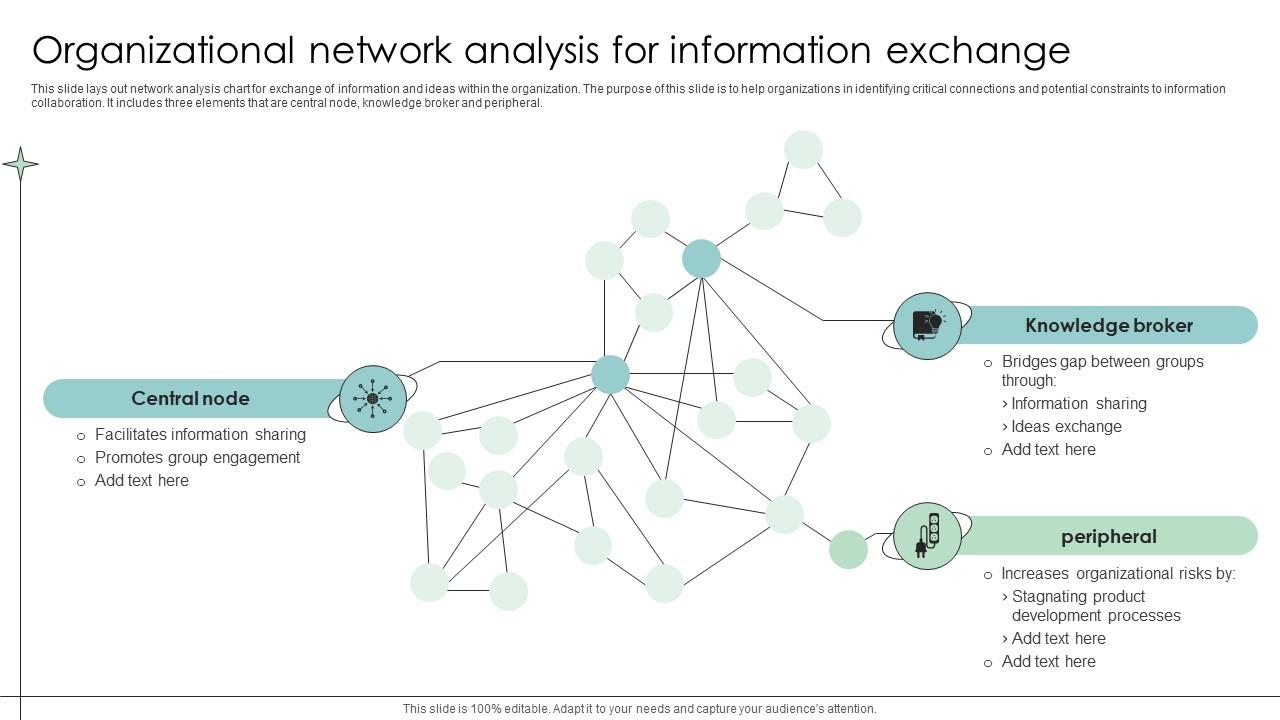
This slide lays out network analysis chart for exchange of information and ideas within the organization. The purpose of this slide is to help organizations in identifying critical connections and potential constraints to information collaboration. It includes three elements that are central node, knowledge broker and peripheral. Presenting our well structured Organizational Network Analysis For Information Exchange. The topics discussed in this slide are Information, Engagement, Organizational. This is an instantly available PowerPoint presentation that can be edited conveniently. Download it right away and captivate your audience.

People who downloaded this PowerPoint presentation also viewed the following :

FAQs for Organizational Network Analysis

The primary purpose of Organizational Network Analysis (ONA) is to map and analyze communication patterns, collaboration flows, and influence networks within organizations to optimize performance and decision-making. Through advanced data visualization and relationship mapping, companies can identify knowledge bottlenecks, enhance cross-functional collaboration, and streamline information flow, ultimately delivering improved operational efficiency and strategic competitive advantage.

ONA improves communication and collaboration by identifying communication gaps, mapping informal networks, and revealing collaboration bottlenecks across departments. Through network visualization and relationship analysis, organizations streamline information flow, enhance cross-functional partnerships, and optimize team structures, with many companies finding that strategic network insights ultimately deliver faster decision-making and stronger organizational cohesion.

Common methodologies for Organizational Network Analysis include social network surveys, communication pattern analysis, collaboration mapping, influence assessment, and digital interaction tracking. These approaches streamline organizational understanding by identifying key connectors, communication bottlenecks, and informal leadership structures, with many companies finding that strategic network insights enhance team efficiency, accelerate decision-making, and ultimately deliver improved organizational performance.

ONA identifies hidden influencers by analyzing communication patterns, collaboration frequencies, information flow pathways, and cross-departmental connections that may not align with formal organizational hierarchies. Through network mapping and relationship analysis, organizations can discover employees who bridge different teams, facilitate knowledge sharing, and drive informal decision-making processes, ultimately enabling better talent management and strategic communication planning.

ONA contributes to leadership development by identifying informal influencers, knowledge brokers, and collaboration patterns across organizational networks, revealing hidden talent and leadership potential beyond formal hierarchies. Through network mapping, organizations streamline succession planning by pinpointing employees with strong cross-functional connections and influence, while enhancing leadership pipeline visibility, ultimately delivering more strategic talent decisions and reduced succession risks.

Technology streamlines organizational network analysis by automating data collection, processing communication patterns, and visualizing complex relationship networks through advanced analytics platforms. These digital tools enable organizations to analyze email flows, collaboration software interactions, and meeting patterns at scale, ultimately delivering faster insights into team dynamics, identifying key influencers, and optimizing organizational structures for enhanced performance.

ONA helps diagnose organizational culture and dynamics by mapping communication patterns, identifying informal leaders, analyzing collaboration networks, and revealing cultural silos across departments. Through network visualization tools, organizations can uncover hidden influence structures, communication bottlenecks, and relationship gaps that traditional surveys miss, ultimately enabling targeted interventions that enhance cultural alignment and operational effectiveness.

**INPUT**: What are some best practices for interpreting the data gathered through ONA? **OUTPUT**: Best practices for interpreting ONA data include focusing on network density patterns, identifying key connectors and information brokers, analyzing communication flow bottlenecks, and mapping influence pathways across departments. These analytical approaches streamline decision-making by revealing hidden collaboration gaps, optimizing resource allocation, and enhancing cross-functional efficiency, with many organizations finding that strategic network insights ultimately deliver improved project outcomes and competitive advantage. **Word count: 60 words**

ONA differs from traditional organizational charts by mapping actual communication patterns, collaboration networks, and informal influence relationships rather than just formal reporting structures. While traditional assessments focus on hierarchical positions and job descriptions, ONA reveals how work actually flows through networks, identifies hidden influencers and knowledge brokers, and uncovers collaboration gaps, ultimately delivering insights that enhance operational efficiency and strategic decision-making.

Organizations implementing ONA often encounter data privacy concerns, employee resistance to network mapping, integration complexities with existing systems, and difficulties interpreting complex relationship data accurately. While these challenges require careful change management and robust data governance, many companies find that transparent communication about ONA's benefits, phased implementation approaches, and proper training ultimately streamline adoption and deliver significant organizational insights.

ONA assists change management by mapping informal networks, identifying key influencers and resistance points, and revealing communication gaps that could hinder transformation efforts. Through network visualization, organizations can strategically engage change champions, address bottlenecks proactively, and design targeted communication strategies, with many companies finding that ONA-informed approaches significantly improve adoption rates and reduce implementation timelines.

Ethical ONA considerations include informed consent, data privacy protection, transparent methodology disclosure, secure data storage, and clear usage boundaries. Organizations must balance network insights with employee privacy rights, ensure voluntary participation where possible, and establish governance frameworks that prevent misuse of relationship data, ultimately building trust while delivering strategic workforce intelligence.

ONA integrates seamlessly with performance management systems, employee engagement surveys, talent mapping tools, and change management frameworks by providing network insights that enhance traditional HR analytics. This strategic combination enables organizations to identify influential employees for leadership development, optimize team formations, and accelerate change initiatives, ultimately delivering more targeted interventions and measurable organizational improvements.

Several organizations have leveraged Organizational Network Analysis to drive significant improvements, including IBM identifying communication bottlenecks that reduced project timelines by 25%, Microsoft optimizing cross-team collaboration in product development, and Pfizer streamlining R&D networks to accelerate drug discovery processes. These implementations demonstrate how network insights enable companies to enhance operational efficiency, break down silos, and ultimately deliver faster innovation cycles and improved organizational performance.

Small businesses can leverage ONA to identify communication bottlenecks, optimize team structures, and enhance collaboration across departments, ultimately improving operational efficiency and decision-making speed. Through network mapping, small organizations streamline resource allocation, reduce redundancies, and strengthen key relationships, with many finding that these insights enable faster customer response times and more agile business processes.

Ratings and Reviews

80% of 100
Review Form
Write a review
Most Relevant Reviews
  1. 80%

    by Jones Cook

    They helped us design the pamphlets for our church’s food drive! The people loved the design, and I’m happy to say it was successful. Thank you, SlideTeam!
  2. 80%

    by Cory Reynolds

    Thanks for all your great templates they have saved me lots of time and accelerate my presentations. Great product, keep them up!

2 Item(s)

per page: