

Organizational Problem Solving Tool Powerpoint Presentation Slides





Try Before you Buy Download Free Sample Product
 Impress Your
Audience
 100%
Editable
 Save Hours
of Time


Management usually discusses critical concerns areas of improvement by analyzing crucial information. The template is considered a solution space for management to brainstorm various solutions provided for organizational progress. Here is a competently designed Organizational Problem Solving Tool template that comprises details about company overview with key people involved, firms product portfolio, and firm strategic objectives. It will cover the firms present scenario by analyzing financial summary, capital funding, financial ratios, and assessing several overheads essential for business operations. The template will cover details about financial statements. The template will cover details about critical concerns firms face in corporate failures, quality-related problems, and operational issues. The organizational improvement initiative addresses functional considerations vital for firm growth, determines three cases future scenario analysis, assesses business priorities crucial for development, analyzes brand building strategies, etc. It implements organizational change by analyzing employees skills, workforce upskilling plan, coordination activities to improve stakeholder communication. This insightful proposal will help users improve marketing effectiveness by potential prospect nurturing, etc. Get access to this 100 percent editable proposal now.
People who downloaded this PowerPoint presentation also viewed the following :
Content of this Powerpoint Presentation
Slide 1: This slide introduces Organizational Problem Solving Tool. State Your Company Name and begin.
Slide 2: This slide states Agenda of the presentation.
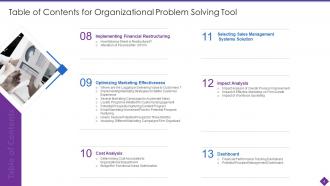
Slide 3: This slide presents Table of Content for the presentation.
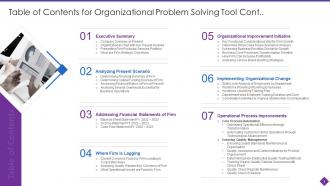
Slide 4: This is another slide continuing Table of Content for the presentation.
Slide 5: This slide depicts title for four topics that are to be covered next in the template.
Slide 6: This slide covers details about the overview of firm’s present situation.
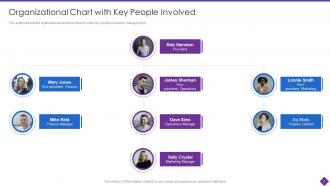
Slide 7: This slide presents the organizational structure of the firm with key people involved in managing firm.
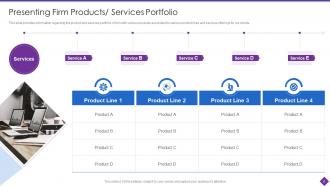
Slide 8: This slide provides information regarding the product and services portfolio of firm with various products.
Slide 9: This slide provides information regarding the firm strategic objectives which firm need to achieve in order to attain profitability.
Slide 10: This slide depicts title for four topics that are to be covered next in the template.
Slide 11: This slide covers details about the overview of firm’s present situation.
Slide 12: This slide provides information regarding the capital structure of firm by analyzing different funding sources of firm.
Slide 13: This slide portrays information regarding the assessment of financial ratios of firm.
Slide 14: This slide provides details about the overheads that considered essential for operating a business.
Slide 15: This slide depicts title for three topics that are to be covered next in the template.
Slide 16: This slide provide glimpse about the balance sheet of the firm with information about assets, liabilities and shareholder’s equity for current year.
Slide 17: This slide provide glimpse about the firm’s ability to generate sales, managing expenses, and ultimately creating profits.
Slide 18: This slide provide glimpse about the firm’s ability to create value for shareholders by generating positive cash flows for current year.
Slide 19: This slide depicts title for four topics that are to be covered next in the template.
Slide 20: This slide portrays information regarding the concerns that are currently existing in the organizations.
Slide 21: This slide provides information regarding the present situation firm with employee productivity and ROI (per1$ spent).
Slide 22: This slide provides information regarding the key issues firm is facing regarding quality at present with defects(parts per million).
Slide 23: This slide explains the present operational issues that firm is facing which leads to high costs, poor agility, etc.
Slide 24: This slide depicts title for six topics that are to be covered next in the template.
Slide 25: This slide covers information regarding the key functional areas that are considered such as organizational change, etc.
Slide 26: This slide displays 'Determine Three Case Future Scenarios Analysis'.
Slide 27: This slide presents 'Assessing Business Priorities Crucial for Growth'.
Slide 28: This slide provides information regarding the business core processes transformation timeline with key initiatives and activities mentioned.
Slide 29: This slide provide the information regarding various ways (three options) through which firm can increase its profitability.
Slide 30: This slide provides information regarding various brand building strategies with initiatives for achieving goals associated to them.
Slide 31: This slide depicts title for five topics that are to be covered next in the template.
Slide 32: This slide exhibits 'Skills Level Analysis of Employees by Department'.
Slide 33: This slide showcases 'Workforce Planning of Existing Employees'.
Slide 34: This slide illsutrates 'Workforce Upskilling Training Plan'.
Slide 35: This slide provides details about necessary training of the specific employees in various departments.
Slide 36: This slide covers information regarding the different coordination activities that firm will conduct.
Slide 37: This slide depicts title for two topics that are to be covered next in the template.
Slide 38: The slide provides information regarding the technological advancement adapted by firm.
Slide 39: The slide provides information regarding automation of customer centric with the help of technological advancement.
Slide 40: This slide depicts title for six topics that are to be covered next in the template.
Slide 41: This slide provides information regarding the quality standards that are ensured in order to manage overall quality.
Slide 42: This slide provides information regarding the quality assurance and control initiatives.
Slide 43: This slide provides information regarding different testing techniques that are analyzed on certain parameters such as cost, operator skill, defect type, etc.
Slide 44: This slide presents 'Tracking Weekly Quality Defects Occurrence with Check Sheet'.
Slide 45: This slide provides information regarding the quality check register that is to be maintained in order to keep track of quality improvement of product.
Slide 46: This slide exhibits 'Quality Check Schedule'.
Slide 47: This slide depicts title for two topics that are to be covered next in the template.
Slide 48: This slide covers information regarding the balance restructuring process.
Slide 49: This slide covers information regarding how firm can optimize its financial debt in order to reduce its borrowings and improve its profitability.
Slide 50: This slide depicts title for eight topics that are to be covered next in the template.
Slide 51: This slide provides information regarding key areas which firm needs to address.
Slide 52: The slide provides information regarding marketing strategies used by firm for better customer experience.
Slide 53: This slide displays 'Several Marketing Campaigns to Accelerate Sales'.
Slide 54: This slide presents 'Loyalty Programs Initiated for Customer Engagement'.
Slide 55: This slide exhibits 'Potential Prospects Nurturing Content Program'.
Slide 56: This slide provides information regarding the email marketing worksheet that is prepared to keep track on different email marketing campaigns.
Slide 57: This slide showcases 'How to Nurture Potential Prospect in Three Months'.
Slide 58: This slide highlights 'Analyzing Different Marketing Campaigns Firm Organized'.
Slide 59: This slide depicts title for two topics that are to be covered next in the template.
Slide 60: This slide provides information regarding the costs associated to various segments in terms of base salaries, etc.
Slide 61: This slide displays 'Budget for Functional Areas Optimization'.
Slide 62: This slide depicts title for one topic that is to be covered next in the template.
Slide 63: This slide will help firm in choosing the suitable system by analyzing them on several parameters with cost associated to it.
Slide 64: This slide depicts title for three topics that are to be covered next in the template.
Slide 65: This slide depicts the impact of successful implementation of overall process automation for better customer satisfaction.
Slide 66: This slide depicts information regarding the impact of turnaround strategy implantation on firm growth.
Slide 67: This slide depicts information regarding the impact of upgrading the skillset of the workforce.
Slide 68: This slide depicts title for two topics that are to be covered next in the template.
Slide 69: This slide presents the dashboard which will help firm in tracking the financial performance.
Slide 70: This slide will provide overall scenario of all accounts and track new leads, top campaigns, expected revenue earned, etc.
Slide 71: This slide displays Icons for Organizational Problem Solving Tool.
Slide 72: This slide is titled as Additional Slides for moving forward.
Slide 73: This slide provides 30 60 90 Days Plan with text boxes.
Slide 74: This slide presents Weekly Timeline with Task Name.
Slide 75: This slide displays Roadmap for Process Flow.
Slide 76: This is About Us slide to show company specifications etc.
Slide 77: This slide shows Post It Notes. Post your important notes here.
Slide 78: This is Our Mission slide with related imagery and text.
Slide 79: This slide displays Column chart with two products comparison.
Slide 80: This slide depicts Venn diagram with text boxes.
Slide 81: This is a Timeline slide. Show data related to time intervals here.
Slide 82: This slide contains Puzzle with related icons and text.
Slide 83: This is a Thank You slide with address, contact numbers and email address.
Organizational Problem Solving Tool Powerpoint Presentation Slides with all 88 slides:
Use our Organizational Problem Solving Tool Powerpoint Presentation Slides to effectively help you save your valuable time. They are readymade to fit into any presentation structure.










FAQs for Organizational Problem Solving Tool
Effective organizational problem-solving tools feature systematic frameworks, data-driven analysis capabilities, collaborative elements, scalability across departments, and clear visualization components. These characteristics enable teams to identify root causes efficiently, streamline decision-making processes, and implement sustainable solutions, with many organizations finding that structured approaches significantly enhance their operational efficiency and strategic outcomes.
Organizations leverage data analysis tools to identify underlying issues through predictive analytics, root cause analysis algorithms, pattern recognition software, and statistical modeling platforms. These technologies streamline problem identification by analyzing historical trends, detecting anomalies, and correlating variables across departments, with many companies finding that data-driven insights reveal hidden operational inefficiencies and enable proactive solutions.
Visual aids like flowcharts, graphs, process maps, decision trees, and data visualizations enhance problem-solving by simplifying complex information, revealing patterns, and facilitating team collaboration. These tools streamline analysis across organizations, with many businesses finding that visual representations accelerate decision-making, improve stakeholder alignment, and ultimately deliver faster resolution times and better strategic outcomes.
Brainstorming techniques enhance collaborative problem-solving by encouraging diverse perspectives, fostering creative thinking, and building on collective ideas through structured sessions. These approaches streamline team dynamics by promoting equal participation, reducing hierarchical barriers, and generating multiple solution pathways, with many organizations finding that collaborative brainstorming ultimately delivers faster innovation and stronger team consensus.
Root cause analysis prevents recurring issues by identifying underlying problems rather than addressing surface symptoms, enabling organizations to implement lasting solutions. Through systematic investigation techniques, companies in manufacturing, healthcare, and financial services eliminate waste, reduce operational costs, and enhance process efficiency, with many finding that strategic root cause analysis delivers sustainable competitive advantage and improved organizational performance.
Organizations implement PDCA effectively by establishing clear problem definitions and measurable objectives during planning, executing small-scale pilots with dedicated teams, systematically collecting performance data during check phases, and institutionalizing successful improvements through standardized processes. This structured approach enables companies across manufacturing, healthcare, and service sectors to continuously optimize operations, reduce waste, and enhance quality, with many finding that regular PDCA cycles ultimately deliver sustained competitive advantage and operational excellence.
Digital problem-solving tools for distributed teams include virtual whiteboards like Miro, collaborative platforms such as Slack and Microsoft Teams, video conferencing solutions, project management software like Asana, and real-time document sharing through Google Workspace. These technologies streamline remote collaboration by enabling visual brainstorming, instant communication, and centralized documentation, with many organizations finding that strategic tool combinations significantly enhance team productivity and decision-making across time zones.
Employee feedback systems integrate into problem-solving methodologies through structured collection channels, real-time analytics platforms, and cross-functional collaboration tools that capture frontline insights. These systems enhance organizational problem-solving by enabling data-driven decision making, accelerating issue identification, and fostering continuous improvement cultures, with many companies finding that employee-generated insights ultimately deliver faster resolution times and more sustainable solutions.
Priority-setting frameworks include the Eisenhower Matrix, MoSCoW method, impact-effort analysis, weighted scoring models, and the Pareto principle. These frameworks streamline decision-making by categorizing problems based on urgency, importance, and resource requirements, with many organizations finding that systematic prioritization enhances operational efficiency and ensures critical issues receive appropriate attention first.
Organizations measure problem-solving success through key performance indicators, cost reduction metrics, time-to-resolution tracking, stakeholder satisfaction surveys, and outcome sustainability assessments. Through data analytics and feedback mechanisms, companies across manufacturing, healthcare, and financial services streamline evaluation processes, enhance operational efficiency, and demonstrate tangible ROI, ultimately delivering measurable improvements and competitive advantage.
**INPUT**: What are the best practices for utilizing SWOT analysis in identifying organizational challenges? **OUTPUT**: Best practices for SWOT analysis include conducting collaborative workshops with diverse stakeholders, using data-driven insights rather than assumptions, prioritizing identified factors by strategic impact, and creating actionable plans from findings. Organizations across sectors like healthcare, retail, and manufacturing find that regular SWOT reviews, combined with competitive benchmarking and market analysis, enable more strategic decision-making and ultimately deliver enhanced operational efficiency and sustainable competitive advantage. [Word count: 60 words]
Fostering a culture of continuous improvement enhances problem-solving by encouraging proactive identification of issues, promoting collaborative solution development, and establishing systematic feedback loops for ongoing refinement. This approach enables organizations to address challenges before they escalate, while empowering teams across departments to contribute innovative solutions, ultimately delivering faster resolution times and sustainable operational improvements.
Implementing problem-solving tools in established organizations faces challenges including resistance to change, entrenched processes, inadequate training, resource constraints, and cultural barriers that favor traditional approaches. While these obstacles require strategic change management, many organizations find that phased implementation, comprehensive staff development, and leadership commitment ultimately streamline operations and deliver enhanced efficiency, with successful adoption providing significant competitive advantages.
Organizations can effectively train employees on problem-solving tools through structured workshops, hands-on simulations, mentorship programs, and real-world project applications that reinforce learning through practice. This comprehensive approach enables teams to master frameworks like root cause analysis and process mapping, while building confidence through guided implementation, ultimately delivering improved decision-making capabilities and enhanced operational efficiency across departments.
Toyota's implementation of root cause analysis and fishbone diagrams revolutionized their manufacturing efficiency, while General Electric's Six Sigma methodology streamlined operations across multiple divisions, and IBM's design thinking workshops enhanced customer experience development. These strategic approaches delivered measurable cost reductions, faster problem resolution, and improved operational efficiency, with many organizations finding that combining multiple problem-solving frameworks ultimately creates sustainable competitive advantage.
-
SlideTeam makes creating presentations easy. Unlimited products, premium quality designs and affordable.
-
Great product, helpful indeed!