


Our Solution Drug Production Business Pitch Deck




Try Before you Buy Download Free Sample Product
 Impress Your
Audience
 100%
Editable
 Save Hours
of Time


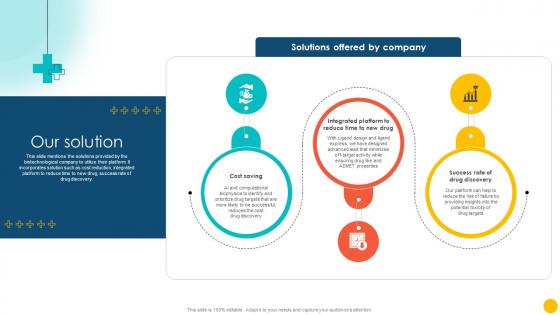
This slide mentions the solutions provided by the biotechnological company to utilize their platform. It incorporates solution such as cost reduction, integrated platform to reduce time to new drug, success rate of drug discovery.
People who downloaded this PowerPoint presentation also viewed the following :
Our Solution Drug Production Business Pitch Deck with all 9 slides:
Use our Our Solution Drug Production Business Pitch Deck to effectively help you save your valuable time. They are readymade to fit into any presentation structure.








FAQs for Our Solution Drug Production
So basically you start with API synthesis - that's making the actual drug ingredient. Then formulation happens where they mix it with other stuff like fillers. Manufacturing comes next for tablets, capsules, whatever. Quality control testing runs through everything though, and honestly that part takes forever. Packaging and labeling follow, plus final release testing before it ships. The FDA watches every step so you're drowning in paperwork the whole time. For your project, I'd probably figure out which manufacturing piece you want to dive into first.
Dude, the FDA literally runs the whole show when it comes to drug manufacturing. They've got these GMP standards that cover everything - your facility setup, how you train people, documentation, equipment validation, the works. Their inspections are no joke either, like they can literally shut you down if you're not following the rules. Any major changes to your process? You need their approval first. Oh and definitely build compliance in from the start - trying to fix it later is such a nightmare. My buddy learned that the hard way at his last job.
So basically QC tests every single batch to check potency, purity, contamination - all that stuff. QA designs the whole system to catch problems before they start. Without both working together, you'd get sketchy meds that could seriously hurt people. The FDA makes companies do this for obvious reasons. Takes forever though - part of why drug development is such a pain. But honestly? You want those safeguards when it's your pills. My cousin works in pharma and says the testing is insane, but I'm glad someone's being that careful.
Three things you gotta nail: process validation, equipment qualification, and supply chain stuff. First, test the hell out of your manufacturing process to make sure it works consistently at bigger volumes - lots of documentation here. Equipment needs proper qualification for the higher capacity. Supply chain honestly screws over way more companies than people realize! Your suppliers need to handle way more raw materials without falling apart. Oh, and don't do what my last company did - jumping straight to full production is a nightmare. Build a detailed scale-up plan early and test it in phases instead.
Honestly, the whole drug manufacturing space is getting crazy right now. AI is speeding up discovery like mad - predicting how molecules will behave instead of the old trial-and-error approach. 3D printing for personalized meds is blowing my mind lately. Continuous manufacturing's replacing those clunky batch systems, making everything cheaper and faster. Robots are handling synthesis and quality control now too. But personalized medicine based on your actual DNA? That's the real deal-changer here. Manufacturing timelines that used to take years are shrinking fast. Worth watching if you're in the space.
So biotech is basically letting us turn living cells into tiny drug factories - we can get bacteria to pump out complex proteins that you'd never be able to make in a regular lab. The cool part? You can design personalized treatments and those monoclonal antibodies everyone talks about. Plus gene therapies that actually fix stuff at the DNA level. Honestly, the speed difference is huge - you can test way more drug candidates way faster. And here's the kicker: you can finally tackle rare diseases that big pharma won't touch because there's no money in it. I'd look at your current pipeline and see where biologics might work better than traditional small molecules.
Dude, contamination will be your worst enemy - I've seen entire batches get trashed because of it. Get serious about sterile technique and monitor everything. Batch consistency is another nightmare, so nail down your protocols and don't deviate. Cross-train people too, because Murphy's law guarantees someone will get sick during your most important run. Oh, and build your quality systems early instead of scrambling later when regulators come knocking. Document like crazy, even when you're behind schedule. Trust me, skipping validation to meet deadlines always bites you in the ass eventually.
Dude, supply chain issues are a nightmare for drug manufacturing. When raw material suppliers get screwed over - COVID was insane for this - production lines just stop. You're scrambling to find new suppliers that actually meet FDA standards, which honestly takes forever because of all the validation hoops. The whole pharmaceutical supply chain is ridiculously complex too. One supplier goes down and it ripples through everything. Can't just swap vendors overnight either. My take? You'll want backup suppliers lined up ahead of time and maybe stockpile some critical materials. Sounds boring but it'll save your ass later.
Dude, start with waste management - that's probably your biggest headache. All that chemical waste needs proper disposal, and it's not cheap. Energy costs are brutal too with all the heating/cooling cycles you're running constantly. Water usage is the third big one since everything has to be crazy pure. The regulatory stuff will keep you busy anyway, so might as well get ahead of it. I'd audit your waste streams first to see where you're hemorrhaging money - my buddy at a pharma plant said that was eye-opening for them. Then tackle energy patterns. You'll probably find some quick wins there.
So pharma companies basically attack costs from a few angles. Heavy investment in process optimization during development - they want the most efficient methods nailed down before scaling. Contract manufacturers are huge too since specialists can do it way cheaper than building your own plants. Modular setups let them ramp production up or down based on demand, which is pretty smart. Some even think about manufacturing costs while they're still designing the drug itself - honestly that seems obvious but apparently not everyone does it. If I were you, I'd look at companies with solid process development teams. They're usually better at keeping costs under control.
So APIs are literally the active ingredient that does all the work in your medication. Everything else? Just filler and coating basically. It's like - imagine your pill is a sandwich and the API is the actual meat inside. The concentration determines how strong your dose is, and if it's not pure enough, you could get weird side effects or the drug just won't work. Quality control during manufacturing is huge here because even microscopic contamination can mess things up badly. Honestly, I always check where companies source their APIs from first when I'm looking into any medication. That's where you'll spot the red flags.
Honestly, continuous manufacturing crushes batch production in most cases. You get better yields and way less waste since everything flows without stopping. Energy costs drop too because you're not constantly heating up and cooling down. But batch still wins for smaller runs - plus you can tweak things more easily if your formula changes a lot. The biggest time-saver with continuous? No more cleaning between batches, which is such a pain. I'd say look at your volumes first and how often you switch formulations. That'll tell you which direction makes sense.
So basically, drug companies now spread production across like 3-4 different countries - your pills might start in India, get processed in Ireland, then packaged in Puerto Rico. Wild, right? Makes everything way cheaper, but man, when one factory shuts down it screws everyone globally. That's what happened during COVID with so many shortages. Different countries also have totally different quality rules, which gets messy fast. Companies are trying to diversify more now so they're not totally screwed if one supplier fails. It's this weird balance between efficiency and not putting all your eggs in one basket.
So digitalization basically tracks everything from start to finish by creating digital records at each step. Raw materials from suppliers, real-time production data, complete batch records - it's all in one centralized system. Way better than those paper nightmares we dealt with before, honestly. You can trace quality issues back instantly and share data with regulators without the headache. Digital batch records are where I'd start first - biggest bang for your buck there. The whole thing just makes transparency so much easier once you get it rolling.
Look, patient safety has to be your top priority - no shortcuts on testing or reporting side effects. Pricing is where it gets messy though. You want profits but can't be like those insulin companies pricing people out of staying alive, you know? Marketing should stick to actual evidence instead of hype, whether you're talking to doctors or patients. Oh, and think about whether people in poorer countries will actually be able to afford this thing. I'd start by checking your company's ethics policies. See what's missing when it comes to putting patients first.
-
Much better than the original! Thanks for the quick turnaround.
-
I was able to find the right choice of PPT template for my thesis with SlideTeam. Thank you for existing.