

Out Of Band SQLi As A Type Of SQL Injection Training Ppt




Try Before you Buy Download Free Sample Product
 Impress Your
Audience
 100%
Editable
 Save Hours
of Time


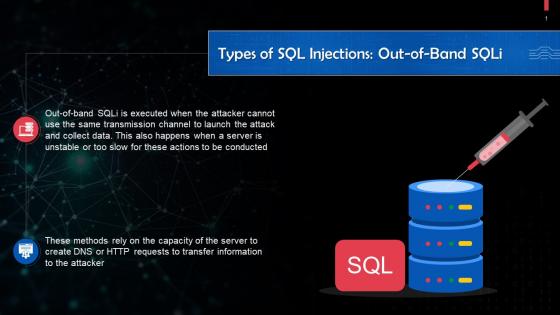
This slide discusses Out-of-Band SQLi. Out-of-band SQLi is executed when the attacker cannot use the same transmission channel to launch the attack and collect data or when a server is unstable or too slow for these actions to be conducted.
People who downloaded this PowerPoint presentation also viewed the following :
Out Of Band SQLi As A Type Of SQL Injection Training Ppt with all 20 slides:
Use our Out Of Band SQLi As A Type Of SQL Injection Training Ppt to effectively help you save your valuable time. They are readymade to fit into any presentation structure.










FAQs for Out Of Band SQLi As A Type Of SQL
Out Of Band SQL Injection is a sophisticated attack method where hackers extract data through alternative communication channels like DNS queries or HTTP requests, rather than receiving responses directly through the application's normal data flow. Unlike traditional in-band SQLi that displays results immediately or blind SQLi that infers data through application behavior, out-of-band techniques enable attackers to bypass restrictive environments and firewalls, ultimately delivering more stealthy data exfiltration capabilities.
Out Of Band SQLi proves more effective when applications lack visible error messages, implement strict output filtering, or use asynchronous database operations that prevent immediate response observation. This technique becomes particularly valuable in enterprise environments like banking systems, e-commerce platforms, and corporate applications where traditional injection methods fail, enabling attackers to extract sensitive data through DNS queries, HTTP requests, or email notifications when standard exploitation channels are blocked.
**INPUT**: What are the common techniques used by attackers to perform Out Of Band SQLi? **OUTPUT**: Out Of Band SQLi techniques include DNS exfiltration, HTTP requests to external servers, email triggers, file system interactions, and time-based network callbacks to bypass traditional detection methods. These approaches enable attackers to extract sensitive data from databases even when direct query responses are blocked, with financial institutions and healthcare organizations increasingly strengthening their monitoring systems to detect such covert communication channels and ultimately protect critical customer information.
Application response behavior significantly enhances Out Of Band SQLi effectiveness by providing attackers with timing patterns, error messages, and network traffic indicators that confirm successful payload execution. When applications process malicious SQL commands that trigger external communications, attackers can monitor DNS lookups, HTTP requests, or database connections to validate vulnerabilities, ultimately enabling more sophisticated data extraction techniques even when traditional response channels are blocked or filtered.
DNS and HTTP requests serve as crucial communication channels in Out Of Band SQLi exploitation, enabling attackers to extract data when traditional response methods are blocked or unavailable. These protocols facilitate data exfiltration by triggering external connections through DNS queries, HTTP callbacks, and file system interactions, with many security professionals finding that monitoring outbound traffic patterns helps detect these sophisticated attacks before sensitive database information is compromised.
Developers can prevent Out Of Band SQLi vulnerabilities through parameterized queries, input validation, stored procedures, least privilege database access, and regular security audits. These practices work together by separating SQL code from user data, sanitizing inputs before processing, and restricting database permissions, with many financial services and healthcare organizations finding that comprehensive implementation significantly reduces attack surfaces while maintaining application performance.
Notable Out of Band SQLi incidents include the 2008 Heartland Payment Systems breach affecting 134 million cards, various healthcare database compromises, and financial institution attacks where attackers used DNS queries and HTTP requests to exfiltrate sensitive data. These cases demonstrate how criminals exploit blind SQL vulnerabilities to bypass traditional security monitoring, with many organizations finding that traditional perimeter defenses fail against these sophisticated data exfiltration techniques.
Penetration testers can effectively simulate Out Of Band SQLi attacks by using DNS exfiltration techniques, HTTP callbacks to external servers, email-based data extraction, and time-based blind injection methods. Through specialized tools like SQLMap with custom payloads, security professionals can demonstrate how attackers exploit alternative communication channels, ultimately helping organizations identify vulnerable database configurations and strengthen their defensive monitoring capabilities.
Tools for identifying Out Of Band SQLi vulnerabilities include Burp Suite Professional, SQLMap, OWASP ZAP, Nessus, and custom Python scripts with DNS monitoring capabilities. These frameworks streamline detection by automating payload injection, monitoring external interactions, and correlating responses, with many security teams finding that combining automated scanning with manual testing ultimately delivers comprehensive vulnerability assessment and enhanced application security.
Monitoring Out Of Band SQLi requires configuring network traffic analysis, database query logging, DNS monitoring, and HTTP request tracking to identify unusual external communications patterns. Security teams can implement SIEM solutions, network intrusion detection systems, and database activity monitoring tools that flag suspicious outbound connections, time delays in responses, and abnormal data exfiltration attempts, ultimately enabling faster threat detection.
Mitigation strategies include parameterized queries, input validation, database permission restrictions, network segmentation, and comprehensive logging systems. These security measures streamline protection by preventing malicious code execution, limiting database access privileges, and monitoring unusual outbound connections, with many financial institutions and healthcare organizations finding that layered defenses ultimately deliver enhanced data security and regulatory compliance.
Parameterized queries and prepared statements prevent Out Of Band SQLi by separating SQL code from user data, ensuring malicious input cannot alter query structure or trigger external communications. These security measures enable organizations, particularly in banking and healthcare sectors, to maintain database integrity while blocking attackers from establishing covert channels, ultimately delivering robust protection and operational confidence.
User input validation serves as the primary defense against Out Of Band SQLi attacks by sanitizing, filtering, and validating all data before database processing, effectively preventing malicious SQL code injection. Through comprehensive validation frameworks, organizations in banking, healthcare, and e-commerce sectors significantly reduce attack vectors while maintaining secure data transactions, ultimately delivering enhanced security posture and regulatory compliance.
Organizations can train development teams through comprehensive security workshops, hands-on SQLi simulation exercises, secure coding bootcamps, threat modeling sessions, and regular vulnerability assessments. These training approaches enhance developer awareness by demonstrating real-world attack scenarios, teaching parameterized query implementation, and establishing secure development practices, with many technology companies finding that continuous education programs significantly reduce injection vulnerabilities while improving overall application security.
Network architecture significantly influences Out Of Band SQLi vulnerability exposure through firewall configurations, network segmentation policies, DNS resolution pathways, and outbound connection controls. Organizations with restrictive network perimeters, proper egress filtering, and segmented database environments typically minimize these attack vectors, while less secure architectures enable data exfiltration through alternative channels, ultimately making network design a critical defense component.
-
The Designed Graphic are very professional and classic.
-
“You have the structure in place that are easy to explore new opportunities.I will be recommending your services to other people.”