

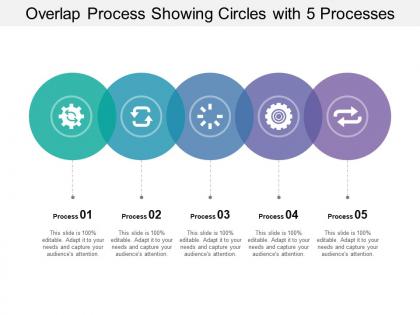
Overlap process showing circles with 5 processes





Try Before you Buy Download Free Sample Product
 Impress Your
 Audience
 100%
100% Editable
 Save Hours
 of Time


Encourage innovation in your group with our Overlap Process Showing Circles With 5 Processes. Create a decision enhancing framework.
People who downloaded this PowerPoint presentation also viewed the following :
Overlap process showing circles with 5 processes with all 5 slides:
Improve your average with our Overlap Process Showing Circles With 5 Processes. Increase the degree of consistency achieved.

FAQs for Overlap process showing circles
The Overlap Process involves executing multiple project phases simultaneously rather than sequentially, enabling faster delivery through parallel workflows, resource optimization, and strategic timeline compression. This approach streamlines project management by reducing overall duration, enhancing team collaboration, and minimizing bottlenecks, with many organizations finding that overlapping design, development, and testing phases delivers significant competitive advantages while maintaining quality standards.
The Overlap Process significantly enhances collaboration by creating shared responsibilities, cross-functional communication channels, and integrated workflows that break down departmental silos. This approach enables teams in manufacturing, healthcare, and financial services to streamline project handoffs, reduce miscommunication, and accelerate decision-making, ultimately delivering improved operational efficiency and stronger organizational alignment.
The Overlap Process delivers enhanced collaboration, reduced project delays, improved resource utilization, better quality control, and increased operational efficiency across organizational workflows. Through strategic task overlapping, organizations in manufacturing, software development, and consulting streamline project timelines, minimize bottlenecks, and enhance team coordination, ultimately delivering faster project completion and competitive advantage.
The Overlap Process differs from traditional methodologies by enabling simultaneous execution of project phases rather than sequential completion, reducing timeline constraints, enhancing resource utilization, and facilitating continuous feedback loops. Through strategic phase integration, organizations streamline project delivery, minimize bottlenecks, and accelerate time-to-market, with many finding that overlapping activities ultimately delivers competitive advantage and operational efficiency.
Common challenges in the Overlap Process include resource conflicts, timeline coordination difficulties, quality control inconsistencies, communication gaps between overlapping phases, and managing interdependencies effectively. While these challenges can initially seem complex, many organizations find that implementing structured project management frameworks, clear communication protocols, and dedicated coordination roles ultimately streamlines operations and delivers faster project completion.
Technology and software tools facilitate the Overlap Process through automated workflow coordination, real-time collaboration platforms, and integrated project management systems that enable seamless handoffs between phases. These solutions streamline resource allocation, enhance communication across teams, and provide visibility into overlapping activities, with many organizations finding that digital tools reduce project timelines while maintaining quality standards.
Manufacturing, healthcare, software development, financial services, and retail are most suited for implementing the Overlap Process due to their complex, interdependent workflows and tight project timelines. These industries benefit significantly from parallel task execution, with manufacturing plants streamlining production lines, hospitals enhancing patient care coordination, and financial institutions accelerating loan processing, ultimately delivering faster time-to-market and improved operational efficiency.
Leaders can effectively communicate Overlap Process principles through regular team meetings, visual workflow demonstrations, cross-functional training sessions, and clear documentation of handoff procedures. By implementing structured communication channels, conducting hands-on workshops, and establishing feedback mechanisms, organizations streamline collaboration, reduce project delays, and enhance operational efficiency, with many teams finding that transparent overlap protocols ultimately deliver improved project outcomes and stronger interdepartmental coordination.
Key metrics for evaluating Overlap Process success include schedule compression ratios, resource utilization rates, quality defect levels, cost variance analysis, and stakeholder satisfaction scores. These measurements enable project managers to assess efficiency gains, identify bottlenecks, and optimize concurrent workflows, with many organizations finding that systematic tracking ultimately delivers faster project completion and enhanced competitive positioning.
Cultural differences significantly impact the Overlap Process through varying communication styles, decision-making approaches, hierarchical expectations, and collaboration preferences across global teams. While some cultures favor direct feedback and open debate during overlapping phases, others prioritize consensus-building and formal protocols, with many international organizations finding that adapting the process to accommodate diverse cultural norms ultimately enhances cross-functional effectiveness and team cohesion.
Documentation serves as the critical foundation for Overlap Process success, providing knowledge repositories, process maps, transition checklists, training materials, and performance metrics. Through comprehensive documentation systems, organizations streamline knowledge transfer, minimize information gaps, and ensure continuity during transitions, with many companies finding that structured documentation reduces overlap duration by 30-40% while maintaining operational excellence.
The Overlap Process integrates seamlessly with Agile methodologies by enabling concurrent development phases, iterative feedback loops, and continuous stakeholder collaboration throughout sprint cycles. This strategic combination enhances project velocity, reduces bottlenecks, and improves team coordination, with many software development organizations finding that overlapping activities ultimately delivers faster time-to-market and enhanced product quality.
Teams can minimize overlap process risks by establishing clear communication protocols, defining precise role boundaries, implementing regular checkpoint reviews, and creating comprehensive documentation systems. These strategies streamline coordination by reducing duplication, enhancing accountability, and maintaining project momentum, with many organizations finding that structured overlap management ultimately delivers faster project completion and improved resource allocation.
Feedback during the Overlap Process can be effectively gathered through structured interviews with outgoing and incoming personnel, collaborative documentation sessions, and regular check-in meetings with stakeholders. Organizations implement digital feedback platforms, peer review sessions, and knowledge transfer assessments to capture insights, ultimately streamlining transitions and minimizing knowledge gaps for enhanced operational continuity.
The Overlap Process contributes to innovation by fostering cross-functional collaboration, breaking down departmental silos, encouraging diverse perspective integration, and accelerating knowledge transfer between teams. This strategic approach enables organizations to combine expertise from multiple domains, streamline product development cycles, and ultimately deliver breakthrough solutions, with many companies finding enhanced creativity and faster time-to-market outcomes.
-
It saves your time and decrease your efforts in half.
-
Excellent template with unique design.