


Overview Of Bluetooth Communication Wireless Technology Mobile Communication Standards 1g To 5g




Try Before you Buy Download Free Sample Product
 Impress Your
 Audience
 100%
100% Editable
 Save Hours
 of Time


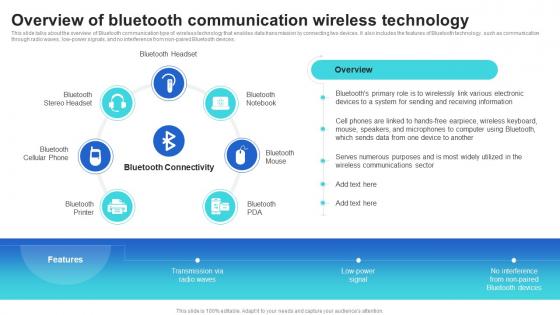
This slide talks about the overview of Bluetooth communication type of wireless technology that enables data transmission by connecting two devices. It also includes the features of Bluetooth technology, such as communication through radio waves, low power signals, and no interference from non paired Bluetooth devices.
People who downloaded this PowerPoint presentation also viewed the following :
Overview Of Bluetooth Communication Wireless Technology Mobile Communication Standards 1g To 5g with all 6 slides:
Use our Overview Of Bluetooth Communication Wireless Technology Mobile Communication Standards 1g To 5g to effectively help you save your valuable time. They are readymade to fit into any presentation structure.





FAQs for Overview Of Bluetooth Communication Wireless Technology Mobile Communication Standards
Bluetooth Classic offers higher data transfer rates and continuous connections ideal for audio streaming and file transfers, while Bluetooth Low Energy (BLE) prioritizes minimal power consumption with intermittent connections perfect for IoT devices and sensors. Healthcare organizations use BLE for patient monitoring systems and fitness trackers, while automotive manufacturers leverage Bluetooth Classic for hands-free calling, with each technology delivering optimized performance for distinct operational requirements.
Bluetooth technology ensures secure communication through advanced encryption protocols, authentication procedures, frequency hopping, and pairing mechanisms that create protected data channels between devices. These security features enable organizations across healthcare, finance, and retail sectors to safely transmit sensitive information, ultimately delivering enhanced data protection and regulatory compliance while maintaining seamless wireless connectivity.
Bluetooth communication enables wireless connectivity across personal devices, smart home systems, automotive integration, health monitoring equipment, and audio streaming applications. Through short-range wireless protocols, consumers seamlessly connect smartphones to headphones, cars to navigation systems, and fitness trackers to mobile apps, while smart home devices automate lighting and security, ultimately delivering convenient, cable-free experiences.
Bluetooth range has evolved significantly across versions, with Classic Bluetooth 1.0-3.0 typically reaching 10 meters, Bluetooth 4.0+ extending to 50-100 meters, and Bluetooth 5.0+ achieving up to 240 meters in optimal conditions. These enhanced ranges enable organizations to deploy wireless solutions across larger facilities, warehouses, and retail spaces, ultimately delivering improved operational flexibility and reduced infrastructure costs.
Developers face challenges including device compatibility across different Bluetooth versions, power consumption optimization, connection stability issues, and security vulnerabilities during data transmission. Through careful protocol selection and robust testing frameworks, development teams streamline integration processes, enhance user experiences, and deliver reliable connectivity solutions, with many mobile and IoT applications finding that strategic implementation ultimately reduces troubleshooting costs.
Bluetooth handles interference through frequency hopping spread spectrum technology, adaptive frequency hopping, and power management systems that automatically switch between 79 available channels up to 1,600 times per second. This enables devices to avoid congested frequencies from WiFi, cellular, and other wireless signals, with many organizations finding that modern Bluetooth implementations deliver reliable connectivity even in dense wireless environments, ultimately ensuring consistent performance and seamless device integration.
Regular Bluetooth SIG updates and new profiles enhance device compatibility, introduce advanced features like improved audio codecs and mesh networking capabilities, and address security vulnerabilities across connected ecosystems. These developments enable manufacturers to deliver faster data transfer, better battery efficiency, and seamless integration between devices, with industries like healthcare, automotive, and smart home finding that newer profiles ultimately provide competitive advantages through enhanced user experiences.
Bluetooth pairing involves device discovery, authentication through PIN or passkey exchange, and encryption key generation to establish secure connections. Security measures include AES-128 encryption, frequency hopping across 79 channels, and authentication protocols that prevent unauthorized access, with modern implementations using more sophisticated pairing methods like Secure Simple Pairing, ultimately delivering reliable wireless communication for businesses.
Bluetooth serves as a crucial connectivity bridge in IoT ecosystems, enabling seamless device-to-device communication, sensor data transmission, mesh networking capabilities, and low-power connections for battery-operated devices. Through Bluetooth Low Energy and mesh protocols, smart homes, healthcare monitors, and industrial sensors streamline operations while reducing power consumption, ultimately delivering enhanced automation and real-time data insights across interconnected systems.
Modern Bluetooth advancements, particularly Bluetooth Low Energy (BLE) and version 5.0+, significantly extend device battery life through optimized power management, improved connection protocols, and enhanced data transmission efficiency. These technologies enable smartwatches, fitness trackers, and IoT devices to operate for weeks rather than days, while maintaining seamless connectivity, ultimately delivering enhanced user experiences and reduced operational costs.
Bluetooth communication differs from Wi-Fi through shorter range (typically 30 feet versus 300+ feet), lower power consumption, and device-to-device connectivity rather than network-based architecture. While Wi-Fi excels at high-speed internet access and data transfer, Bluetooth streamlines personal area networking, audio streaming, and IoT device pairing, with many businesses finding that strategic combination of both technologies delivers optimal connectivity solutions.
Developers optimize Bluetooth performance for multiple devices through efficient connection management, strategic data prioritization, and adaptive power scaling techniques. By implementing connection pooling, minimizing data packet overhead, and using selective device polling, applications can maintain stable connections while reducing latency, with many IoT and healthcare systems finding that these optimizations deliver seamless multi-device experiences and enhanced operational efficiency.
Best practices for designing Bluetooth-enabled devices include intuitive pairing processes, clear connection status indicators, automatic reconnection capabilities, robust signal management, and seamless multi-device switching functionality. These design principles enhance user adoption by minimizing technical complexity, reducing connection failures, and delivering consistent performance across environments, with many manufacturers finding that prioritizing simplified interfaces and reliable connectivity ultimately drives higher customer satisfaction and competitive differentiation.
Bluetooth's environmental and health considerations include minimal radiation exposure due to low power consumption, reduced electronic waste through wireless connectivity, and energy-efficient protocols that extend device battery life. While electromagnetic field exposure remains well below safety limits, many organizations find that Bluetooth's short-range design and power management features deliver sustainable communication solutions with negligible health risks.
Bluetooth enables automotive connectivity through hands-free calling, audio streaming, smartphone integration, tire pressure monitoring, and emergency assistance systems. Modern vehicles leverage these wireless capabilities to enhance driver safety by minimizing distractions, streamlining device pairing, and enabling real-time diagnostics, with manufacturers increasingly finding that seamless connectivity delivers competitive advantage and improved customer experiences.
-
I was mind-blown by the services that SlideTeam provided me. Thanks a ton!
-
Enough space for editing and adding your own content.