

Overview Of Private Blockchain Networks Analysis Of Privacy Measures PPT Example BCT SS V





Try Before you Buy Download Free Sample Product
 Impress Your
Audience
 100%
Editable
 Save Hours
of Time


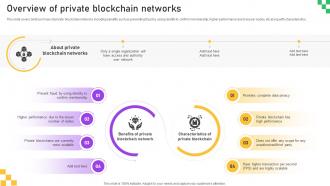
This slide covers brief summary of private blockchain networks including benefits such as preventing fraud by using identity to confirm membership, higher performance due to lesser nodes, etc along with characteristics.
People who downloaded this PowerPoint presentation also viewed the following :
Overview Of Private Blockchain Networks Analysis Of Privacy Measures PPT Example BCT SS V with all 9 slides:
Use our Overview Of Private Blockchain Networks Analysis Of Privacy Measures PPT Example BCT SS V to effectively help you save your valuable time. They are readymade to fit into any presentation structure.








FAQs for Overview Of Private Blockchain Networks Analysis Of Privacy Measures PPT Example
Private blockchain networks operate with restricted access, centralized control, faster transaction speeds, enhanced privacy, and regulatory compliance capabilities, while public blockchains offer open access, decentralization, transparency, and immutability. These distinctions enable organizations in banking, healthcare, and supply chain management to leverage private networks for sensitive operations, ultimately delivering operational efficiency and data security while maintaining strategic control over their blockchain infrastructure.
Private blockchain networks typically use faster consensus mechanisms like Practical Byzantine Fault Tolerance (PBFT), Proof of Authority (PoA), or simplified voting protocols, rather than energy-intensive Proof of Work used in public blockchains. These streamlined approaches enable organizations to achieve transaction finality in seconds rather than minutes, ultimately delivering enhanced operational efficiency and reduced costs for enterprise applications.
Financial services, healthcare, supply chain management, energy, and government sectors are currently benefiting most from private blockchain networks. These industries leverage private blockchains for secure transactions, patient data management, product traceability, and regulatory compliance, with many organizations finding that controlled access enhances operational efficiency while maintaining strict privacy requirements.
Private blockchain networks ensure data privacy and security through restricted access controls, advanced encryption protocols, permissioned consensus mechanisms, and comprehensive audit trails. These networks enable organizations like banks and healthcare institutions to maintain complete control over sensitive data while facilitating secure internal transactions, ultimately delivering enhanced compliance and operational transparency without exposing confidential information to external parties.
Common private blockchain use cases include supply chain tracking, financial transaction processing, healthcare record management, identity verification systems, and regulatory compliance reporting. These implementations enable organizations to streamline operations through enhanced transparency, automated compliance, and secure data sharing, with many financial institutions and healthcare providers finding significant improvements in audit efficiency and operational control.
Private blockchain networks typically achieve superior scalability compared to public blockchains through controlled participation, optimized consensus mechanisms, and dedicated infrastructure resources. With fewer nodes and streamlined validation processes, private networks enable faster transaction processing and higher throughput, with many financial institutions and healthcare organizations finding that these controlled environments deliver enhanced performance while maintaining security and regulatory compliance.
Smart contracts in private blockchain solutions automate business processes, enforce compliance rules, streamline multi-party agreements, and reduce manual oversight requirements. These programmable contracts enable organizations to execute complex workflows automatically, from supply chain verification to financial settlements, while maintaining greater control and privacy than public alternatives, ultimately delivering faster transaction processing and reduced operational costs.
Organizations manage access control within private blockchain networks through identity verification systems, role-based permissions, multi-signature authentication, smart contract governance, and administrative oversight protocols. These mechanisms enable institutions like banks and healthcare providers to control data visibility, transaction authorization, and network participation levels, while maintaining regulatory compliance and operational security, ultimately delivering enhanced privacy and streamlined collaboration across trusted business partners.
Setting up a private blockchain presents challenges including scalability limitations, integration complexity with existing systems, consensus mechanism selection, security framework implementation, and ongoing maintenance requirements. While these technical and operational hurdles require strategic planning and resources, organizations across finance, healthcare, and supply chain sectors increasingly find that proper infrastructure investment and skilled development teams ultimately deliver enhanced data control, operational efficiency, and competitive advantage.
Private blockchain networks facilitate interoperability with public blockchains through cross-chain protocols, atomic swaps, and bridge technologies that enable seamless data and asset transfers between different blockchain environments. These integration methods allow organizations to maintain control over sensitive operations while accessing public blockchain benefits, with many financial institutions finding that hybrid approaches deliver enhanced security, regulatory compliance, and expanded market reach.
Private blockchain implementation costs include infrastructure setup, development resources, ongoing maintenance, security measures, and staff training. While initial investments can be substantial, organizations across finance, healthcare, and supply chain sectors find that streamlined operations, reduced intermediary fees, and enhanced transaction efficiency ultimately deliver significant cost savings and competitive advantages.
Governance models in private blockchain systems typically involve centralized oversight by the network owner, permissioned validator selection, predefined consensus mechanisms, and formal policy frameworks for network changes. Unlike public blockchains, private networks enable organizations to maintain direct control over participation, transaction validation, and protocol updates, with many enterprises finding that this streamlined governance delivers faster decision-making and regulatory compliance.
Permissioned nodes are critical control points in private blockchain networks, determining who can validate transactions, access data, and participate in consensus mechanisms. This selective participation enables organizations to maintain regulatory compliance, protect sensitive information, and ensure network security, while streamlining operations for specific stakeholders like supply chain partners or financial institutions.
Private blockchains enhance supply chain transparency by creating secure, permissioned networks where authorized participants can track products, verify authenticity, and share real-time data across multiple stages. Manufacturing companies, pharmaceutical firms, and food producers increasingly leverage these systems to streamline inventory management, reduce fraud, and ensure compliance, ultimately delivering greater operational efficiency and consumer trust.
Popular tools for building private blockchain networks include Hyperledger Fabric, R3 Corda, Quorum, Multichain, and Amazon Managed Blockchain. These platforms streamline development by offering customizable consensus mechanisms, enhanced privacy controls, and enterprise integration capabilities, with many financial institutions and healthcare organizations finding that these solutions deliver faster transaction processing, reduced operational costs, and improved data security.
-
This design is not only aesthetically pleasing but it has many uses making the cost worthwhile. The graphics look stunning, and you can edit them as per your needs.
-
Placing an order on SlideTeam is very simple and convenient, saves you a lot of your time.