

Pandemic Business Playbook Powerpoint Presentation Slides





Try Before you Buy Download Free Sample Product
 Impress Your
Audience
 100%
Editable
 Save Hours
of Time


The pandemic business playbook lays out processes to raise awareness of new health and well-being protocols to enable business as usual and get back to work safely. Check out our professionally designed Pandemic Business Playbook template that covers a guide for covid-19 pandemic preparedness and response for businesses. This presentation aims to provide an overview of the potential hazards posed in the workplace due to covid19. This ppt includes a comprehensive risk assessment for all workplaces or to replace any legislated workplace safety obligations. Companies can use this ppt as a guide for employers in addition to guidance delivered by public health authorities such as the world health organization WHO. The outline of this playbook includes employer responsibilities, the hierarchy of controls, health screening, and isolation protocol. Further, it covers self isolation and returning to the workplace protocol, physical distancing protocol, pathogen decontamination measures, employee training, and communication plan. Book a free demo with our research team now.
People who downloaded this PowerPoint presentation also viewed the following :
Content of this Powerpoint Presentation
Slide 1: This slide displays the title Pandemic Business Playbook.
Slide 2: This slide displays the purpose of Pandemic business playbook.
Slide 3: This slide exhibit table of content.
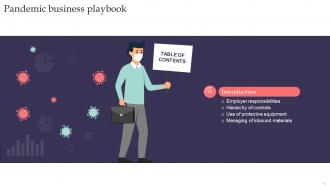
Slide 4: This slide exhibit table of content- Introduction.
Slide 5: This slide covers post-pandemic work guidelines for the employer.
Slide 6: This slide covers hierarchy of controls to eliminate the spread of COVID-19 in the workplace.
Slide 7: This slide depicts that employers are encouraged to complete a risk assessment to determine when and which protective equipment may be required.
Slide 8: This slide provides information about Managing of inbound materials at workplace.
Slide 9: This slide exhibit table of content- Health screening.
Slide 10: This template covers daily general screening guidelines for internal or external personnel.
Slide 11: This template depicts that daily Self-screening protocol/guidelines for workplace.
Slide 12: This template covers daily on site screening guidelines for workforce.
Slide 13: This template covers visitors and contractors guidelines for workforce.
Slide 14: This template covers host directions guidelines for workplace.
Slide 15: This slide exhibit table of content- Isolation protocol.
Slide 16: This template covers isolation coordinator guidelines for the workplace.
Slide 17: This template covers isolation room protocol for workplace.
Slide 18: This slide exhibit table of content- Self-isolation and returning to the workplace protocol.
Slide 19: This template covers to provide guidance on Self-isolation and returning to the workplace protocol/guideline.
Slide 20: This slide exhibit table of content- Physical distancing.
Slide 21: This template covers physical distancing protocols for workplace.
Slide 22: This template covers physical distancing protocols during shift change at workplace.
Slide 23: This template covers Physical distancing protocol/guidelines during breaks.
Slide 24: This slide exhibit table of content- Pathogen decontamination toolkit.
Slide 25: This template covers preventative disinfection measures.
Slide 26: This template covers pathogen decontamination schedule for offices.
Slide 27: This slide exhibit table of content- Post Pandemic Toolkit.
Slide 28: This template covers pandemic training plans considered while workplace reopening or continuing to operate.
Slide 29: This template covers health screening, isolation guidelines flowchart as post pandemic measures for returning to the workplace.
Slide 30: This template covers Self-screening checklist for post pandemic work place safety.
Slide 31: This is the icons slide.
Slide 32: This slide presents title for additional slides.
Slide 33: This slide exhibits yearly profits area charts for different products.
Slide 34: This slide displays yearly bar graph for different products.
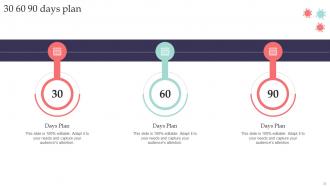
Slide 35: This slide depicts 30-60-90 days plan for projects.
Slide 36: This slide shows roadmap of company.
Slide 37: This slide exhibits yearly timeline of company.
Slide 38: This slide shows puzzle for displaying elements of company.
Slide 39: This is thank you slide & contains contact details of company like office address, phone no., etc.
Pandemic Business Playbook Powerpoint Presentation Slides with all 44 slides:
Use our Pandemic Business Playbook Powerpoint Presentation Slides to effectively help you save your valuable time. They are readymade to fit into any presentation structure.











FAQs for Pandemic Business Playbook
Businesses can pivot during pandemics through digital transformation, remote work infrastructure, supply chain diversification, contactless service delivery, and flexible business model adaptation. These strategies enable organizations to maintain operations while meeting changing customer needs, with many companies finding that accelerated digitization, enhanced e-commerce capabilities, and agile workforce management ultimately deliver competitive advantages beyond crisis periods.
Companies can leverage cloud computing, collaboration platforms, project management tools, video conferencing systems, and automation software to enhance remote work capabilities. These technologies streamline communication, enable real-time collaboration, and maintain operational efficiency across distributed teams, with many organizations finding that strategic digital integration ultimately delivers improved productivity, reduced overhead costs, and greater workforce flexibility in an increasingly remote business environment.
Best practices include transparent regular updates, multi-channel communication approaches, empathetic leadership messaging, clear guidance on safety protocols, and consistent stakeholder engagement strategies. These approaches enhance trust by maintaining open dialogue, addressing concerns proactively, and providing actionable information, with many organizations finding that frequent, honest communication ultimately strengthens relationships and improves employee morale during challenging periods.
Businesses should assess supply chain risks by mapping critical suppliers, identifying single-source dependencies, evaluating geographic vulnerabilities, and analyzing inventory buffers across all tiers. Through diversification strategies, alternative sourcing partnerships, and enhanced visibility technologies, organizations can streamline risk mitigation while maintaining operational continuity, ultimately delivering greater resilience and competitive advantage in uncertain environments.
Mental health support serves as a critical foundation of pandemic response plans, encompassing employee assistance programs, flexible work arrangements, regular wellness check-ins, mental health days, and access to counseling services. These initiatives streamline workforce stability by reducing burnout, maintaining productivity, and enhancing employee retention, with many organizations finding that comprehensive mental health strategies ultimately deliver stronger resilience and competitive advantage during crisis periods.
Businesses can effectively forecast revenue by implementing scenario-based modeling, real-time data analytics, rolling forecasts, and stress testing across multiple market conditions. These approaches enable organizations to maintain liquidity buffers, diversify revenue streams, and optimize working capital management, with many companies finding that flexible forecasting paired with conservative cash reserves ultimately delivers greater financial resilience during uncertainty.
Companies should adopt digital-first marketing strategies including enhanced social media engagement, virtual events, content marketing focused on value-driven messaging, email automation, and community building initiatives. These approaches enable businesses to maintain customer connections, demonstrate empathy and support, while pivoting messaging to address pandemic-specific needs, ultimately delivering sustained brand relevance and customer loyalty.
Organizations can restructure customer service by implementing omnichannel support systems, enhancing digital self-service options, integrating AI-powered chatbots, expanding remote assistance capabilities, and personalizing interactions through data analytics. These approaches enable businesses to meet evolving consumer expectations for instant, flexible support across multiple touchpoints, while reducing operational costs and improving response times, ultimately delivering enhanced customer experiences in an increasingly digital-first marketplace.
Businesses can ensure health guideline compliance through regular sanitization protocols, mandatory mask policies, temperature screenings, social distancing measures, and contactless payment systems. These comprehensive approaches enable organizations across retail, hospitality, and manufacturing sectors to maintain operational continuity while prioritizing employee and customer safety, ultimately delivering enhanced trust and sustainable business resilience.
Data analytics enables businesses to understand pandemic-driven consumer shifts by tracking purchasing patterns, digital engagement metrics, sentiment analysis, and behavioral changes across channels. Through real-time dashboards and predictive modeling, retailers pivot inventory strategies, restaurants optimize delivery services, and financial institutions adjust product offerings, while streaming platforms and e-commerce companies leverage usage data to enhance customer experiences and capture emerging market opportunities.
Remote work presents both challenges and opportunities for team dynamics, including reduced spontaneous collaboration, potential isolation, communication gaps, and difficulty building relationships among new team members. However, organizations can address these through structured virtual team-building activities, regular one-on-one check-ins, collaborative digital platforms, and hybrid meeting formats, with many companies finding that intentional communication strategies ultimately enhance team cohesion and productivity.
Small businesses can collaborate through resource sharing, joint purchasing agreements, co-marketing initiatives, knowledge exchanges, and strategic partnerships that leverage complementary strengths. These alliances enable smaller organizations to access larger markets, reduce operational costs, and share expertise, with many retail cooperatives and supplier networks finding that collaborative approaches deliver enhanced bargaining power and competitive resilience.
Pandemic-driven innovations include remote collaboration platforms, contactless service delivery, digital customer engagement tools, automated supply chain management, and flexible workforce models. These technologies streamline operations by reducing physical dependencies, enhancing operational resilience, and enabling scalable business continuity, with many organizations finding that hybrid approaches ultimately deliver competitive advantages and improved cost efficiency.
Businesses can design flexible contingency plans by incorporating scenario modeling, modular response frameworks, real-time monitoring systems, cross-functional decision trees, and rapid communication protocols. These adaptive strategies enable organizations to pivot quickly across different pandemic phases, with many companies in healthcare, retail, and manufacturing finding that flexible workforce arrangements, diversified supply chains, and digital-first operations ultimately deliver sustained resilience and competitive advantage.
Previous pandemics highlight the importance of supply chain diversification, remote work infrastructure, digital transformation acceleration, emergency cash reserves, and flexible operational models. These lessons enable businesses to build resilience through multiple supplier networks, robust technology platforms, and agile workforce strategies, with many organizations finding that pandemic preparedness ultimately delivers competitive advantage in an increasingly volatile business environment.
-
“Love it! I was able to grab an exciting proposal because of SlideTeam.”
-
Designs have enough space to add content.