

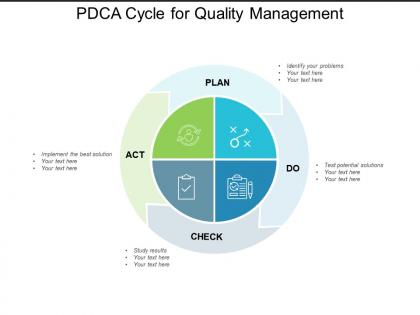
Pdca cycle for quality management




Try Before you Buy Download Free Sample Product
 Impress Your
 Audience
 100%
100% Editable
 Save Hours
 of Time


Handle insinuations with our PDCA Cycle For Quality Management. Clearly expose baseless accusations.
People who downloaded this PowerPoint presentation also viewed the following :
Pdca cycle for quality management with all 5 slides:
Clearly expose baseless accusations with our PDCA Cycle For Quality Management. Be able to handle insinuations.


FAQs for Pdca cycle
Okay so PDCA is basically Plan, Do, Check, Act - and they all connect. You Plan (figure out the problem + solution), then Do it small-scale first, Check what actually happened, and Act on those results. What's cool is Act loops back to Plan, so you're never really finished improving. Each step flows right into the next one. Honestly? Just pick something small and run through it once. I was skeptical at first but it's way less overwhelming than trying to fix everything at once. The whole thing becomes pretty natural after you've done a few cycles.
Start small - pick one process to test PDCA on before going company-wide. During the Plan phase, get super clear on what you're trying to achieve. Collect real baseline data in the Do phase, then actually dig into that data during Check (honestly, most teams just skim this part and wonder why nothing improves). Act is where you lock in what worked and fix what didn't. Oh, and make sure everyone knows this repeats - it's not a one-and-done thing. Track everything obsessively at first to build momentum.
PDCA is honestly a game-changer for staying on track with projects. Plan your next move, Do the actual work, Check if it worked out like you expected, then Act on whatever you figured out. Each round teaches you something new, so you're not making the same dumb mistakes over and over. Your processes just keep getting better each time you run through it. I started using it on my sprints a few weeks back - it's wild how much clearer everything becomes when you can see what's actually broken versus what you think is broken. Give it a shot on your next project phase.
Honestly, track two things - how well your PDCA process is actually working and whether you're hitting your goals. So like, are teams finishing cycles? How fast are they moving? Are people actually following the steps or just winging it? Then measure the real stuff - defects down, costs lower, whatever you were originally trying to fix. The cool part is when problem-solving starts happening faster everywhere. Oh, and definitely set up some basic dashboard from the beginning. Trust me, you'll want that data later when someone asks if this whole thing is actually worth it. Makes proving value way easier.
Look, people get super impatient and want to skip the reflection part - you know, where you actually figure out what worked? They'll jump from doing something straight to making changes without thinking it through. Also your teams will try to bite off way too much at once, then freak out when it doesn't go perfectly. Honestly, I'd start with tiny pilot projects first. Build in review sessions that people can't skip, and make a big deal about learning from the failures too. Once it becomes second nature, then you can scale up. The whole thing falls apart if you rush it.
PDCA is honestly perfect for Six Sigma and Lean stuff. Map DMAIC right onto it - Define/Measure becomes your Plan phase, Analyze/Improve is Do, then Control handles Check/Act. Same deal with Lean value stream work. I've watched so many teams crash and burn jumping straight into the fancy tools without structure. PDCA keeps you grounded. Your next kaizen event? Run it through PDCA first - way more systematic that way. The framework just works better than people think it will.
Yeah, PDCA totally works outside manufacturing! Healthcare teams use it all the time - they'll plan a new patient handoff process, test it on one floor, check if infection rates drop, then roll it out everywhere. Schools do the same thing with teaching methods. Test in a few classrooms first, see how kids respond, then expand what's working. Honestly, I think it's even better in these fields because there's so much chaos compared to a factory floor. Just pick one thing that's bugging you and run through those four steps. Way less overwhelming than trying to fix everything at once.
Okay so data is literally everything in PDCA - you can't skip it. First, collect baseline numbers to spot problems and set targets. While you're testing changes, keep tracking stuff in real-time. The analysis part is honestly where things get interesting (maybe that's just me being a nerd though) - this is when you figure out if your changes actually did anything. Then you decide: keep it, tweak it, or throw it out completely based on what the numbers tell you. Start measuring your important stuff right away or you'll have no clue what's working.
Honestly, PDCA works best when it doesn't feel like another corporate thing you have to do. I'd start with super short weekly check-ins - maybe 15 minutes where people can share what they're testing or what bombed. Celebrate the small wins from each cycle, and definitely let everyone pitch ideas during the "Study" phase, not just the bosses. People need to feel safe admitting failures in the "Check" part though - that's where the real learning happens. Skip those marathon quarterly reviews that make everyone want to hide. Quick and regular beats long and dreaded every time.
Honestly, tech makes PDCA cycles so much smoother. Dashboards let you track your Plan metrics without constantly checking spreadsheets - which is a lifesaver. For the Do phase, digital tools help standardize everything so people aren't winging it. Analytics platforms catch patterns during Check that you'd totally miss otherwise. I'm always amazed what shows up in the data. Collaboration tools are clutch too since nobody wants those painful email threads. When you get to Act, you'll have way better data to work with for the next round. Just pick one tool per phase to start.
Toyota's the classic example - they're always using PDCA to cut waste and improve their production lines. Amazon does it too with delivery routes and warehouse setups. But honestly, smaller businesses can totally pull this off. Like, a local restaurant could plan a new dish, test it for a week, check what customers think and how it sells, then decide whether to keep it or change the recipe. You really don't need to make it complicated though - just grab one thing that's annoying you at work and try a quick experiment with it.
So PDCA totally works across different industries - you just tweak it for what matters most to you. Healthcare folks obsess over patient safety in their planning phase. Manufacturing? They're all about those quality metrics. When it comes to actually doing stuff, tech companies love their pilot programs while food producers do small batch tests. The checking part varies too - banks audit compliance data, retailers track customer scores. PDCA's honestly pretty flexible once you figure out what success looks like for your specific situation. Oh, and don't overthink it at first.
Ugh, the worst trap is everyone skipping the "Study" part - they just want to DO something already. Plus people either plan forever (analysis paralysis is real) or they treat PDCA like it's some one-and-done project instead of actually cycling through it. Honestly? Just block time for your Study sessions or they'll never happen. Set deadlines for each phase so you don't get stuck. Write down what bombed and what worked before jumping into the next round - I know it's boring but you'll thank yourself later.
At least quarterly, but honestly it depends what you're working on. Fast-moving stuff? Check monthly. The real trick is making sure your original assumptions still hold up and your metrics actually matter to people who care. I've watched teams just go through the motions for months - total waste of time. Calendar reminders help a ton here. Just pause and ask yourself: "Are we still solving something that actually matters?" Your Plan phase might need fresh data if things have shifted. Don't get stuck on autopilot like everyone else does.
Honestly, just get them some basic problem-solving training first. Throw in a few hands-on workshops too - people need to see PDCA in action because it clicks way faster that way. Make sure they know data collection, root cause analysis, and how to actually measure if stuff worked. Templates help a ton so they're not reinventing the wheel every single time. But here's the thing - start small. Pick low-stakes improvement projects where nobody's gonna freak out if something goes sideways. That's how they build confidence without the pressure. Once they nail a couple easy wins, they'll get it.
No Reviews