

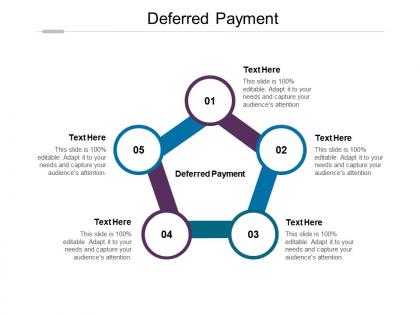
Deferred payment ppt powerpoint presentation summary skills cpb




Try Before you Buy Download Free Sample Product
 Impress Your
Audience
 100%
Editable
 Save Hours
of Time


Our Deferred Payment Ppt Powerpoint Presentation Summary Skills Cpb are topically designed to provide an attractive backdrop to any subject. Use them to look like a presentation pro.
People who downloaded this PowerPoint presentation also viewed the following :
Deferred payment ppt powerpoint presentation summary skills cpb with all 2 slides:
Use our Deferred Payment Ppt Powerpoint Presentation Summary Skills Cpb to effectively help you save your valuable time. They are readymade to fit into any presentation structure.


FAQs for Deferred payment ppt powerpoint presentation
Deferred payment options enable businesses to improve cash flow management, reduce immediate financial pressure, maintain working capital for operations, and strengthen supplier relationships through flexible terms. These arrangements help companies, particularly in manufacturing and retail sectors, optimize resource allocation and operational efficiency, while building strategic partnerships that deliver competitive advantages and enhanced financial stability.
Deferred payment arrangements significantly influence purchasing decisions by reducing financial barriers, enabling customers to acquire products immediately while spreading costs over time, and increasing perceived affordability of higher-value items. These flexible payment options enhance customer confidence and purchasing power, with retailers across sectors like electronics, furniture, and automotive finding that deferred terms boost conversion rates, increase average order values, and ultimately deliver stronger customer acquisition and loyalty.
Industries like healthcare, education, retail, automotive, and real estate commonly implement deferred payment plans to improve customer accessibility and increase sales volume. These sectors benefit from higher conversion rates, expanded customer bases, and improved cash flow management, while customers gain financial flexibility, ultimately delivering competitive advantage and enhanced customer loyalty in increasingly price-sensitive markets.
B2B deferred payment terms typically offer longer periods, ranging from 30 to 120 days, with credit evaluations and established business relationships driving approval processes. B2C deferred payments focus on shorter terms, often 6-12 months, with streamlined digital approvals and consumer credit scoring, ultimately enabling retailers to boost sales while banks and financial institutions deliver accessible financing solutions.
Companies should consider credit risk from potential non-payment, cash flow disruption affecting operations, increased administrative costs for tracking payments, and potential disputes over terms. These financial exposures require careful client assessment, clear contracts, and robust collection processes, with many organizations finding that proper risk management frameworks ultimately enable competitive payment flexibility while protecting profitability.
Businesses can effectively communicate deferred payment terms through clear written agreements, transparent fee structures, automated reminders, and accessible customer portals that detail payment schedules. These communication strategies enhance customer relationships by providing upfront clarity about interest rates, deadlines, and penalties, while digital tools enable real-time tracking, ultimately reducing disputes and improving payment compliance across diverse customer segments.
Creditworthiness serves as a primary assessment tool for deferred payment eligibility, with lenders evaluating credit scores, payment history, debt-to-income ratios, and financial stability indicators. Through comprehensive credit analysis, financial institutions can determine appropriate payment terms, interest rates, and risk levels, while borrowers with stronger credit profiles typically secure more favorable deferment conditions and extended repayment flexibility.
Marketing strategies for deferred payment options include targeted messaging emphasizing financial flexibility, seasonal campaigns aligned with budget cycles, educational content explaining benefits, and personalized offers based on customer purchase history. Retailers and e-commerce platforms find success through email campaigns, social media promotions, and point-of-sale displays, ultimately increasing average order values while reducing cart abandonment rates and enhancing customer acquisition.
Deferred payment agreements involve contract law compliance, default risk management, interest rate regulations, consumer protection requirements, and tax implications. These legal frameworks vary by jurisdiction and industry, with many financial institutions and retailers finding that proper documentation, clear terms, and regulatory adherence ultimately streamline operations while minimizing disputes and enhancing customer trust.
Businesses can track deferred payment receivables through automated accounting software, aging reports, payment milestone tracking, customer communication systems, and regular reconciliation processes. These tools enable organizations to monitor payment schedules, identify potential delays, and maintain cash flow visibility, with many financial services and manufacturing companies finding that systematic tracking reduces collection times while enhancing customer relationships.
Technology solutions for deferred payment processing include payment gateways with installment capabilities, buy-now-pay-later platforms, automated billing systems, credit assessment APIs, and blockchain-based smart contracts. These technologies streamline operations by automating payment schedules, reducing manual processing, and enhancing customer experiences, with retail and e-commerce businesses finding significantly improved cash flow management.
Deferred payment significantly enhances cash flow management by extending payment timelines, reducing immediate financial pressure, and allowing organizations to allocate resources more strategically across operational priorities. This approach enables businesses to maintain liquidity during growth phases, invest in revenue-generating activities, and smooth seasonal fluctuations, with many companies finding that strategic payment deferrals ultimately deliver improved working capital efficiency and competitive positioning.
Cultural perceptions of debt significantly influence deferred payment acceptance by shaping consumer attitudes toward borrowing, credit relationships, and financial obligations. In debt-averse cultures like Germany and Japan, consumers prefer immediate payment methods, while credit-friendly societies like the US embrace buy-now-pay-later options, with retailers increasingly tailoring payment strategies to regional cultural norms for competitive advantage.
**INPUT**: What are the best practices for establishing clear policies around deferred payment terms? **OUTPUT**: Best practices include defining specific payment timelines, establishing creditworthiness criteria, setting clear interest rates, outlining consequences for default, and creating transparent approval processes. These policies streamline cash flow management by reducing payment disputes, minimizing financial risk, and enhancing customer relationships, with many organizations finding that structured deferrals ultimately deliver improved customer retention while maintaining operational stability. [Word count: 58 words]
Businesses can measure deferred payment success through conversion rates, average order values, customer retention metrics, default rates, and overall revenue growth from payment flexibility programs. Financial services and retail companies increasingly track payment completion rates, customer lifetime value improvements, and reduced cart abandonment, with many finding that strategic deferred payment options enhance customer loyalty while maintaining healthy cash flow dynamics.
-
Colors used are bright and distinctive.
-
Graphics are very appealing to eyes.
-
Design layout is very impressive.
-
Very well designed and informative templates.
-
Nice and innovative design.